
 Close
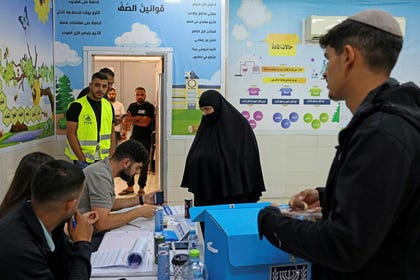
A woman registers at a polling station in the southern bedouin city of Rahat on Tuesday during Israel’s legislative election. Credit: AFP/HAZEM BADER
A woman registers at a polling station in the southern bedouin city of Rahat on Tuesday during Israel’s legislative election. Credit: AFP/HAZEM BADER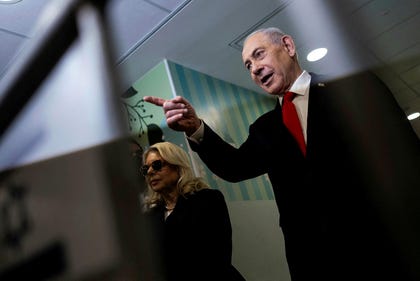 Close
Prime Minister Benjamin Netanyahu at a polling station in Jerusalem, Tuesday. Credit: Jewel Samad/Reuters
Prime Minister Benjamin Netanyahu at a polling station in Jerusalem, Tuesday. Credit: Jewel Samad/Reuters
Tuesday’s election cost Netanyahu’s coalition its majority, yet the opposition may still be unable to replace him. The frustration of its voters does not augur the demise of the state. But there is a real danger that the decline will continue, even accelerate, a process that began with Netanyahu and Likud’s relatively surprising victory in 2015 (then too, contrary to the polls and even the exit polls).
In retrospect, this was the moment the prime minister’s self-confidence swelled and when he became more immersed in the three criminal affairs in which he was charged in 2019. His investigation and subsequent prosecution brought on a holy war against the judiciary, a series of closely spaced general elections amid political instability, his close alliance with the far-right parties and, finally, his absolute shirking of responsibility for the failures that made possible the October 7 massacre.
In recent years, Netanyahu resembled a driver who was determined to smash the Zionist project into a wall, indifferent to the outcries of the passengers who were stuck behind him and had no way of extricating themselves.
For many in the change bloc, the hope for an exceptional showing by Gadi Eisenkot’s Yashar party on Tuesday represented the last off-ramp from the expressway to hell. So far, that hasn’t happened. The power of tribal-religious identity politics and fanning the fear of the Arabs played into Netanyahu’s hands, even though his bloc is 11 Knesset seats smaller than after the 2022 election. In that one, too, a year before the massacre, he played on the same sentiments.