
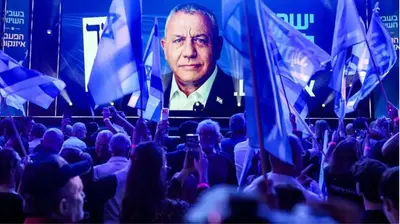
TEL AVIV — As the head of Israel’s Northern Command in the late 2000s, Gen. Gadi Eisenkot was a principal architect of what has become the Israel Defense Forces’ most fearsome and brutal strategy — the Dahiya Doctrine, which calls for exerting overwhelming, disproportionate force on civilian areas where the enemy operates.
“We will wield disproportionate power against every village from which shots are fired on Israel and cause immense damage and destruction,” he told an Israeli newspaper in 2008, describing operations underway against Hezbollah in the Beirut suburbs and south Lebanon. “From our perspective, these are military bases.”
Years later, as the military chief of staff, however, Eisenkot built a reputation as an advocate for operational precision and restraint, and for adherence to the IDF’s code of ethics and judicial system. Now, as the leader of the Israeli political opposition bloc and the man best positioned to dislodge Prime Minister Benjamin Netanyahu, Eisenkot, 66, faces a tactical quandary on an entirely different scale. To form a government, will he join forces with the Arab parties that won a record number of votes in Tuesday’s election, delivering up to 67 seats in parliament where 61 is needed for a majority?
Or would he partner with just one Arab party, Ra’am, to build a minority government? Will he cut a deal with ultra-Orthodox religious parties, even though he fiercely opposes their demands for blanket military exemptions? Or will he retreat from his demand that Netanyahu leave political life, and form a unity government? Eisenkot has criticised Netanyahu and his charges of electoral fraud but otherwise said little since Tuesday’s vote, in which Netanyahu lost his majority but retained the largest bloc in parliament — 53 seats — compared with 48 for the opposition and 19 for the Arab parties. The public has chosen change,” Eisenkot declared after the initial results were released.
“A leader worthy of the name would accept the people’s verdict and announce today that he is leaving political life. Millions of Israelis have had enough of the culture of lies, enough of the failure, enough of the division and the incitement,” he said, adding a direct warning: “Netanyahu, do not dare use Israel’s security for your own political ends.”
Eisenkot started election day visiting communities hit hardest in the Oct. 7, 2023, Hamas-led attack, then stopped by the grave of his youngest son, Gal, who was killed at age 25 during a hostage rescue operation in Gaza, before going to vote in Herzliya, his hometown. Eisenkot is a security hawk, the son of Moroccan immigrants and father of four surviving children. Two of his nephews were also killed in the war. His party, Yashar, Hebrew for “straight” or “honest,” won 21 seats, compared with 27 for Netanyahu’s Likud.
Negotiations with other parties could take weeks, and President Isaac Herzog will decide whether to give Netanyahu or Eisenkot the official mandate to assemble a majority coalition. Whether Eisenkot gets the nod, it has been a remarkably fast rise for the plain-speaking, low-key former commander and career military officer, and for the party he founded just 13 months ago. Political experts say he has neared the threshold of power by offering Israelis a soldier’s security credentials, a reputation for straight dealing, and a loss shared by thousands of families. On the campaign trail, he vowed to end Hamas rule in Gaza within 18 months, while opposing annexing the West Bank and promising to tear down illegal settler outposts. Above all, he ran on accountability. Netanyahu has refused a state inquiry into the failures of Oct. 7; Eisenkot pledged one on his first day in office and said it should examine his own record as army chief.