

Listen to this article
Estimated 5 minutes
The audio version of this article is generated by AI-based technology. Mispronunciations can occur. We are working with our partners to continually review and improve the results.
This First Person is the experience of Atai Okokon, who lives in Calgary. For more information about CBC’s First Person stories, please see the FAQ.
I asked the woman at the pharmacy counter how she would like to pay for her child’s asthma inhaler.
“Does my insurance no longer work?” she asked in a whisper, her voice shaky and unsure. “I was laid off and I am not sure how long my employer coverage would last.”
I tried putting it through a second time.
“I am sorry, ma’am. The coverage has been terminated.”
She brought out her credit card to pay. It was declined. She hesitated for a bit, turned out her purse to see if she had enough cash, but she was $2 short. The tears rolled freely down her cheeks.
Her son needed his medication, but she couldn’t afford it.
It wasn’t the first time I experienced this. I had seen it in Nigeria, where I had trained and worked as a pharmacist. I had witnessed people become bankrupt, and some die, because they could not afford life-saving medication. I had provided samples, paid for medicines from my meagre salary, offered less expensive alternatives and discontinued medications that may not have been necessary to lower their expenses.
But I did not expect to see it in Canada.
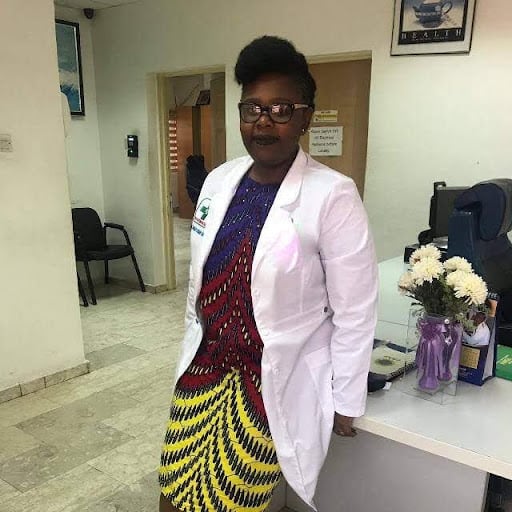
Okokon worked as a pharmacist in Nigeria before moving to Canada. (Submitted by Atai Okokon)
In 2012, I accepted a full scholarship to study global health at Oxford University in the U.K., leaving the counter for the classroom. It was there I first heard about the inverse care law — the concept that those with the most needs often have the least access to care. I assumed it mostly applied in “poorer” countries. I was surprised to learn that countries can spend so much on health care and yet their citizens struggle to pay for the services. North America featured prominently in these discussions and Canada stood out as a country that had made universal health care work.
Eight years after I graduated, I moved to Calgary. I had admired and loved Canada from afar and as a health-care professional, I was excited to practise in a country where I believed anyone — no matter how much they earned or where they lived — could access most health-care services without thinking of the cost.
I had a child after I moved to Canada and throughout my pregnancy, I did not spend a dime on routine tests, scans and specialist visits. I was unemployed but never worried about the cost of childbirth or what I would do if there were complications.
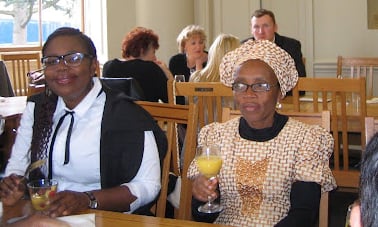
Okokon, left, with her mother Ekanem, in 2013 at a lunch at Oxford University for graduates and their families. (Submitted by Atai Okokon)
But that’s also when I realized that getting medications was a different ball game. Outside the hospital, for the most part, medications are not free. I had terrible nausea in my first trimester. I woke up with it and, like a shadow, it stayed with me the whole day. The doctor prescribed medication but when I went to the pharmacy and heard the cost, I decided to find other ways to cope with the nausea.
“It will only last 12 weeks,” I told myself.
I was in the process of getting licensed as a pharmacist in Alberta and I did not want my husband, the sole provider at that time, to carry that extra financial burden.
That plan did not work. My nausea became worse and my husband bought a month’s worth of medication. I felt so guilty about the cost that I stretched it out, taking it only on the worst days, and said nothing to my husband. My doctor had also prescribed iron pills, as my levels were quite low, and a kind pharmacist gave me samples when I explained my financial situation.
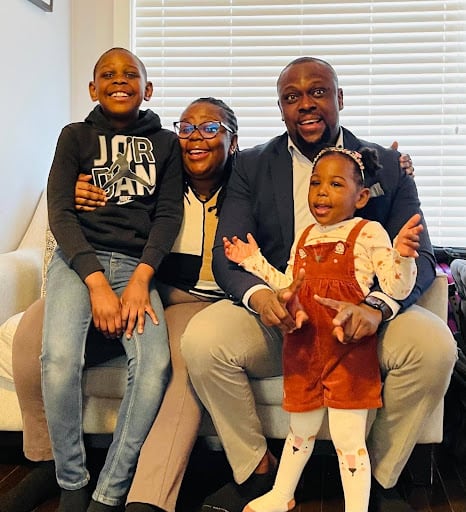
Okokon with her family in Calgary in 2025. From left to right: her son Tomiwa, Okokon, her husband David and daughter, Toyosi. (Submitted by Atai Okokon)
One in five Canadians do not have drug insurance coverage and have to pay for their medication. I was one of them.
And so was the woman standing in front of me at the pharmacy counter. Her sniff jolted me back to reality. She had lost her job, and with it, her coverage. She now had to bear the cost of the inhaler her child needed. Luckily, we had some samples in the pharmacy and I gave her one.
She sighed in relief and through tears, told me the money she had with her would now go towards scraping together something for dinner. It was a déjà vu moment for me. I might as well have been behind the counter in Nigeria.
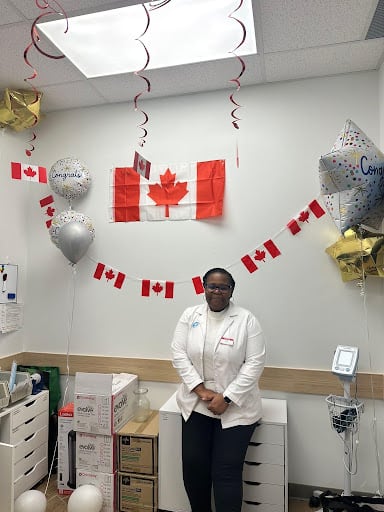
On the day Okokon took her citizenship oath in December 2024, her colleagues at her pharmacy in Calgary threw her a surprise party with cake and decorations. (Submitted by Atai Okokon)
Today, something similar happens on almost every shift. I find myself substituting, adapting, de-prescribing or troubleshooting insurance claims so that my patients can access the medicines they need. Just like I did in Nigeria.
I have experienced the health-care system of the country I now call home both as a patient and a practitioner and it’s made me realize a prescription is only a piece of paper when a patient cannot afford their medicines.
Do you have a compelling personal story that can bring understanding or help others? We want to hear from you. Here’s more info on how to pitch to us.