
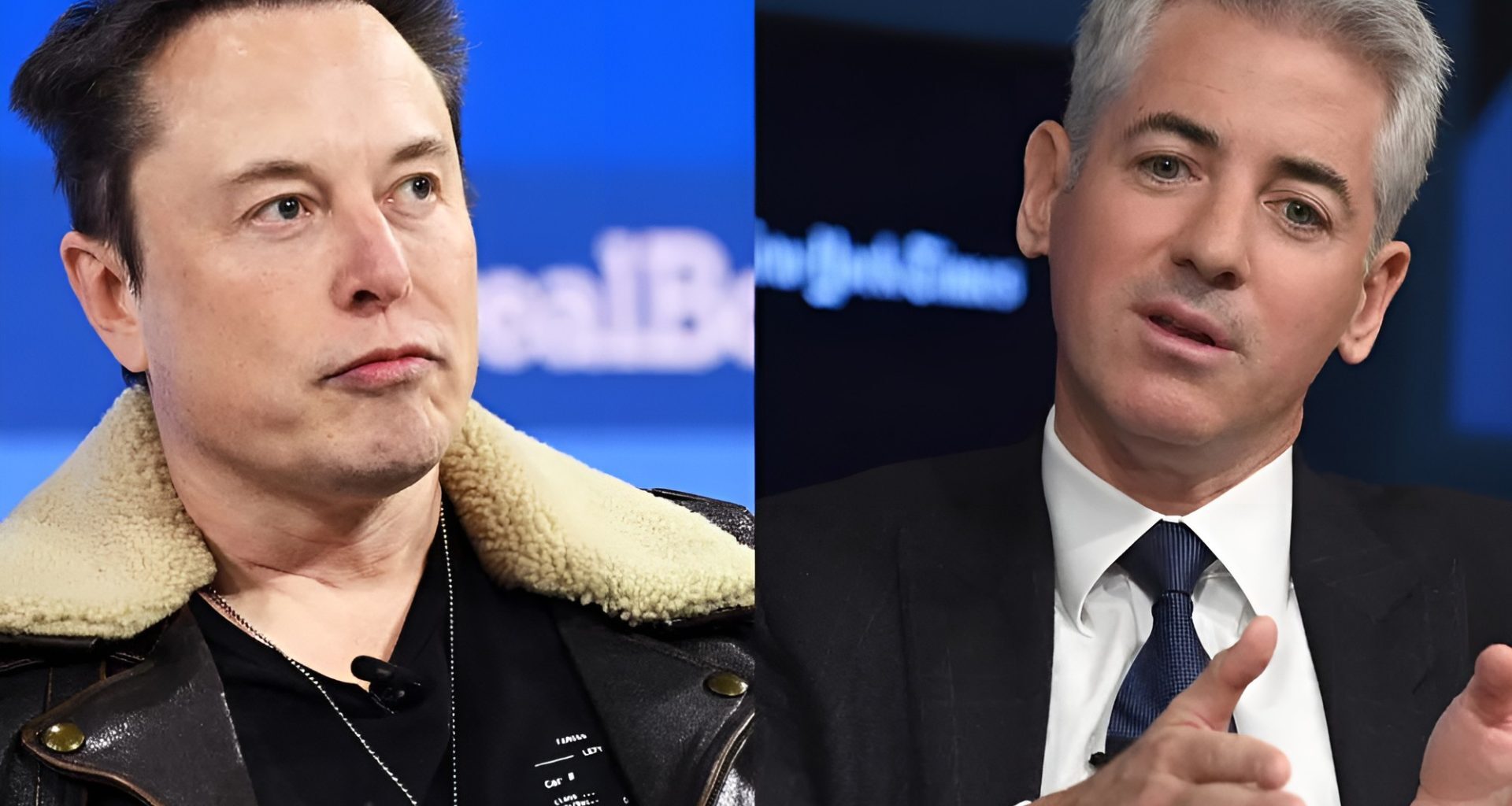
Elon Musk might have just popped the latest iteration of the AI bubble by loudly proclaiming a few days back that the “debt markets have almost entirely shut off access to money for any company that doesn’t have substantial revenue independent of AI data centers.”
In fact, Daytona.io – a platform that provides fast, isolated virtual sandboxes for running AI-generated code and AI agent workflows – cited Musk’s X post while revealing that a GPU provider tried to renegotiate a signed contract and their banks cut their lending offers in half after Musk’s post went viral.
Interestingly, SpaceX’s own borrowing might be about to go on an overdrive, at least according to the billionaire hedge fund manager, Bill Ackman.
Bill Ackman: If Elon Musk “meets his objective, he might have to borrow a trillion dollars of capital”
As we noted recently, SpaceX plans to end 2026 with 2.5-3 GW of compute capacity, which now includes plans for 1.2 million NVIDIA Blackwell GPUs at its Colossus 2 data center alone, and plans to add another 13 GW by the end of 2027, bringing its total capacity to around 20 GW.
Against this backdrop, Bill Ackman has just shared his views on the AI buildout, declaring that he thinks this compute infrastructure-related frenzy is sustainable, barring the so-called neoclouds – cloud computing providers that deliver GPU-as-a-Service and AI inference capacity – who he thinks are in a similar league as highly levered real estate developers:
“So, I think it is sustainable because, you know, intelligence is again an enormously valuable asset. And I think the demand therefore for the compute that enables intelligence, I think, is going to be sustained.”
“And, you know, the companies that are, you know, the hyperscalers that are building out a lot of this infrastructure have the financial resources, the creditworthiness in order to access the capital.”
“I worry more about the pure play neocloud companies that are a bit like highly levered real estate developers playing a theme. I think they’re much more at risk. They’re much more sensitive to the cost of capital.”
While Ackman is much more sanguine on the prospects of the so-called hyperscalers, he does think that SpaceX might have to borrow as much as $1 trillion to achieve Elon Musk’s ambitious compute-related buildout:
“But you have, I mean, SpaceX, Elon on the earnings call gave some projections for how many gigawatts of data centers he was going to open. If he meets his objective, he might have to borrow a trillion dollars of capital.”
Do note that Ackman appears to be pricing each GW of compute capacity at $50 billion ($1 trillion/20 GW). However, as we noted above, SpaceX only needs to add 13 GW of incremental compute capacity to achieve its cumulative target of 20 GW for 2027.
Also, given the fact that SpaceX’s 2027 compute-related CapEx is expected to surge to $390 billion, we can infer a per GW cost of around $30 billion ($390 billion/13 GW) for this buildout phase. In short, SpaceX’s actual debt load might be substantially less than the trillion-dollar-figure penciled in by Ackman.
Elsewhere, Sequoia’s Shaw Maguire recently published an article on X, detailing his economic modeling on SpaceX. Elon Musk then replied to Maguire’s post with a terse comment:
“Launching super intelligence satellites into deep space with a mass driver on the Moon can achieve >>petawatt/year capability, which would far exceed the best case value of Earth’s economy.”
Basically, Musk wants to place a lot AI compute satellites in deep space, where round-the-clock sunshine is available to power “petawatt/year” capacity. To put this into perspective, all of humanity currently uses around 20 terawatts of energy, and a petawatt is 50x this astronomical number!
Under Elon Musk’s vision, compute satellites would be manufactured at scale on the moon and then propelled into a deep space orbit using a long electromagnetic track akin to what a maglev train uses. This is possible as escaping Earth’s gravity requires a velocity of 11.2 km per second, while on the moon this velocity threshold is just 2.38 km per second. Of course, if this vision pans out, SpaceX would likely need trillions of dollars in additional financing.

About the author: Rohail Saleem reports on the business of AI and semiconductors for Wccftech: the chips, data centers and compute deals behind companies such as NVIDIA, AMD, TSMC, OpenAI and Anthropic, and what those deals mean for the hardware people buy. He has written more than 2200 articles for Wccftech since 2019, often reading earnings reports, supply-chain data and analyst notes to explain where the money and the hardware are going. He holds a commerce degree from the University of Toronto’s Rotman Commerce program.
Follow Wccftech on Google to get more of our news coverage in your feeds.