Intel shares plunge headlines usually mean a company is losing the AI race. This time, it’s more complicated. On October 29, 2026, Intel reported its best data center growth in 15 years, then told investors its next quarter would be much weaker than expected. As of 10:45 p.m. ET, the stock had dropped about 21% in after-hours trading, to $72.85, from a regular-session close of $92.07.
For anyone not following chip stocks, here’s the context. Intel makes the processors inside most Windows PCs and many of the servers that run cloud services. Its stock had more than doubled this year, up roughly 150%, on hopes that AI would revive the company. That’s why a disappointing forecast hit so hard. Here’s what Intel reported, why AI is both helping and hurting it, and what it means if you’re buying a PC or watching the stock.
Intel’s Quarter in Plain NumbersIntel’s result or forecastWall Street expectedQ3 revenue$16.51 billion (up 21% year over year)About $16.48 billionQ3 adjusted earnings per share$0.52$0.40Q4 revenue forecast$15 billion to $16 billion$17.07 billionQ4 adjusted earnings per share forecastAbout $0.25$0.43
Adjusted earnings per share is profit divided by the number of shares, leaving out one-off items. In short, Intel’s July-to-September quarter was fine and even beat expectations on profit. The problem is the October-to-December forecast.
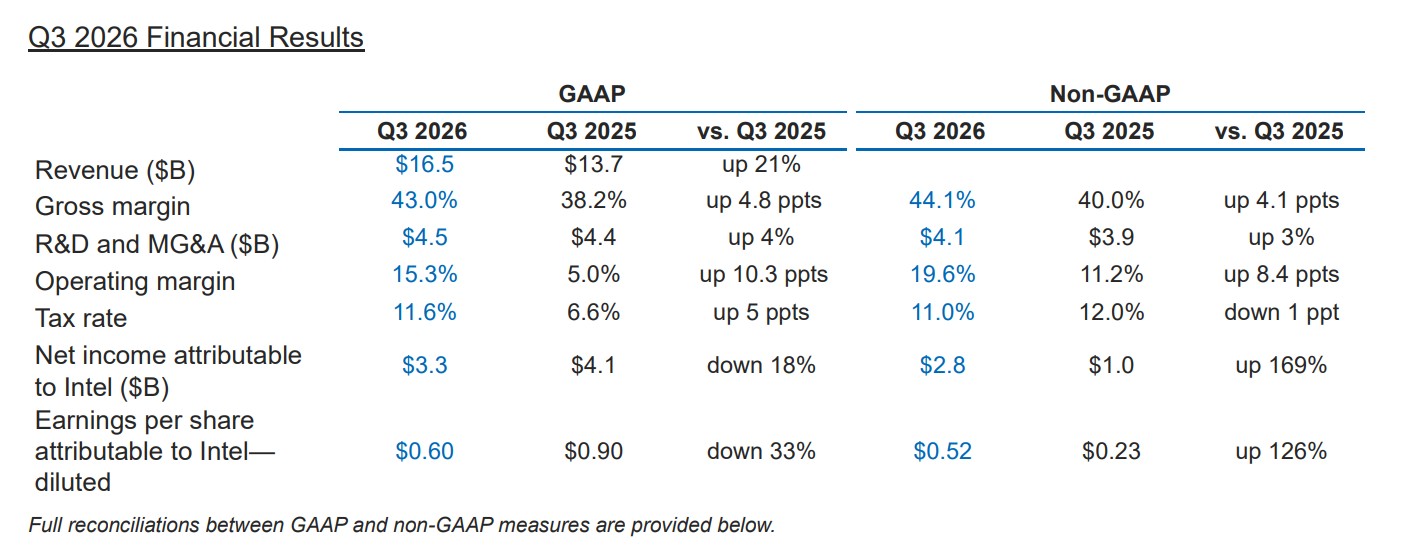
By our math, the midpoint of Intel’s revenue forecast is about 9% below what analysts expected, and its profit forecast is about 42% below. The midpoint also means revenue would fall roughly 6% from the quarter Intel just reported, during a holiday season when PC sales usually help.
The Strange Part: AI Is Intel’s Best Customer and Its Biggest Problem
Here’s the chain that connects Intel’s good news to its bad news.
AI data centers need huge amounts of memory. Every AI server uses large amounts of DRAM, the short-term memory chips that hold data while a processor works on it.Memory makers are selling to AI first. Because AI buyers pay more, memory chips for regular PCs got scarce and expensive.PC makers pass the cost on. CEO Lip-Bu Tan said that “year-to-date system endpoint prices have increased significantly,” meaning laptops and desktops cost more this year.Buyers delay upgrades. Higher prices push households and companies to keep their old PCs longer.Intel sells fewer PC chips. PC chip revenue fell 5% to $8.1 billion in the third quarter, and Intel expects a much steeper drop in the fourth.
Tan called it “the unprecedented memory crunch,” and he warned that in 2027 memory will be “a very severe issue to all of us.” Intel now expects the overall PC market to shrink 12% in 2026 and another 10% in 2027. Finance chief David Zinsner said, according to Intel’s earnings release, that “we see the PC slowdown continuing at least through the first half of next year.”
Meanwhile, the same AI boom is lifting Intel’s server business. Its Data Center and AI unit grew 78% to $7.3 billion, because AI systems still need regular processors, called CPUs, to manage data and run software around the AI chips. Zinsner said demand for those products “continues to meaningfully exceed available supply.” In other words, Intel can’t build enough of what AI customers want, while AI is shrinking demand for what it builds the most of.
This isn’t only Intel’s problem, either. The global RAM shortage has already pushed up prices for phones, game consoles and laptops this year, and memory makers like SK Hynix have warned the shortage could last into 2027.
Data Center Is Now Almost Half of Intel’s Chip Sales
One number shows how fast Intel is changing. By our math, using Intel’s reported growth rates, data center chips made up about 32% of the two main product units’ combined sales a year ago. This quarter, that share jumped to about 47%.
Q3 2025 (our estimate)Q3 2026PC chips (Client Computing)~$8.5 billion$8.1 billionData center and AI~$4.1 billion$7.3 billionData center share~32%~47%
That sounds like the AI turnaround investors wanted. However, Intel’s PC business is still its biggest single unit, and it’s the one under pressure. Until data center sales clearly pass PC sales, a bad PC year can still drag the whole company down.
Intel Shares Plunge: Why One Forecast Hit So Hard
Three things made this miss painful.
The bar was high. A stock that has gained about 150% in a year is priced for good news. Seaport Research Partners analyst Jay Goldberg summed it up: “No result is good enough, and bad results receive extra punishment.”A factory accident added to it. An October explosion at Intel’s plant in Kiryat Gat, Israel, killed two people and shut the plant for about two weeks. Intel expects the blast to cost about $600 million in revenue over two quarters, including about $300 million in the fourth quarter. By our math, that explains only about a fifth of the gap between Intel’s forecast and Wall Street’s estimate. The rest is mostly the PC slowdown and supply limits.Spending stays heavy. Intel is on track to spend about $20 billion on factories and equipment this year, with more planned for 2027, and Zinsner said Intel doesn’t expect positive cash flow this year.
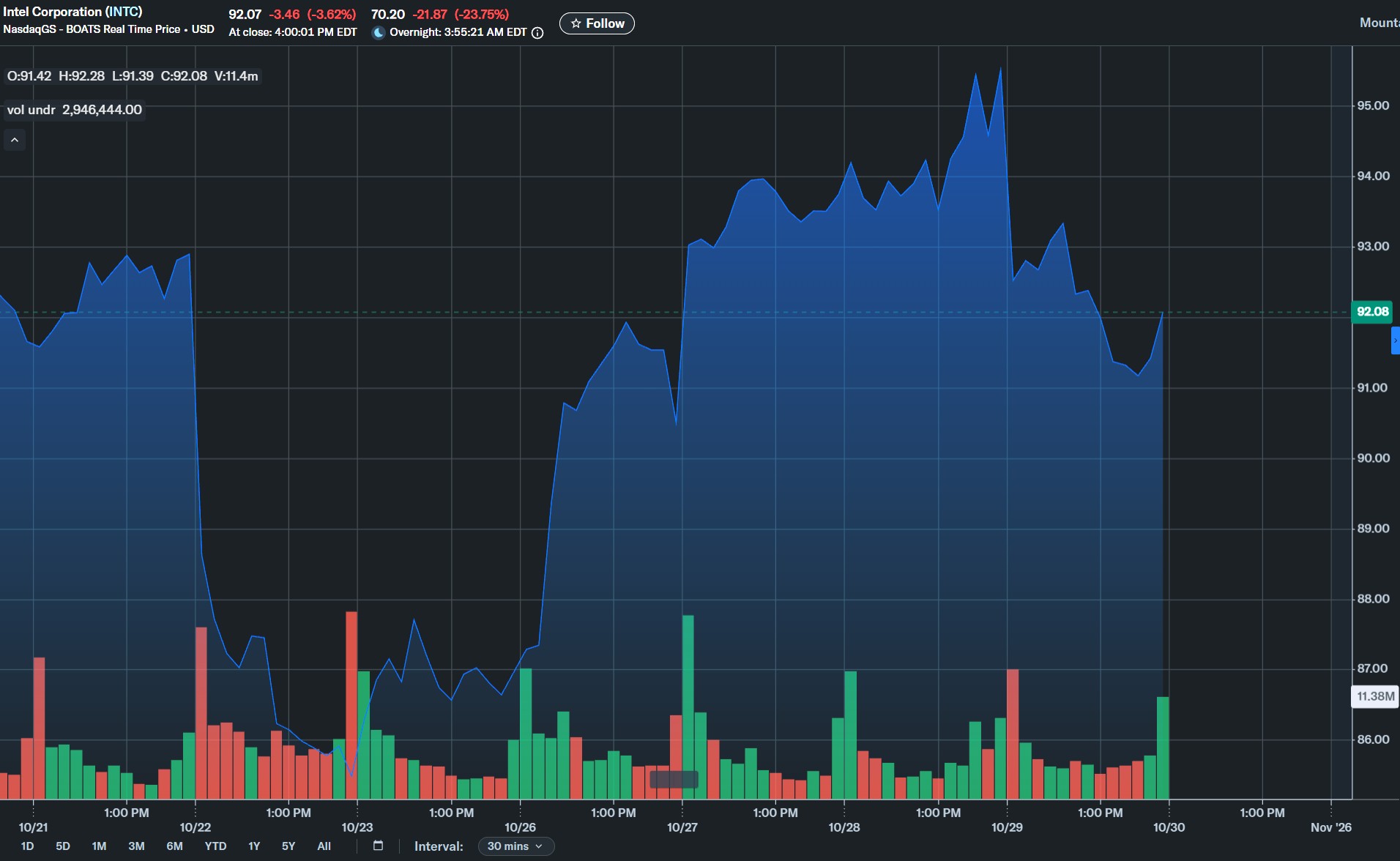
Reports put the potential loss in market value at more than $112 billion if the after-hours drop holds through Friday’s regular session. Chip stocks including Nvidia, AMD, Micron and Qualcomm also slipped 1% to 6% after hours, a sign that investors are rethinking how evenly AI’s gains are spread.
What to Watch NextFriday’s open (October 30): whether the after-hours drop holds once regular trading starts.Foundry customers: Tan said Intel is “engaged with a couple of highly strategic customers” for its contract chipmaking business and expects announcements within about two quarters.Intel 14A: Intel says its next major manufacturing process is on track, with production targeted for 2028.Memory prices: any sign that DRAM supply is catching up would be the clearest early signal for a PC recovery.
Stock prices are as of 10:45 p.m. ET on October 29, 2026, in after-hours trading. This article is for information only and is not financial advice.
FAQsWhy are memory chips so expensive in 2026?
AI data centers buy enormous amounts of DRAM and high-bandwidth memory, so chipmakers prioritize them. That leaves less supply for phones, PCs and consoles. The Steam Machine price jump shows how far the RAM crisis can push a gadget’s price.
Are other laptop makers raising prices too?
Yes. Apple, Microsoft and others raised prices or cut memory on some models this year.
Are Intel’s new laptop chips any good?
Intel’s newer chips focus on efficiency, but some budget models trade cores for cost.
Is the phone market shrinking for the same reason?
Largely, yes. Research firms expect smartphone shipments to fall in 2026 as memory costs push prices up.
Who is spending the most on AI infrastructure?
Cloud giants and AI labs are raising record sums for chips and data centers. SpaceX’s $40 billion debt deal for AI chips shows how far companies will go to secure supply.
Vincee Cole is a technology journalist with four years of experience covering the full spectrum of modern tech — from consumer devices, artificial intelligence, to quantum computing, blockchain, and digital assets. His reporting cuts through complexity to deliver stories that are sharp, grounded, and relevant to both general readers and industry insiders. Previously, he worked with fintech research teams across Southeast Asia, analysing how emerging technologies are reshaping financial systems at scale.