
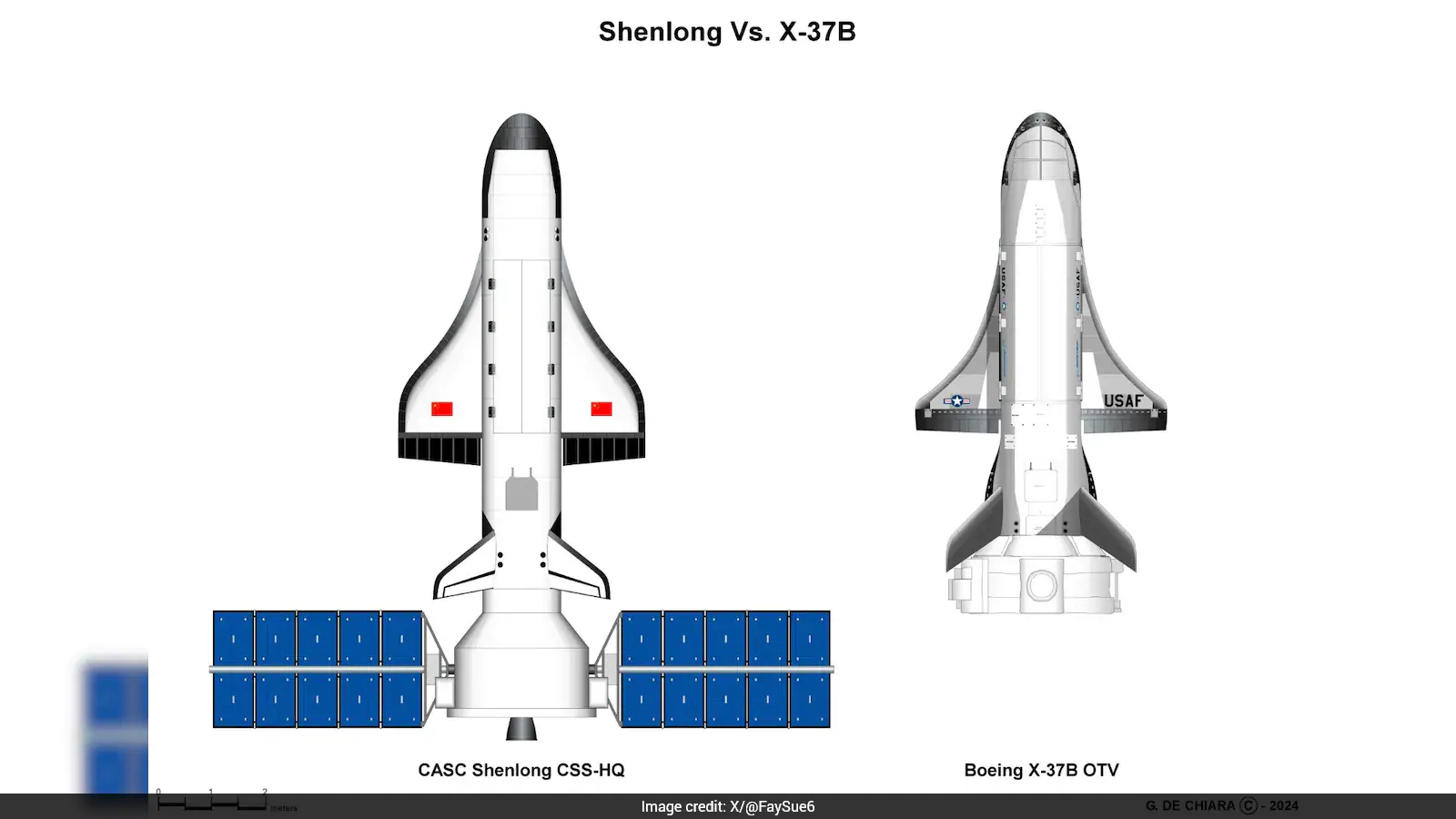
A photograph recently released by the US Defence Intelligence Agency (DIA) has shown a mysterious Chinese plane in remarkable detail for the first time. Called Shenlong (or “divine dragon” for the Chinese), the space plane is shown docked to another satellite with its solar panels deployed and payload-bay door open. The development is significant because China has been using the spacecraft to release unidentified objects in low Earth orbit. Shenlong’s photo has led to comparisons with America’s X-37B, built by Boeing.
What Is China’s Shenlong Spaceplane?
According to space.com, Shenlong is China’s experimental reusable space plane. It is an uncrewed spacecraft designed to travel into orbit, carry out experiments and return to Earth.
The spacecraft, currently in its fourth mission, is launched vertically aboard a Long March 2F rocket from the Jiuquan Satellite Launch Centre. Once in orbit, it can operate autonomously before returning to Earth and landing on a runway.
China has disclosed very little about Shenlong’s design, capabilities or mission objectives. It has also not released an official photograph of the spacecraft.
Its activities, however, have been closely monitored by independent satellite trackers.
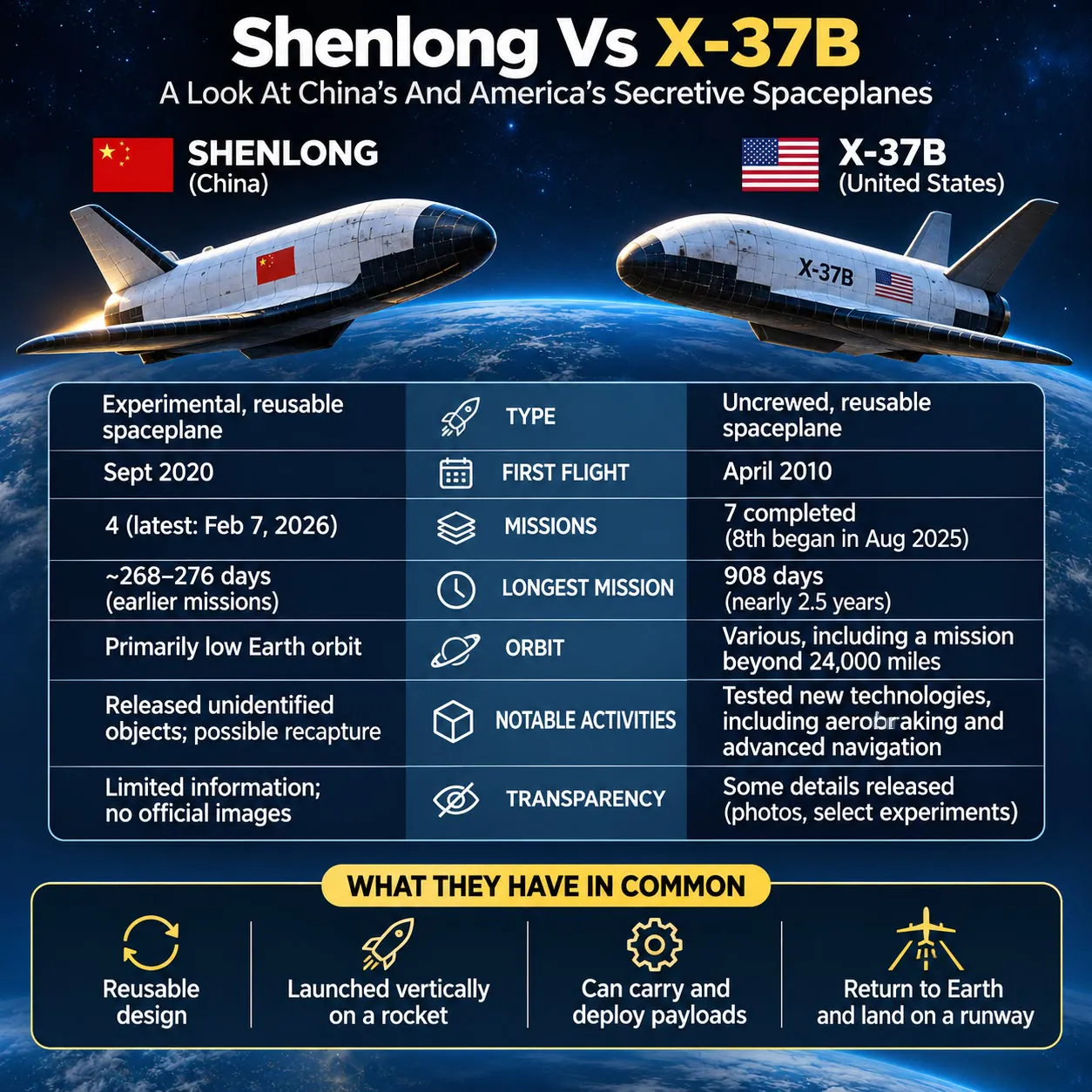
China’s first known spaceplane mission began in September 2020 and lasted approximately two days. A second mission, launched in August 2022, remained in orbit for 276 days. Its third mission began in December 2023 and ended in September 2024, after approximately 268 days in orbit.
The fourth mission began on February 7, 2026.
Shenlong became part of the news cycle after several US outlets reported about the plane releasing unidentified objects in the US skies.
During its latest mission, orbital tracking data analysed by astrophysicist Jonathan McDowell indicated that the spacecraft released a smaller object and subsequently recaptured it, repeating the exercise. Such manoeuvres have fuelled speculation about its ability to inspect, retrieve or interact with other objects in space.
What Is America’s X-37B Spaceplane?
The X-37B is America’s uncrewed, reusable spaceplane, developed by Boeing for the US Space Force. It is designed to conduct experiments, test advanced technologies and return equipment to Earth for examination.
The spacecraft made its first flight in April 2010. Since then, it has completed seven missions, with its longest flight lasting 908 days – nearly two and a half years. Its eighth mission began in August 2025.
Unlike conventional satellites, which generally remain in orbit until the end of their operational lives, the X-37B can return to Earth and land autonomously on a runway. Its payload bay also allows it to carry experiments and deploy smaller objects in space.
The US Space Force and Boeing have disclosed some details about its activities, including experiments involving radiation, navigation systems and space-domain awareness. However, most of its operational objectives remain classified.
One of its significant achievements came during its seventh mission, when the spacecraft demonstrated an aerobraking manoeuvre to change its orbit while conserving fuel.
The X-37B has also operated at significantly different orbital altitudes. One of its missions reached an altitude of more than 24,000 miles, demonstrating its ability to operate beyond conventional low Earth orbit.
 Shenlong Vs X-37B: What Is Known About The Differences Between Them?
At first glance, the two spacecraft look remarkably similar. Both have delta-shaped wings, payload bays and heat-resistant surfaces designed to withstand the extreme temperatures of atmospheric re-entry.
Both are launched vertically aboard rockets, operate autonomously in space and return to Earth for runway landings.
However, there are differences in their operational history, capabilities and publicly available information.
The X-37B has a longer flight record, having completed seven missions before beginning its eighth in 2025. Shenlong has completed fewer missions, although its latest flight continues China’s efforts to develop reusable space technology.
The American spacecraft has also demonstrated a wider range of orbital operations, including aerobraking and flights at much higher altitudes. Shenlong’s publicly tracked missions, meanwhile, have largely involved low Earth orbit.
Another important difference is the level of transparency. The US has released photographs of the X-37B and disclosed some of its experiments. China, on the other hand, has kept Shenlong’s design and activities largely under wraps.
The two programmes are therefore difficult to compare directly, particularly because neither country has disclosed the full capabilities of its spacecraft.
Why Are The US And China Developing Space Planes?
Reusable spaceplanes offer several advantages over conventional satellites and spacecraft. They can carry experimental equipment into orbit, deploy smaller satellites and return hardware to Earth for inspection. This makes them useful platforms for testing technologies under actual space conditions.
Their ability to manoeuvre also gives them capabilities that conventional satellites may not possess.
One particularly important application is close-proximity operations, in which one spacecraft approaches another in orbit. Such manoeuvres could have peaceful uses, including satellite inspection, maintenance, refuelling and the removal of space debris.