
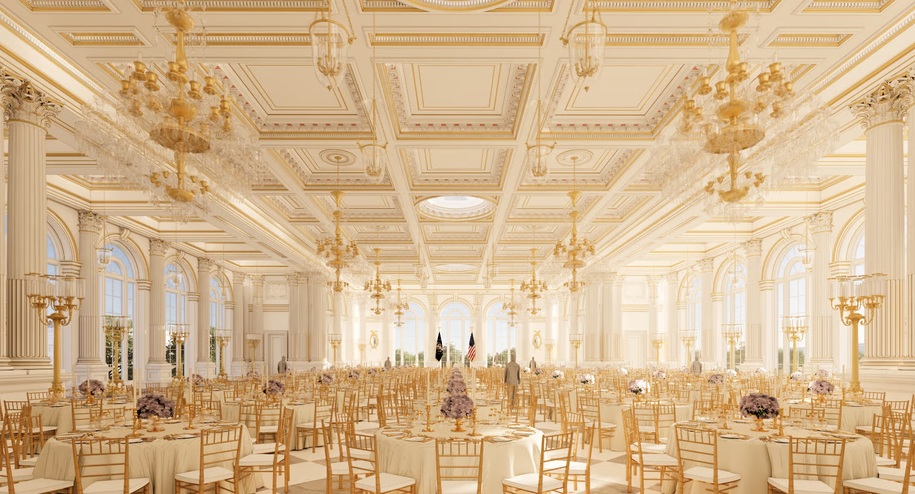
In my previous diary I wrote about the companies that are involved in Trump’s disastrous demolition of key parts of the White House and the building of his disgusting White House ballroom. One of those companies is McCrery Architects, led by James McCrery, which designed the ballroom. There’s an interesting piece in Punch List Architecture Newsletter, a publication geared to architects, that offers more background on McCrery (he’s a wingnut) and on what the architecture community thinks of his ballroom design (they don’t like it).
It will surprise nobody here that McCrery specializes in religious architecture. His portfolio includes cathedrals in Tennessee, North Carolina, and Texas, as well as a Carmelite monastery in Wyoming. Punch List notes that McCrery describes his career arc in religious terms.
“God helps people understand what it is that His will for them is,” (McCrery) said in the Bentz interview. “I truly believe that. It’s most efficacious when the person is open to that help, that guidance.” He has similarly dismissed modernist architecture as “ungodly”: “It’s exactly not created. It’s counter to God’s creation, in every aspect and in every detail.”
The broader architecture community does not have much nice to say about McCrery’s White House ballroom design — or about how he was chosen. Punch List notes that the American Institute of Architects sent a letter to the Committee for the Preservation of the White House in which it raised alarms about several aspects of the ballroom plan.
Though it is couched in diplomatic language, the letter calls out the administration for choosing McCrery without an open public process and raises questions about what it calls the design’s “scale and balance”: “We urge careful consideration of adjustments that would align the proposed additions more closely with the White House’s historic character.”
McCrery’s former mentor, famed architect Peter Eisenman, was less diplomatic.
(Eisenman) called McCrery’s ballroom design “bonkers” before adding, “putting a portico at the end of a long facade and not in the center is what one might say is untutored.”
Ouch.
The author of the Punch List piece, Christopher Hawthorne, agrees with the criticism:
I don’t disagree with the growing consensus that the ballroom design, a big-footed architectural presence stomping toward the southern edge of the White House grounds, violates the very standards of beauty and proportion that McCrery loves to rhapsodize about in interviews, to say nothing of the protocols long in place to guide changes to 1600 Pennsylvania Ave. I’m also of course reminded of the heavily gilded architecture that Viktor Orbán’s autocratic government coaxed from the typically more subtle Sou Fujimoto in Budapest…
Hawthorne goes on to say — even more pointedly — that what McCrery’s ballroom design suggests is “not so much a bloated classicism or an effort to turn Washington into Mar-a-Lago north, although it is both of those things, as a blueprint for making concrete the notion that the White House has turned in some fundamental sense into a retail outlet, a place where access and influence are nakedly bought and sold.”
If you want to let James McCrery know what you think of his involvement in destroying the People’s House, his firm’s general email is info@mccreryarchitects.com). He is also a professor at Catholic University: Mccrery@cua.edu.