
Unlock the Editor’s Digest for free
Roula Khalaf, Editor of the FT, selects her favourite stories in this weekly newsletter.
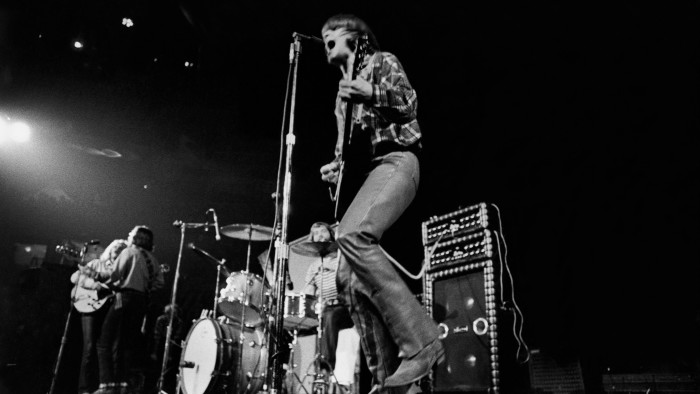
When Creedence Clearwater Revival released “Proud Mary” as a single in January 1969 they had existed for a decade. They got a taste of success in 1968 with “Susie Q”, but nothing about the Bay Area band suggested longevity, let alone greatness.
Then “Proud Mary” raced to number two in the US charts, and Creedence became America’s favourite band. In “Proud Mary”, 23-year old John Fogerty composed a contemporary standard, a song that could have leapt from a Mark Twain tale, while encapsulating the hippie dream of taking to the open road. Or the river — for Proud Mary is a steamer which the song’s narrator hitches a ride on, fleeing his poorly paid job. Once aboard, he finds generous people who “are happy to give” if “you have no money” and his sense of joy is captured in the song’s chorus: “Rollin’, rollin’, rollin’ on the river.”
In Fogerty’s autobiography Fortunate Son he describes how, having received notice of an honourable discharge from the US army, he turned a cartwheel, picked up his guitar and started composing, writing that “a weight had been lifted.” “Proud Mary” arrived quickly and Fogerty admits surprise at having written “a song about a boat”.
Creedence recorded “Proud Mary” as a straight-ahead rock song and, in an era of downbeat, psychedelic rock, its simplicity lit up the radio and it became an international hit. “Proud Mary” mentions Memphis and New Orleans — Mississippi riverboat cities — yet Fogerty had never travelled outside California; his imagination, seemingly sparked by the R&B, rockabilly and Stephen Foster songs he loved, led him to celebrate a mythic South.
It’s a testament to his songwriting skills that Southern-born singers began recording “Proud Mary”: Solomon Burke’s April 1969 effort begins with him relating how his forefathers worked on the Proud Mary “as stokers, cooks and waiters”; Burke’s version, slower and reflective of an African American consciousness, is wise and majestic. Fogerty paid tribute: “It’s great when someone sings your song, but when he understands it, you listen like it was the first time.”
Phil Spector, the dominant producer of early-1960s US pop, got The Checkmates Ltd featuring Sonny Charles to record “Proud Mary” in the autumn of 1969 — its bombastic sound and female gospel chorus overwhelm the song, which struggled to chart.
Tina Turner wanted to sing “Proud Mary” as soon as she heard Creedence’s version, but it took almost two years to convince her then husband, Ike Turner, that they should do so; their 1971 version transformed the song into a celebration of Black pride and survival. Tina begins by informing listeners to “listen to the story” as voices, backed by guitar and bass, tell of a South they knew too well. After a couple of minutes the band kick in and “Proud Mary” becomes an explosive rock-soul number; it was a hit in both pop and R&B charts. “Proud Mary” became a centrepiece of Ike & Tina’s live show and, after they split, was one of the few Ike-era songs she retained in her set — a live version was included on her 1988 Tina Live in Europe album, while she re-recorded “Proud Mary” for the 1993 biopic, What’s Love Got to Do With It.
 Tina Turner in 1971, the year she released her explosive version of ‘Proud Mary’ © Michael Ochs Archives
Many other artists recorded “Proud Mary” — Tom Jones, Status Quo, Junior Walker, Glee Cast among them — but none matched Creedence, Burke or Turner’s efforts. Fogerty recalled his mother, who rarely liked his music, proudly telling him she’d heard the Boston Pops orchestra playing “Proud Mary” with country guitarist Chet Atkins.
As for Elvis Presley, who incorporated “Proud Mary” into his live show, Fogerty noted: “It seemed like he hurried through it . . . you just wished he killed it.” The version on Presley’s 1972 Madison Square Garden album bears this out.
For a long time, Fogerty refused to sing his old songs — a dispute with Fantasy Records over his publishing had turned toxic. Then came an impromptu stage appearance in 1987 with Bob Dylan and George Harrison at a Taj Mahal concert in Los Angeles. Dylan told Fogerty: “If you don’t do these tunes, the world’s going to remember ‘Proud Mary’ as Tina Turner’s song.” This spurred him to start singing CCR songs again, including “Proud Mary”.
At this year’s Glastonbury Festival, Fogerty concluded his performance with the song that had established him as a singular voice in American music. Creedence Clearwater Revival, never fashionable or mythologised, are in our streaming era one of the most popular 1960s-era bands — their simple yet dynamic songs attracting similar numbers of listeners as The Beatles and Stones.
Let us know your memories of ‘Proud Mary’ in the comments section below
The paperback edition of ‘The Life of a Song: The stories behind 100 of the world’s best-loved songs’, edited by David Cheal and Jan Dalley, is published by Chambers
Music credits: Concord; Sony; A&M; Capitol; Parlophone; Deutsche Grammophon