
By Alexander Davey
The Central Committee’s main objectives for its Five-Year Plan period are guided by six principles – first by “upholding the party’s overall leadership,” and only second by “putting the people first,” according to the Fourth Plenum communiqué. This hierarchy shows how political authority and party control take precedence over welfare-oriented governance priorities. Yet, Beijing acknowledges that sustained productivity and welfare gains require large investment in both industrial and social infrastructure.
The leadership’s priority remains the expansion of total economic output. Employment and production continue to serve as the preferred levers of welfare, rather than direct income transfers. Social stability is understood to stem from participation in the productive economy, not from welfare dependency. The concept of “steadily advancing” common prosperity reflects a long-term, structural approach rather than a redistributive agenda. The party’s notion of fairness is based on earned improvement, not entitlement.
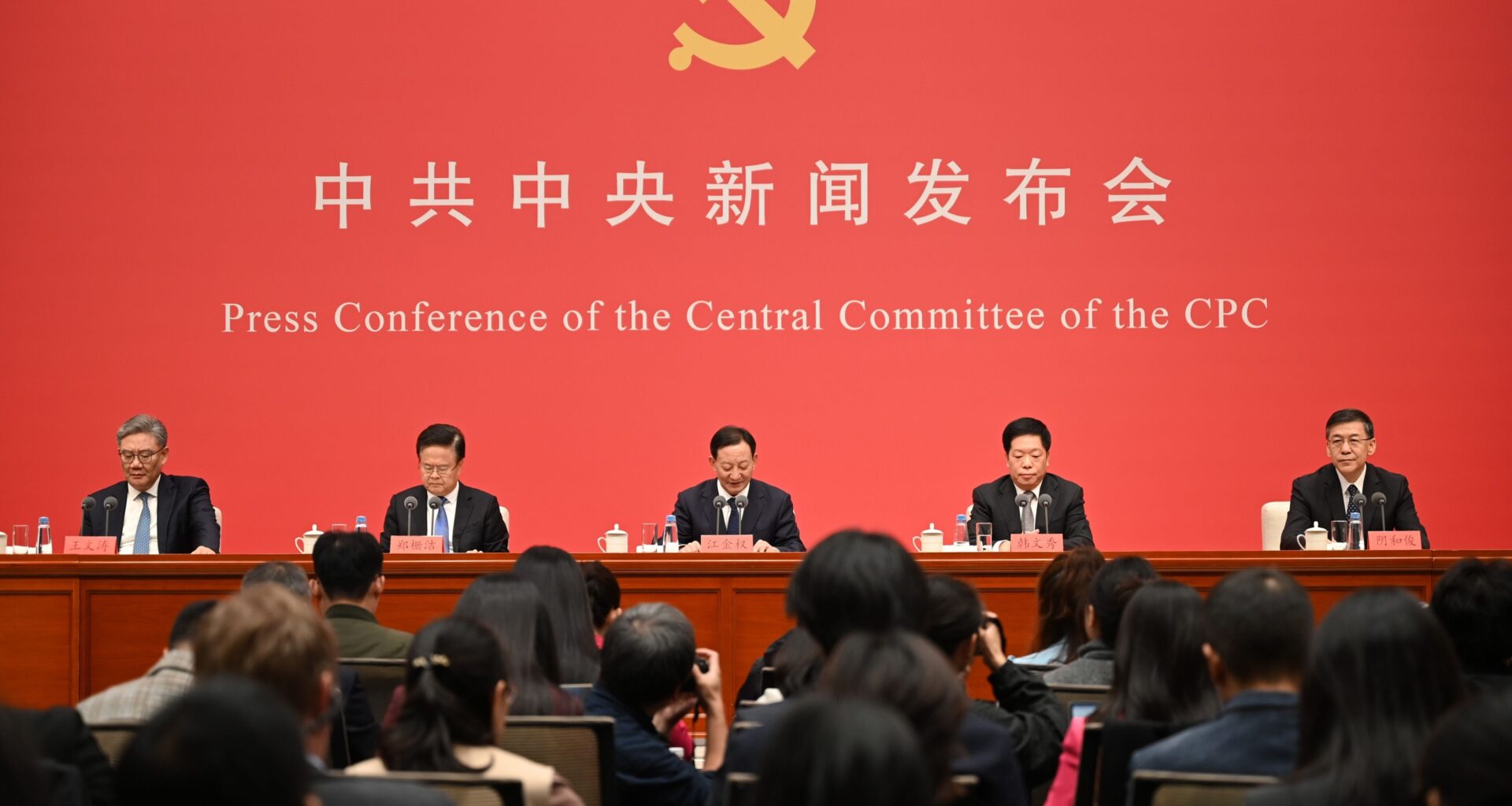
The forthcoming Five-Year Plan reaffirms Beijing’s reliance on state-led investment as the engine for both growth and welfare. According to a senior party-state leader, upgrading core manufacturing sectors – like chemicals, machinery, and shipbuilding – is projected to create new market space worth around EUR 1.209 trillion over the next five years.
In parallel, China plans to build or renovate over 700,000 kilometers of underground pipelines, representing more than EUR 600 billion in new investment, and accelerate the cluster development of strategic emerging industries – notably, new energy, advanced materials, aerospace, and the low-altitude economy, which they expect to generate multiple markets worth several hundred billion euros. This strategy is explicitly framed as a long-term mechanism for stimulating domestic demand.
In their view, social welfare investment functions as an economic multiplier rather than a redistributive instrument – productive spending designed to raise growth and improve livelihoods through participation, not transfers. Growth is the prerequisite for welfare, not its consequences.
China’s next development phase thus reinforces a distinctly supply-side vision of social progress. The party’s wager is that sustained investment, guided by central coordination and executed through state-led industrial policy, can generate productivity gains that underpin social welfare. Yet this approach also exposes a structural tension: redistribution remains contingent on growth, and growth on the continued effectiveness of state capital deployment. Whether this model can translate infrastructure and industrial upgrading into genuine domestic demand and social inclusion will define the success – and the limits – of the “common prosperity” agenda in the years ahead.
Media coverage and sources: