
An ocean technology company has just unveiled a pioneering underwater habitat prototype at a hangar in Miami, designed to allow scientists to live and carry out research beneath the sea’s surface for days at a time.
Developed by DEEP, a UK-based subsea engineering firm, the new Vanguard pilot human habitat is part of an ambitious effort to make long-term underwater living possible.
Revealed at a hangar in Miami, Florida, on October 29, the prototype can support up to four crew members for up to a week. The firm aims to make it possible for researchers, explorers, and oceanographers to live underwater for extended time periods.
Until now, most expeditions have only allowed scientists to stay submerged for a few hours at a time. “Beneath the surface of the ocean lies a vast, largely unexplored frontier that has fascinated humans for centuries,” the company said.
Scientists go underwater
According to the company, the modular structure consists of three sections, including a living chamber, a diving center, and a base anchored to the seabed.
Inside the first compartment, which measures about 40 feet (12 meters) in length and another 12 feet (3.7 meters) in width, crews can eat, sleep, and conduct research while protected from intense water pressure.
Meanwhile, the diving center is connected to an underwater base anchored to the seabed and ensures that the habitat remains stable and protected from waves and storms.
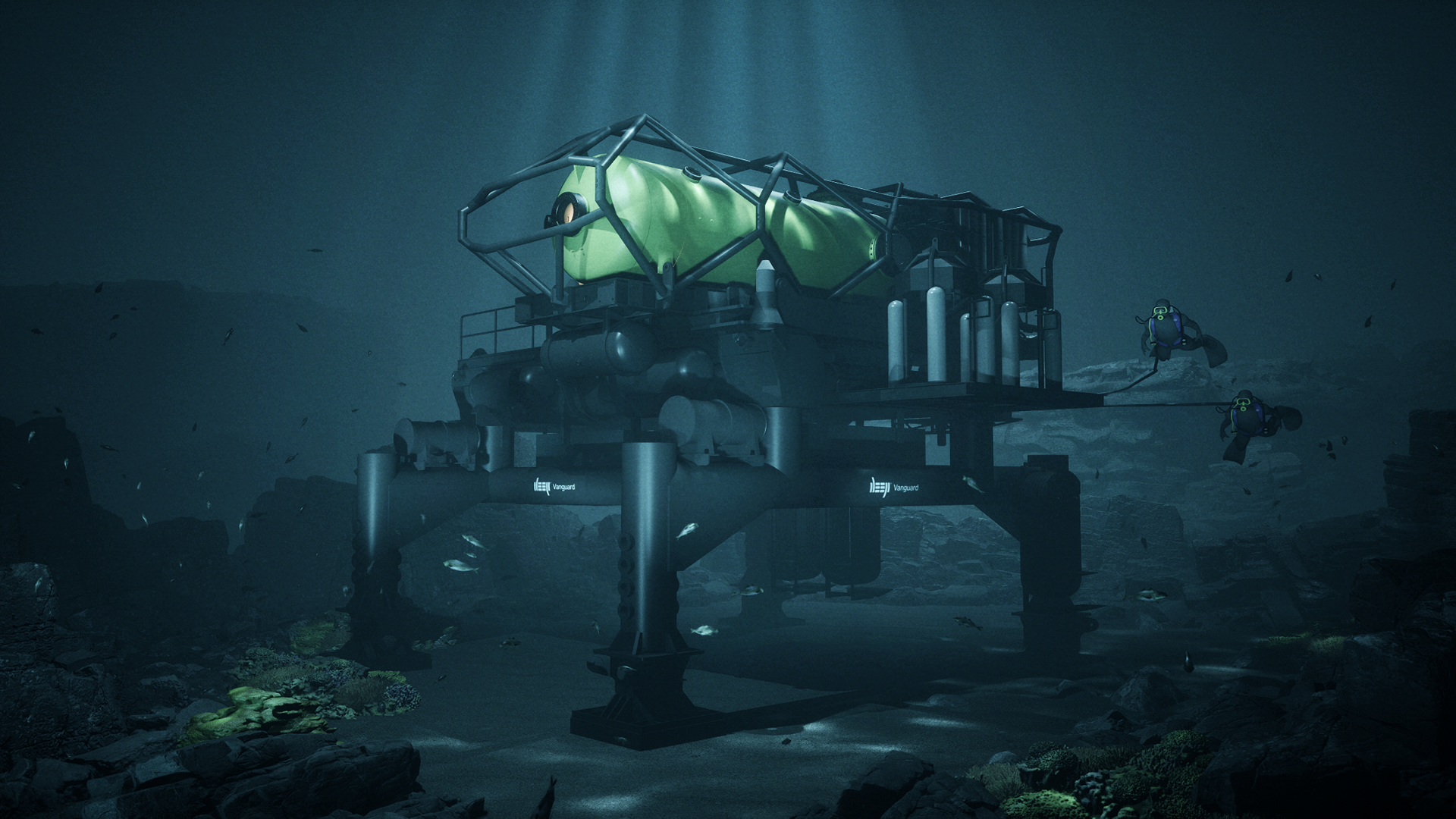 The Vanguard pilot habitat aims to advance ocean exploration and expand our understanding of the marine environment.
Credit: DEEP
A floating platform stationed on the surface supplies compressed air, power, and communications. Together these systems create a fully functional “subsea habitat” that’s capable of sustaining human life under the ocean.
“There are zones in oceans around the world that are unexplored at those depths, and making them available and accessible by divers will open up a whole new realm of science,” Norman Smith, DEEP’s CEO and the lead engineer behind Vanguard, explained.
Vanguard operates at a depth of about 65 feet (20 meters), a depth that divers can access with standard scuba gear. However, the company is currently in the process of designing new prototypes that are expected to go as deep as 650 feet (200 meters).
Exploring the ocean floor
The underwater habitat is designed to serve as a secure living environment for marine scientists. By eliminating the constant need to resurface, they will be able to observe fragile ecosystems directly from beneath the waves.
As per DEEP, Vanguard marks the first step in making humans aquatic. “This could revolutionize areas such as coral reef restoration, climate monitoring, and even astronaut training for future space missions,” the company stated.
The project is the first new subsea human station of its kind. It is also the first underwater habitat to be classified by Det Norske Veritas (DNV), an international accredited registrar and classification society on subsea standards headquartered in Høvik, Norway.
“By allowing teams to remain submerged for extended periods, the habitat will enable more comprehensive research and real-time observation of marine ecosystems,” DEEP disclosed in a statement.
In the future, the company intends to move beyond just one habitat and build a network of underwater stations for continuous ocean research. “Each mission will build upon the last, refining technology and operations until living beneath the sea becomes routine,” the firm concluded.