


Listen to this article
Estimated 5 minutes
The audio version of this article is generated by text-to-speech, a technology based on artificial intelligence.
Quebec Premier François Legault is warning the province may be heading toward a recession and says he has revised his economic priorities to help Quebec weather the storm caused by U.S. President Donald Trump’s tariffs.
While his latest plan, announced less than a year before the 2026 general election, is largely inspired by the one that guided him since he was elected in 2018, it also includes some new ideas that, according to him, will help the province integrate into the new reality of the economy.
The situation is serious and Quebecers need to be “told the truth,” Legault told reporters on Monday, presenting his new economic vision for Quebec.
He said the province is “very close” to the threshold marking a recession, noting that economic uncertainty has paused some investments, which “will have an impact eventually.”
Legault cited the forest industry’s 60,000 jobs as examples of positions that are at risk due to punishing 45 per cent tariffs from the United States.
He said he is keeping in mind Trump and Prime Minister Mark Carney’s priorities, and he intends to intervene in the economy to create new jobs that he hopes will replace those that are set to disappear.
Legault presented his new economic vision for Quebec on Monday at the Beauharnois hydroelectric plant, days after giving CBC and Radio-Canada a preview.
WATCH | Premier says Quebec needs a plan to face a possible recession: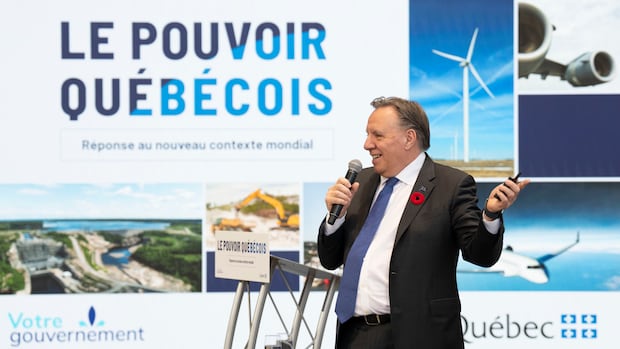
Energy development at centre of Legault’s new economic vision to deal with U.S. tariffs
Premier François Legault’s strategy, called Quebec power, includes accelerating major infrastructure projects, boosting hydro production and ensuring the province’s businesses get their fair share of federal defence contracts. He says the idea is to replace jobs that will be lost due to the trade war caused by Donald Trump’s tariffs.Energy investments are key
Hydro-Québec is at the forefront of Legault’s “new economic vision,” with the premier saying that in Quebec, “we’re blessed by the gods.”
The Crown corporation is planning to invest $200 billion by 2035 to double its energy capacity – the biggest construction project in Quebec’s history, Legault added.
His plan also rests on the Churchill Falls MOU, the tentative agreement between Quebec and Newfoundland and Labrador which would replace the 1969 hydroelectric contract between the provinces.
The deal would increase the power of Churchill Falls and develop a run-of-river plant on Gull Island. But since the election of Progressive Conservative Premier Tony Wakeham, who is aiming to get a better deal for his province, the agreement has been on shaky grounds.
Legault said he’s against putting more money on the table, but he would be open to the idea of modulating instalments differently.
The premier said he would be open, for example, to the idea of investing less money until 2041 — the end of the current contract — even if it means paying more later.
“If we’re making changes, I have things that I’d like to improve,” Legault warned. “It’s give and take.”
Critical minerals, defence
Despite the setbacks of Northvolt and other companies like Lion and Taiga Motors, Legault said he wouldn’t abandon the battery sector entirely, saying other opportunities will arise when Trump leaves the White House.
In the meantime, according to the premier, Quebec must take advantage of new “strategic opportunities,” such as critical minerals and defence.
The federal government announced in its latest budget investments of $30 billion over five years to strengthen national defence.
European Union countries also want to invest more in their armed forces to meet new spending targets they have set for themselves.
Quebec, according to Legault, is well positioned to meet those needs, especially given Bombardier and Davie, two Quebec flagship companies whose factories are capable of producing civilian and military equipment in the province.
WATCH | Legault prioritizing defence spending: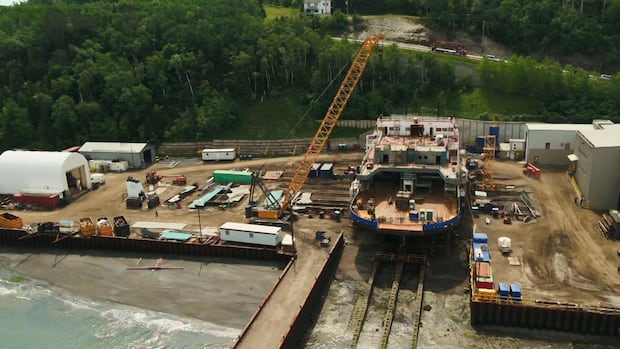
Why Quebec is taking a new approach and making defence spending a top priority
Premier François Legault is slated to present his new economic vision for Quebec. Defence and security spending are expected to be the main focus. The government says it wants to help Quebec businesses to get their fair share of contracts from Ottawa and the European Union.Investing in data centres
Part of Legault’s vision for Quebec is to invest more in data centres, despite them being energy-intensive and creating few jobs.
“Now, we have data centres that are ready to pay the full [electricity] price,” Legault said. “And companies increasingly want to set up next to data centres.”
The premier said the Quebec government is already in contact with Google, but it would not allow the American giant to pay a preferential rate for hydroelectricity.
“I’m not closed to American companies as long as there are guarantees of benefits for Quebec, that prices are good and that we make big profits with hydroelectricity,” he told CBC and Radio-Canada on Friday.
Another bill to fast-track infrastructure projects
Legault hinted that his government would also introduce legislation to give Hydro-Québec more leeway.
Finance Minister Eric Girard is set to table Bill Q-5 in the next few weeks, the premier said.
Bill Q-5, whose name alludes to the Carney government’s C-5 – One Canadian Economy Act – would exempt some infrastructure projects of national interest from certain environmental laws that would otherwise slow their materialization.
However, in 2020 the Legault government adopted Bill 66, which has a similar purpose.
The law is meant to speed up 181 infrastructure projects and was a last-ditch effort to inject stimulus into an economy reeling from the effects of COVID-19.