
EDITOR’S NOTE: Call to Earth is a CNN editorial series committed to reporting on the environmental challenges facing our planet, together with the solutions. Rolex’s Perpetual Planet Initiative has partnered with CNN to drive awareness and education around key sustainability issues and to inspire positive action.
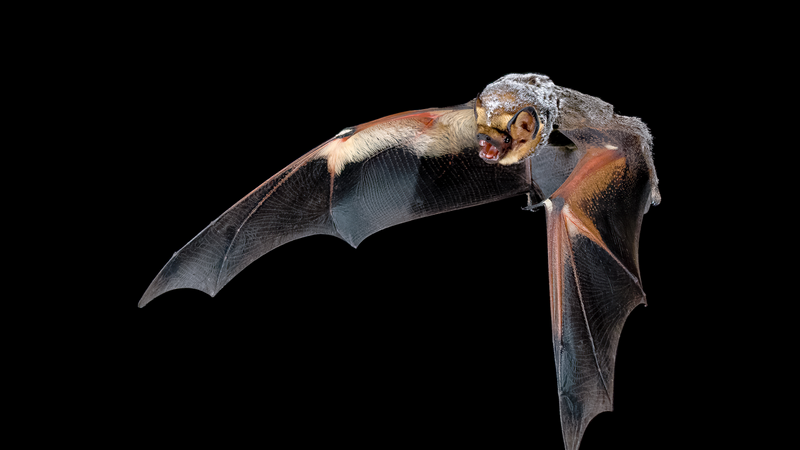
Bats are found on every continent except for Antarctica, but their populations are falling. Habitat loss, disease and pesticides have contributed to their decline but in recent years they have faced a growing threat: wind turbines. According to the UN Environment Programme, millions of bats globally are killed by turbines each year. Estimated annual bat deaths from turbine blades include around 50,000 in Canada, over 200,000 in Germany and more than 500,000 in the US.
As well as their hugely important ecological roles, bats are crucial to global economies, explains professor Winifred Frick, chief scientist at the nonprofit Bat Conservation International. Many species consume agricultural insect pests, some disperse fruit seeds and others act as essential crop pollinators. Mexican long-nosed bats and lesser long-nosed bats, for example, pollinate the agave plant, which is what tequila is made from — “if you like your margarita, toast to a bat,” Frick jokes.
Though early research into the major cause of turbine-induced bat deaths pointed to barotrauma — where dramatic pressure changes near turbine blades rupture bats’ internal organs — more recent evidence suggests that most die from direct impact with the blades.
However, the cause of death isn’t what’s important, says Frick — either way, bats are being killed in their millions. While wind provides an important source of renewable energy — accounting for 8% of all global electricity — it should be operated “responsibly so that it doesn’t cause declines in bat populations,” she adds.
In many countries, developers must carry out an Environmental Impact Assessment before installing a wind farm. A spokesperson for the Global Wind Energy Council (GWEC) said in an email that “Nature reserves, breeding grounds, and important biodiverse areas will usually be excluded from consideration for potential wind farm locations,” and that during the development process, surveys investigate the potential impact on habitats and wildlife migration routes.
However, researchers have noted that regulation to protect bats from wind turbines varies greatly across the globe and can be poorly enforced. Voluntary compliance “is problematic on a global scale and therefore virtually nonexistent,” according to one study.
Once a wind farm is built, the main strategy currently used to protect bats from turbines is “blanket curtailment”— effectively pausing the turbines at low wind speeds when bats are most likely to be present.
An analysis of published research found that this method reduced bat fatalities by over 60% — when turbines were stopped below wind speeds of 5 meters per second, from dusk to dawn, between mid-July and mid-October. However, simulations show that this could also reduce annual energy generation of the turbines by over 10%, in certain regions and under some curtailment scenarios.
One solution to reduce energy generation loss is “smart curtailment,” which aims to “protect the bats when they are at risk and let the turbines operate when there are no bats at risk,” says Kevin Denman, managing director of US-based EchoSense.
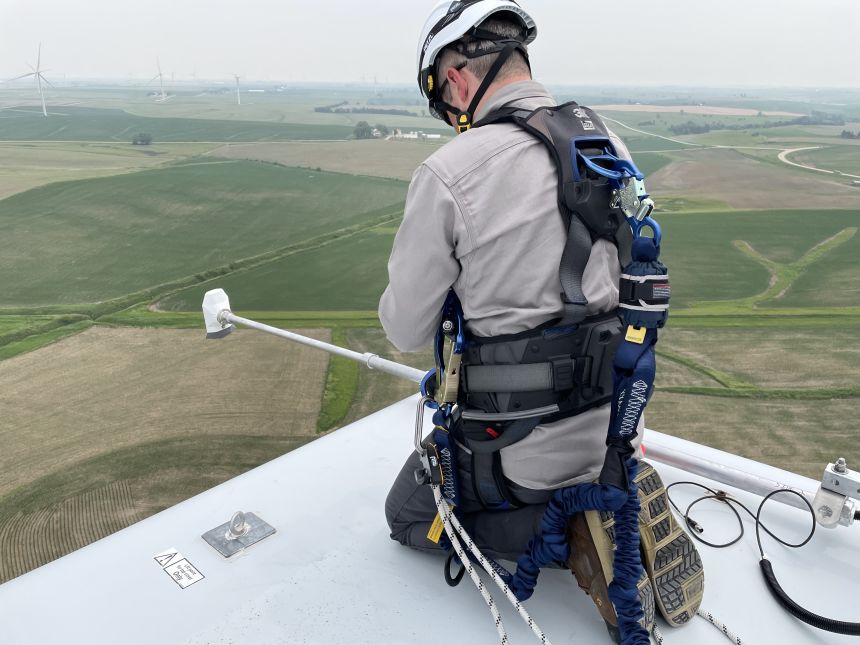
His company does this by fitting sensors to turbines to listen out for the acoustic signals made by bats when they echolocate — navigate through their aerial environment using high frequency sounds. When these signals are detected, nearby turbines are curtailed in response, giving the bats enough time to pass by unharmed.
“Our system returned roughly 50% of that energy that was lost with the blanket curtailment strategy,” says Denman, in reference to a 2023 study that was co-funded by the US Department of Energy. The study also found that the system resulted in “no significant difference in bat fatalities compared to blanket curtailment.”
Several other companies worldwide are developing detection systems: France-based Biodiv-Wind uses infrared cameras for bat detection, while Spanish company DTBird & DTBat uses AI to identify individual bat species from their calls in real time. While his company doesn’t use this technology, such species-identifying AI systems could allow for selective turbine curtailment for endangered bat species, says Roger Rodriguez, bat biologist at EchoSense.
Asked about “smart curtailment” technologies, the GWEC spokesperson said: “The wind industry welcomes every step taken to balance the generation of clean and renewable electricity with the protection of nature,” adding that bio-acoustic technologies “are often required in wind farms to ensure the turbines operate with little risk to local bat populations.”
Another approach being tested involves discouraging bats from approaching the “rotor swept area” of turbines — the danger zone for bats — using ultrasonic deterrents. “You’re basically creating a very loud environment,” says Leon Hailstones, marketing vice president at NRG Systems, which has developed the technology.
Its system uses speakers mounted to a turbine to blast ultrasonic sounds — inaudible to humans — spanning the frequency range that many impacted bat species use for echolocation. The theory is that this will disorient the bats and so they will tend to avoid these airspaces, says Hailstones. Used in conjunction with curtailment, he suggests that deterrents might further help to reduce bat fatalities and improve turbine energy output.
Some studies have shown that ultrasonic acoustic deterrents can be effective for certain bat species, but that more research is needed.
However, “There’s some evidence that acoustic deterrents actually can increase fatalities of certain species of bats,” due to their natural curiosity, says Frick. In addition, “high frequency sound doesn’t travel that far” and so adequately covering the rotor-swept area is problematic, she says. Hailstones says that NGR Systems is currently experimenting with the positioning and angling of its deterrent devices on turbines to address this issue and maximize cover of this dangerous area for bats.
Frick maintains that to protect wildlife, efforts should focus on wind turbine placement and operation to minimize risk. “We want to find ways in which we can maximize energy production, but do that in a way that is ecologically responsible and not causing biodiversity loss.”