
You are reading our Cooking newsletter
Sign up to get a taste of Los Angeles — and the world — in your own home and in your inbox every Friday
By continuing, you agree to our Terms of Service and our Privacy Policy.
In a conference room far above the celebrity impersonators and other cacophony of Hollywood Boulevard, the air was thick with the fragrance of Japanese curry.
Mild, lightly peppery and highly aromatic, it wafted from the tasting stations spread around the room at Japan House, the Japanese cultural organization that hosted a curry workshop earlier this month.
All Japan Curry Manufacturers Assn. — a 1941-founded trade group devoted to the homey, comforting dish — led the workshop and a tasting highlighting the ingredient that forms the backbone of one of Japan’s most iconic dishes.
A handful of notable L.A. chefs and shop owners sipped the brown gravy from sample cups, comparing flavor notes.
Typically served over rice or udon, Japanese curry is nostalgic and hearty. It’s also the ideal dish for the cold, rainy spell in which we find ourselves this week.
Often mild in heat, it’s rich with flavor, studded with vegetables and available throughout the L.A. area if you know where to look. Champion’s Curry, in Pasadena, is a Kanazawa export that serves a thick, deep brown variety, often with katsu. The version served at downtown and Chinatown gem Suehiro is a little lighter, but simmers for 10 hours.
At the curry workshop, Kagura, a family-run local chain with outposts in Torrance, El Segundo and Monterey Park, among others, served its heady signature curry, which can also be ordered as noodle soup.
Preparing Japanese curry at home is a breeze. My pantry’s always stocked with curry roux cubes, one of the two chief methods for making the dish.
It’s a holdover from growing up in West L.A., where my mom would often bring me to grocery shop around Sawtelle. Usually from the Nijiya tucked into the ground-floor corner of a strip mall, we would pick up a box or two, then brown some meat, add some vegetables, toss in the roux cubes (or powdery curry flakes, if you prefer) and pour in water or broth.
Let it simmer until it perfumes the entire house.
At Japan House, the chefs, restaurateurs and representatives of Japan’s curry companies shared their own tips and tricks. Steep LA co-owner Samuel Wang mentioned he prefers to finish his curry with fresh banana for a thicker consistency and hint of sweetness. Chef David Kuo pondered a Taiwan-meets-Japan curry special he might run at his Mar Vista mini-mart, Little Fatty. Cookbook author and Toiro owner Naoko Takei Moore discussed the many ways — new and old — that Japanese curry has taken shape over the decades (including, more recently, as the sauce base for pizza).
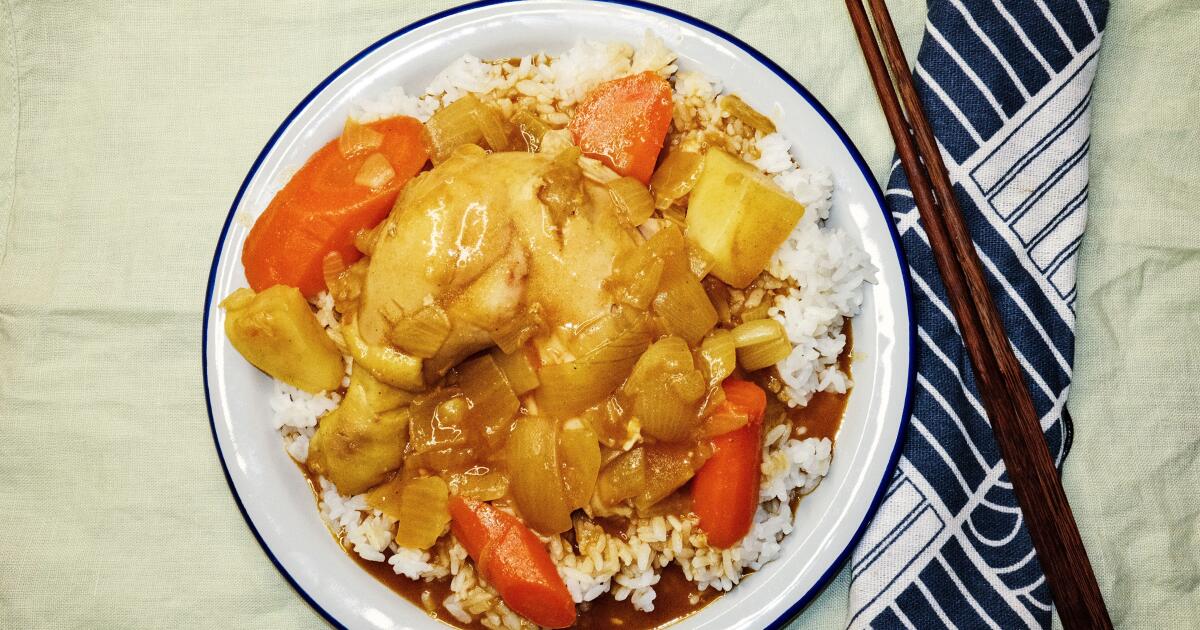
If you’re looking for comfort in food form during these cold, rainy days, try Japanese curry. Here’s a whole-chicken recipe to get you started, written by a chef devoted to Japanese cuisine and his heritage. Included, too, are a few other Japanese recipes for hearty, cozy fare to warm you.
Eating out this week? Sign up for Tasting Notes to get our restaurant experts’ insights and off-the-cuff takes on where they’re dining right now.
Yakitoriguy’s Whole-Chicken Japanese Curry
Local chef and online personality Yakitoriguy gained a following through his educational series and dinner events devoted to yakitori, or grilled chicken, but he also holds the iconic Japanese curry near to his heart. Here, he shares his recipe for whole-chicken Japanese curry, which feeds a small army and freezes beautifully.
Get the recipe.
Cook time: 1 1/2 hours. Serves 6 to 8.
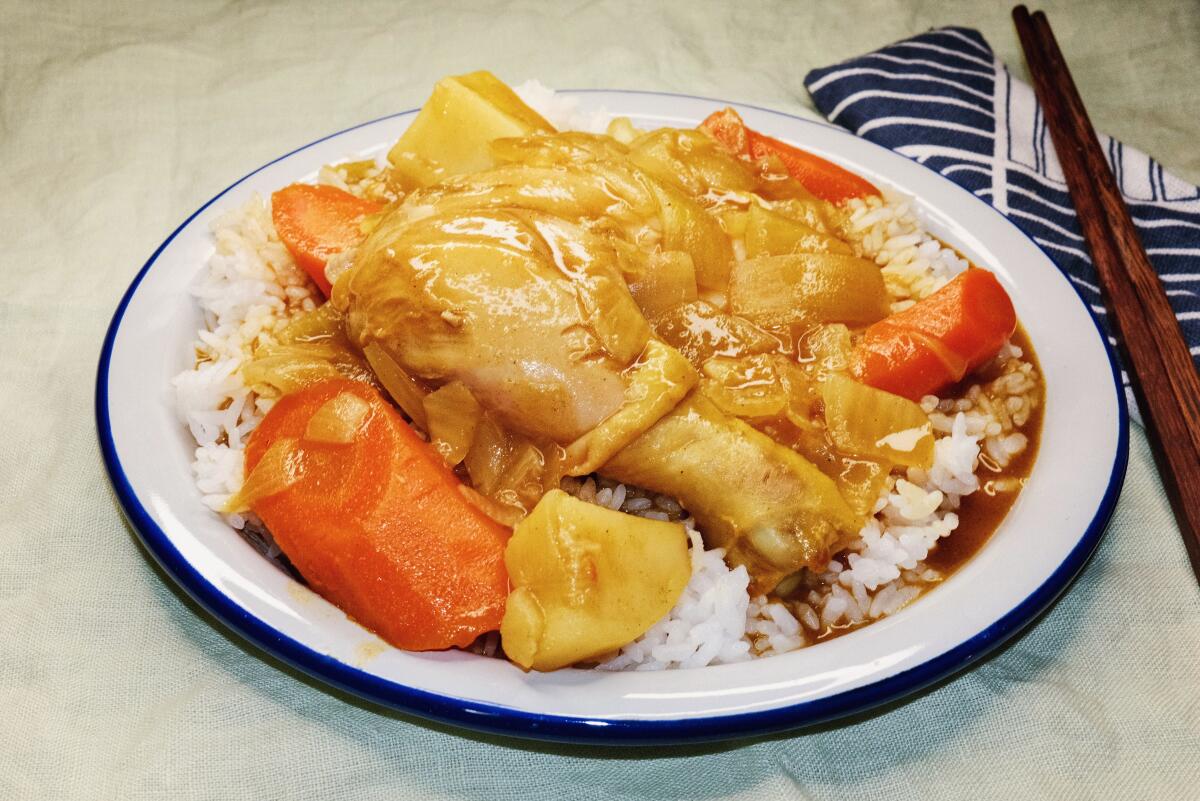
(Stephanie Breijo / Los Angeles Times)
Dashi-Maki Tamago (Home-Style Japanese Omelet)
Just as comforting and beloved as Japanese curry is dashi-maki tamago, a fluffy, light, savory omelet made complex with a hint of dashi.
Get the recipe.
Cook time: 1 hour, 15 minutes. Serves 4.
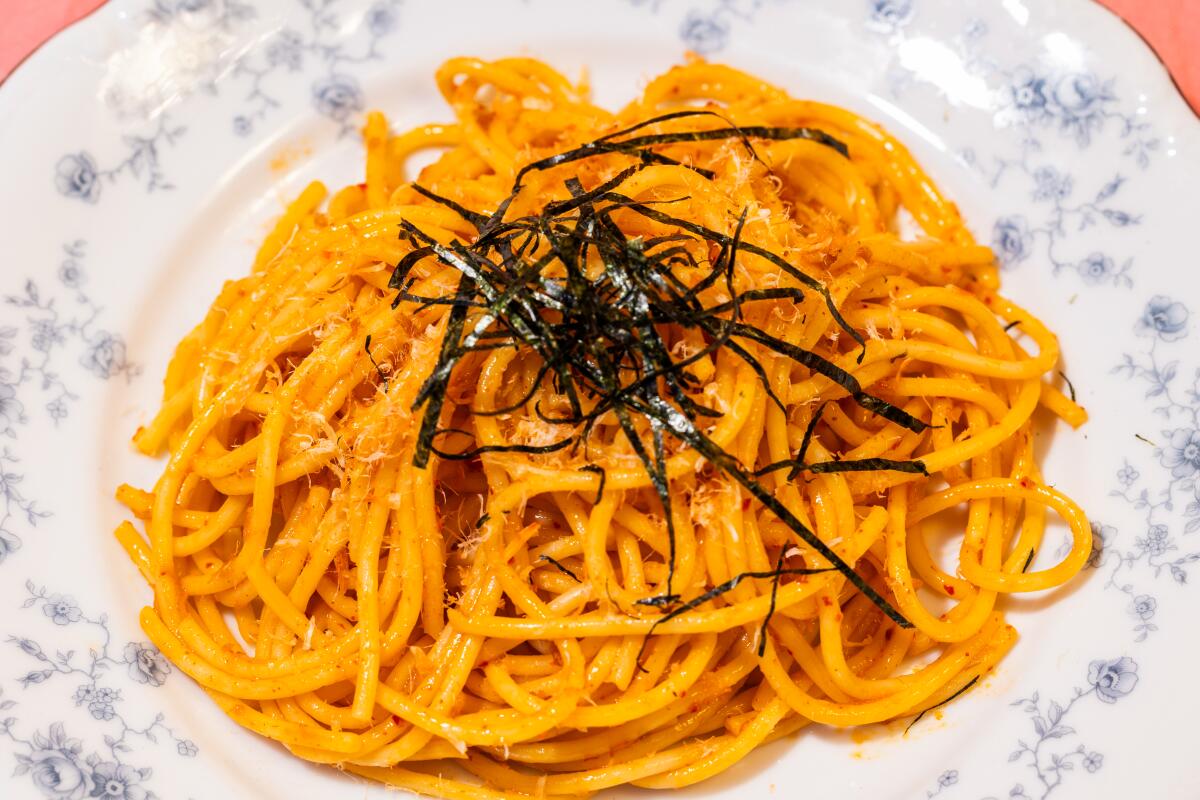
Diep Tran’s Buttered Spaghetti With Dried Shrimp And Sake
For another Japanese recipe that’s a comforting, cold-weather winner, look to journalist Diep Tran’s spaghetti inspired by mentaiko pasta. Swapping dried shrimp for cod roe adds new depths of flavor in a sauce that comes together quickly with butter and sake.
Get the recipe.
Cook time: 20 minutes. Serves 4 to 6.
(Zoe Cranfill / Los Angeles Times)