
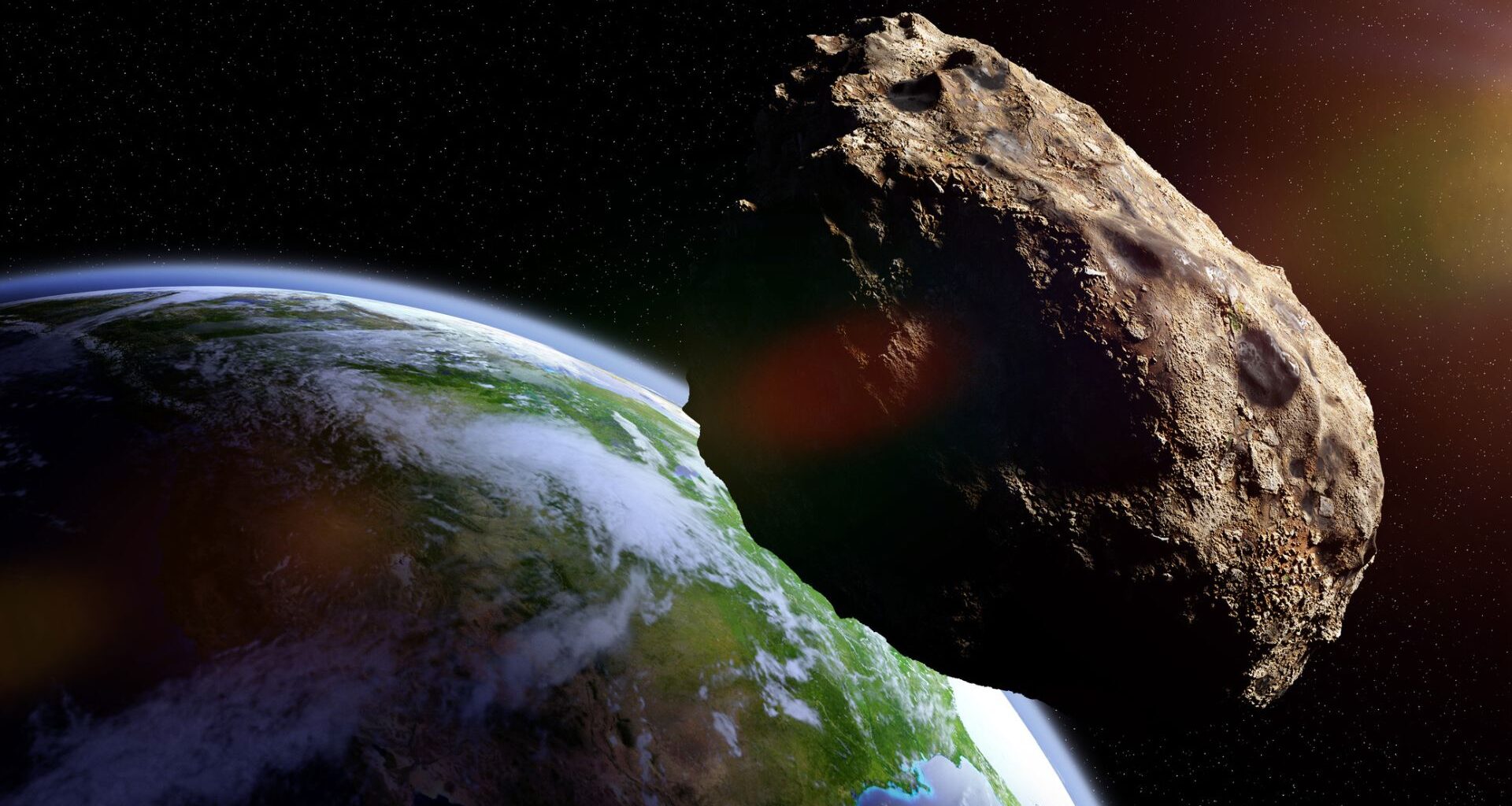
On February 15, 2013, the people of Chelyabinsk, Russia, witnessed something terrifying. A six-story-tall asteroid weighing nearly 10,000 metric tons tore through the atmosphere at more than 64,000 km/h. Just 19 to 24 km above the city, it exploded with a force 30 to 40 times stronger than the Hiroshima atomic bomb.
The blast shattered thousands of windows, damaged 7,200 buildings across six cities, and injured more than 1,500 people, mostly from flying glass, as curious observers who rushed toward their windows to see the brilliant flash. It is a miracle that no one died.
Asteroids do not hit Earth often, but when they do, as the Chelyabinsk event was a reminder, we are vulnerable. The consequences range from local destruction to regional devastation. The next time one comes, will we be ready? The answer somehow sounds like a sci-fi plot. It is a growing planetary defense system built by astronomers, space agencies, and even citizen scientists worldwide.
How asteroids reach Earth
Asteroids are ancient remnants from over four billion years ago. Some formed from cosmic dust that never grew large enough to become planets, while others are fragments left behind by collisions between larger rocks. These objects orbit the Sun, sometimes in stable paths, sometimes on unpredictable ones.
An asteroid only becomes a threat when its orbit intersects Earth’s. Whether it reaches the ground depends on three factors. Angle, composition, and size.
Chelyabinsk was a lucky example. Its shallow entry angle caused it to explode in the atmosphere before hitting the ground. Yet the shock wave still had the power to blow out windows across a massive region.
Its composition also mattered. The Chelyabinsk and Tunguska meteors were made of stone. Fragile enough to break apart during entry. The Tunguska event of 1908 flattened 2,150 km² of Siberian forest with a blast strong enough to toss people through the air, but because it was a stony asteroid and exploded high above a remote area, no one died. An iron-rich asteroid of similar size would have plowed through the atmosphere and hit the ground, causing far deeper destruction.
But the most important factor of all is size. An object five meters across, roughly the size of a car, can survive its descent. At 100 meters wide, an asteroid has a near-certain chance of reaching the surface. The heat of impact alone can melt the ground, ignite fires, and trigger seismic tremors. If it hits the ocean, the resulting tsunami could devastate coastal regions.
Larger city-killer asteroids, like the 160-meter-wide Dimorphos, could obliterate entire urban centers. A strike on London would produce a crater 1.6 km wide and 320 meters deep, level buildings throughout the city, and unleash a lethal air blast afterward. Asteroid impacts are rare, but the consequences are too great to ignore. That is why global monitoring efforts matter.
In 1998, the U.S. Congress assigned NASA a new mission. Identifying and tracking near-Earth objects (NEOs) one kilometer wide or larger. In 2005, the mandate expanded to include all NEOs larger than 140 meters, which is the threshold for potentially devastating impacts. Since then, NASA has cataloged more than 30,000 NEOs and discovered hundreds more each year.
One of the most important observatories in this effort sits atop Mount Lemmon in Arizona. Its powerful camera scans the night sky, capturing wide-field images. Software analyzes each frame to detect moving objects. Any new discovery is cross-checked against existing catalogs. If it is new, astronomers calculate its orbit and send the data to the Minor Planet Center at Harvard.
The Mount Lemmon telescope is just one part of a global network. Astronomers around the world, professionals and hobbyists, report their findings to the Minor Planet Center. This includes contributors from the Planetary Society, an international community that encourages space research and public participation. Led in part by science communicator Bill Nye, the Society helps coordinate amateur observations worldwide.
These combined eyes on the sky help confirm new asteroids quickly. When the Minor Planet Center learns of a new discovery, it alerts the network. Observers worldwide then submit their sightings. More sightings mean more data points, and more data points make orbital calculations more accurate.
One program that excels at this is Spacewatch, operating from Kitt Peak National Observatory. Its 0.9-meter telescope specializes in follow-up tracking. It can record an asteroid’s motion across four data points in about 20 minutes. Combine that with data from observers in other parts of the world, and astronomers can determine an asteroid’s path with high precision.
All collected information is sent to NASA’s Center for Near-Earth Object Studies (CNEOS). CNEOS analyzes the orbits of 1.3 million NEOs by reconstructing their trajectories forward and backward through time. Each asteroid is classified as low or high risk based on the probability of an impact with Earth within the next century. The system can also identify objects on potential collision paths within 15 to 30 minutes of detection, which is critical for emergency response.
But orbit predictions alone aren’t enough. To understand whether an asteroid will burn up, shatter, or hit the ground intact, scientists need to know its density, rotation, and surface shape. Radar systems help answer these questions by sending electromagnetic waves toward passing NEOs. The waves bounce back, distorted by the asteroid’s texture and shape. These distortions reveal details about composition, size, and even spin rate, vital clues for determining whether an asteroid could survive atmospheric entry.
The next stage of detection: The NEO surveyor
Despite this global vigilance, Earth’s defenses have major blind spots. Many asteroids are darker than coal and reflect almost no visible light, making them nearly impossible to detect from the ground until they are very close. Ground telescopes also cannot scan the entire solar system due to atmospheric limitations and the reliance on reflected sunlight.
To close this gap, NASA is building the Near-Earth Object Surveyor, a space telescope designed to detect asteroids using infrared rather than visible light. Its infrared sensors will detect both bright and extremely dark objects up to 30 million miles from Earth, far beyond the range of ground observatories.
Scheduled to launch after 2027, it will search for 5 years to identify two-thirds of all NEOs larger than 140 meters. Once operational, NEO Surveyor will be a monumental step toward fulfilling Congress’s requirement of detecting 90 percent of city-killer asteroids.
Turning detection into defense
Finding an asteroid is only the first step. Stopping one is something else entirely. In 2021, NASA took the first major step toward an active planetary defense with the Double Asteroid Redirection Test, or DART. Its mission was simple. Crash a spacecraft into an asteroid to see if it could nudge it off course.
The target was Dimorphos, a 160-meter moonlet orbiting the larger asteroid Didymos. Dimorphos was not a threat to Earth, but its size made it an ideal test subject. DART launched aboard a SpaceX Falcon 9 in November 2021 and traveled nearly a year before reaching the asteroid system 11 million km from Earth.
Despite being only a meter-wide box with expandable solar arrays, DART used its ion propulsion system to accelerate toward Dimorphos at 6.6 km/s. NASA expected the impact to shorten Dimorphos’s orbit around Didymos by at least 73 seconds. Instead, the orbit shrank by 32 minutes. The mission exceeded expectations and proved that even a relatively small spacecraft can alter the trajectory of a much larger object, provided it has sufficient warning time.
Other nations are beginning similar projects. China plans its own asteroid-deflection mission before 2030, possibly as early as 2027. Russia has proposed repurposing its powerful RS-28 Sarmat missile, capable of carrying multiple warheads, as a potential asteroid interceptor.
NASA has also explored several theoretical alternatives. A massive spacecraft could act as a gravity tractor, tugging an asteroid off course through mutual gravitational pull. Another idea is the ion beam deflector, in which a spacecraft’s engines continuously blast an asteroid with ions to push it off a collision course gently. And then there is the classic but controversial option. Using a nuclear device to vaporize part of an asteroid’s surface and force it off its trajectory.
Why vigilance still matters
Asteroids rarely hit Earth, but they come close more often than most people realize. In August, a meteorite exploded over New Jersey and punched through a home. Soon after, a skyscraper-sized asteroid named 2025 FA22 passed Earth at just twice the distance between Earth and the Moon. A close call for an object once listed among NASA’s highest-risk threats.
In another case, an asteroid passed at a quarter of the Earth-Moon distance, and NASA discovered it only two days beforehand. The odds of a catastrophic impact in any given year are low. But they are not zero. With thousands of NEOs still undiscovered and some detected only days before passing Earth, continuous monitoring remains our greatest shield. Earth’s man-made defense system is still evolving, but it is no science fiction. It is a real, coordinated, international mission to protect our world.