
Born a year apart, 250 years ago, a Covent Garden barber’s only son and a Suffolk mill owner’s fourth child grew up to become the greatest artists England ever produced.
Nothing in their families in 1775-76 presaged such a thing. But amid convulsions shaking the nation in the next half century — Napoleonic wars, industrial revolution, land reforms, expanding empire — two self-made men transformed painting and defined ideas of Englishness which are still potent today.
Tate Britain’s Turner and Constable: Rivals and Originals tells that exhilarating story. It celebrates landscape as their new area of opportunity, obsession and battleground, explores their stunningly different approaches, and dramatises how competition stimulated daring and experiment.
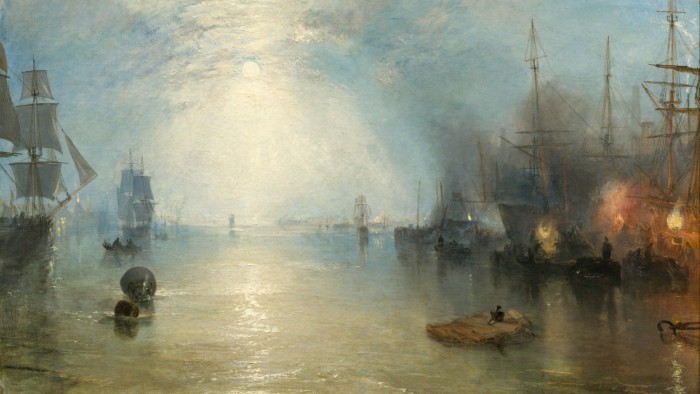
Although most works are from British collections, dazzling American loans lift the show above the familiar. JMW Turner imports include magnificent examples of the artist converging ancient and modern time and nature’s elemental power. On loan from Washington’s National Gallery of Art, “Keelmen Heaving in Coals by Moonlight” is an industrial nocturne charged with mystery in the double lustre of orange firelight and iridescent moon illuminating the Tyne, a composition based on Claude’s classical “A Seaport”. Meanwhile Yale Center for British Art’s “Staffa, Fingal’s Cave” depicts a geological wonder reached by a brand new steamer.
 ‘The White Horse’ (1819) by John Constable © The Frick Collection, New York
For John Constable, the sequence of glorious, vital “six-footers”, portraying barges and flickering reflections on the River Stour, unfolds thanks to the Frick’s pitch-perfect, serene “The White Horse”, and the airy “View on the Stour near Dedham”, on loan from California’s Huntington Library — light cumulus clouds, swallows skimming water, exquisitely delineated reeds, lilies. They join the turbulent, nervously painted “The Leaping Horse”, pigment slapped on with a palette knife, to show how the six-footers, begun early in Constable’s ecstatic marriage, changing tone when his wife Maria became deathly ill, brought autobiographical expressiveness to landscape. “Painting is but another word for feeling”, Constable said.
All this is heralded in the opening pair of lovely, youthful scenes of towers and winding waterways. Constable’s day-bright silvery trees frame the Stour meandering to the village and church in “Dedham Vale” (1802). Turner’s hillside rivulet bubbles down from a ruined medieval keep in “Dolbadarn Castle” (1800); by a stream, soldiers and an imprisoned Welsh prince glow in the twilight.
 ‘Vale of Dedham’ (1828) by Constable © National Galleries of Scotland
So the rivals set out their stall: fresh, sparkling renderings of everyday scenes, innovative in their large scale, and sublime romantic landscapes incorporating history and myth. In alternating galleries, Tate highlights aspects of each career — Constable’s cloudscapes, Turner’s vertiginous watercolours of glaciers and mountains — then brings the artists head-to-head.
Precocious Turner quickly scintillated. Elected Royal Academician at 26, he had already won admiration in his teens; a rarity, “The Rising Squall, Hot Wells, from St Vincent’s Rock, Bristol” (1792) — recently discovered, it sold for £1.9mn in July — depicts storm-tossed vessels on the river Avon in scumbles of half-opaque colour. Life-long, Turner would manipulate such layers of thin, wet glazes, eventually blending forms into glistening hazy effects as in, 50 years later, the translucent veils through which the morning star is mirrored in Lake Lucerne in “The Blue Rigi” (1842).
 ‘Shade and Darkness — the Evening of the Deluge’ (1843) by Turner © Tate
“Atmosphere is my style, indistinctness my fault,” Turner declared. Dissolving the world into light, steam, fog, he made landscape epic. Human ambition is vanquished by nature — tiny silhouetted figures in a blizzard — in “Snow Storm: Hannibal and his Army Crossing the Alps”. The spinning vortex “Shade and Darkness — the Evening of the Deluge” insists on man’s cosmic insignificance. Sun blazes temples and triumphal arches into blurs, closing a golden age, in “Ancient Italy: Ovid Banished from Rome”. As natural forces overpower man, these imperious paintings overwhelm the viewer.
Constable, whose subject was lived reality not enchanted visions, found his way more slowly; he sold only 20 paintings in England in his lifetime, and was 52 when elected to the Royal Academy. While Turner the restless entrepreneur traversed Europe, tapping the burgeoning tourist market, Constable doggedly homed in on his childhood terrain and its pastoral rhythms.
 Constable’s ‘Rainstorm over the Sea’ (c1824-1828) © Royal Academy of Art
“The Valley of the Stour at Sunset”, capturing shifting light in sweeping banks of pastel, is dated October 31 1812, denoting the end of harvest-time. Painted outdoors, “Flatford Mill” surveys the Stour flowing through his father’s land one summer day in 1816, trees in full leaf, wind rustling, a tow-horse waiting on the gravel path where Constable inscribes his signature, like a boy carving his name in the earth with a stick. “The sound of water escaping from mill dams, willows, old rotting planks, slimy posts and brickwork, I love such things. These scenes made me a painter,” Constable said.
“There isn’t a Turner that doesn’t somehow fly and there isn’t a Constable that doesn’t burrow,” Frank Auerbach suggested. Even when Constable’s spires pierce the sky, as in “Salisbury Cathedral”, you sense, as Auerbach says, that “he seems to have walked every path . . . Everything has been worked for and made personal . . . Constable’s own body is somehow inside the landscapes”.
The ultimate face-off, Turner’s “Fighting Temeraire”, voted the nation’s favourite painting in a 2005 BBC poll, versus Constable’s “The Hay Wain”, which came second, remains at the National Gallery. But Tate reprises a celebrated 1831 confrontation, between Constable’s febrile “Salisbury Cathedral” — quivering trees, raindrops glinting on brambles, glassy river, pellucid rainbow — and Turner’s invented sunset vista “Caligula’s Palace and Bridge”. Critics at the time marvelled at “Turner’s fire and Constable’s rain”, declared that Constable was “all truth” and Turner “all poetry”, though the paintings also share much: majestic composition, exaltation of nature, nostalgic sentiment.
 ‘The Valley of the Stour at Sunset’ (1812) by Constable
So who wins? I enjoyed changing my mind. Midway, when the six-footers meet Turner’s clotted historical fantasies such as “The Fifth Plague of Egypt”, Constable’s breezy energetic naturalism triumphs, and his truth-to-nature often makes Turner’s theatricality — “Juliet and her Nurse” in a flaming Venice, for example — look overwrought, even fake.
But Constable never fully recovered his verve after Maria’s death, and Turner had the luck to live longer. Although the broken surfaces and fabulous sprinkled white glittery light in Constable’s last works — Washington’s Phillips Collection’s “On the River Stour”, the Art Institute of Chicago’s “Stoke-by-Nayland”, both finished 1837, the year he died — demonstrate radical freedom, they don’t compare to the miracle of late Turner taking painting to the brink of modern abstraction.
 ‘St Benedetto, Looking towards Fusina’ (1843) by Turner © Tate
Revisiting a 1798 sketch, “Norham Castle: Sunrise” (1845) is a ghostly oil painting whose smudgy blue building and ochre shores melt in the sun’s rays into pools of opalescent colour, as cows, spectral outlines, arrive for their morning drink. In the Venetian sunset “St Benedetto, Looking towards Fusina” (1843), waterside buildings tremble like a mirage under coruscating white-yellow pigment; funereal black gondolas float by. Paint, no longer strictly descriptive, conveys themes of lost time, fugitive memory, falling empires. “Without one single accurate detail,” Ruskin said, this painting by Turner was “the likest thing to what it is meant for . . . of all that I have ever seen.”
To April 12 2026, tate.org.uk
Find out about our latest stories first — follow FT Weekend on Instagram, Bluesky and X, and sign up to receive the FT Weekend newsletter every Saturday morning