
 Credit: DGA Essais de Missiles Site Landes
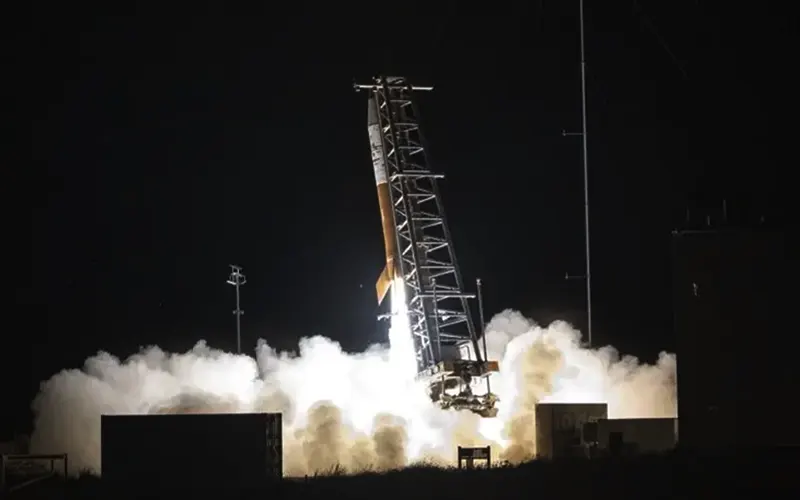
ArianeGroup has launched the first flight of its SyLEx rocket from the Directorate General of Armaments (DGA) Missile Testing Centre in Biscarrosse.
The DGA contracted ArianeGroup to begin working on the multi-use suborbital launch system in 2021. According to a DGA press release dated 28 November, SyLEx (Système de Lancement d’Expériences, or Experimental Launch System) is designed to provide a sovereign capability for in-flight testing of new technologies in support of French strategic deterrence, the development of hypersonic demonstrators, and civilian applications.
SyLEx is powered by ArianeGroup’s in-house-developed SPARK solid-propellant motor, which carries approximately two tonnes of propellant and produces up to 325 kN of thrust. The single-stage variant stands 10 metres tall, has a launch mass of 3.3 tonnes, and can reach altitudes of up to 200 kilometres. The two-stage SyLEx rocket will stand 15 metres tall, with a launch mass of 6.5 tonnes, and will be capable of reaching altitudes of up to 400 kilometres.
Both variants have a maximum payload capacity of 600 kilograms. The payload section features a jettisonable fairing, onboard telemetry, and a configurable volume, supporting a wide range of mission applications.
The DGA and ArianeGroup launched the first successful SyLEx mission from the DGA Missile Testing Centre in Biscarrosse late on 27 November. The rocket carried an ArianeGroup experimental payload, which the company described simply as “a technological integration and demonstration platform.” According to a DGA release, the flight “confirmed the critical phases of lift-off and in-flight tracking.”
“This successful first flight secures sovereign testing capabilities for France using sounding rockets,” said Vincent Pery, ArianeGroup Director of Defence Programmes. “SyLEx has been designed and built by ArianeGroup teams in under three years, based on test-and-learn methods. Thus, DGA’s renewed confidence in ArianeGroup’s expertise enables France’s autonomy and sovereignty in suborbital launch capabilities. We are already advancing to the next phase of our incremental roadmap: the two-stage version.”
The first flight of a two-stage SyLEx variant, which ArianeGroup refers to as SyLEx Block 2, will only occur in 2027.
In addition to SyLEx, ArianeGroup has also been contracted by the DGA to develop the V-MAX hypersonic glider. This type of vehicle is designed to detach from a rocket, skim through the upper atmosphere at speeds above Mach 5, and perform sharp manoeuvres, making it far more challenging to track and intercept than a conventional warhead.
The V-MAX glider completed its first flight test in June 2023 using an American-made sounding rocket. During a February 2025 hearing before the French Senate, ArianeGroup CEO Martin Sion confirmed that future trials would be conducted with a “French sounding rocket that we are developing.” With SyLEx now operational, V-MAX is expected to become one of its earliest strategic payloads, marking a key step toward full French sovereignty in hypersonic-flight testing.
Keep European Spaceflight Independent
Your donation will help European Spaceflight to continue digging into the stories others miss. Every euro keeps our reporting alive.