
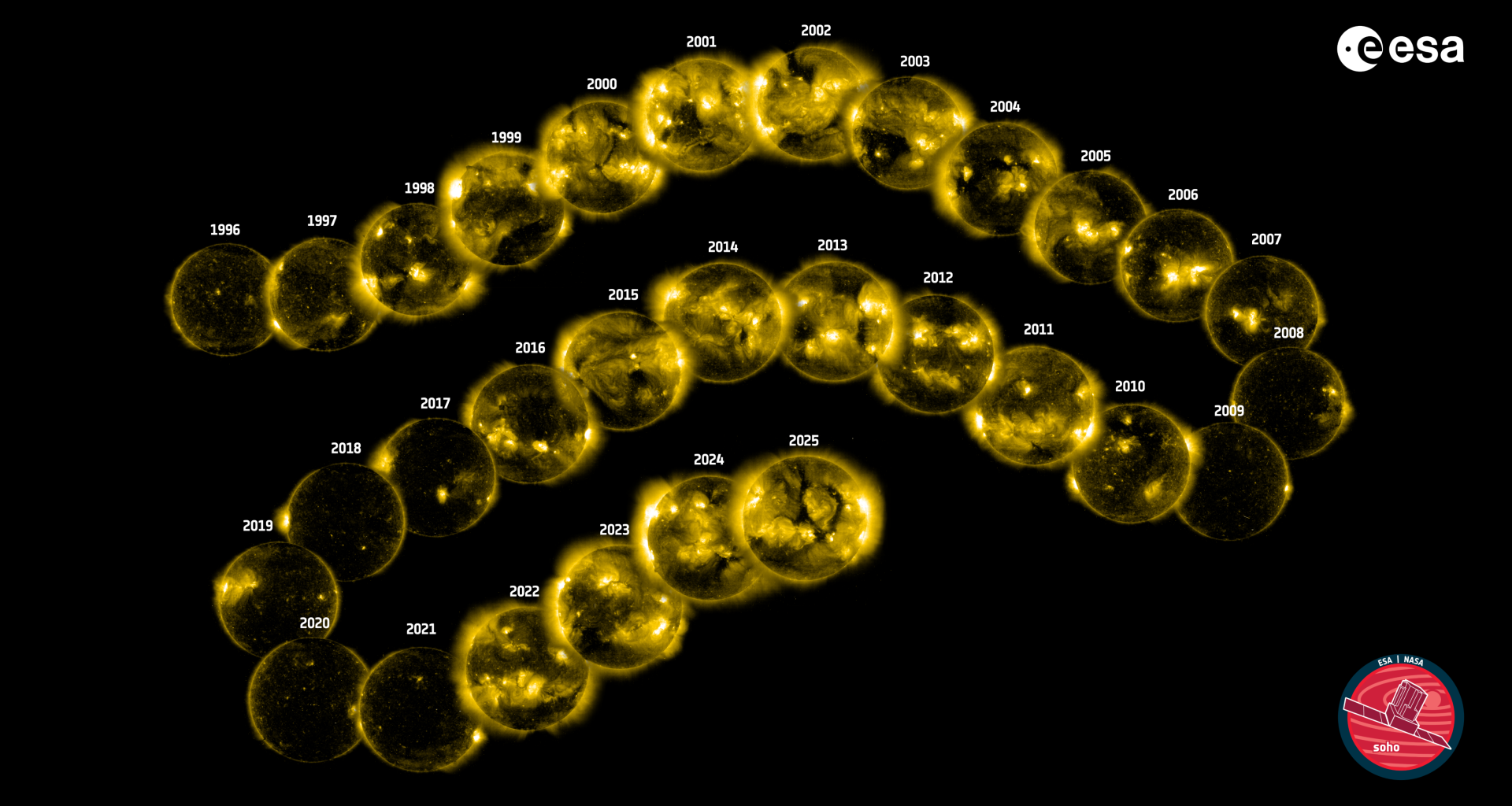
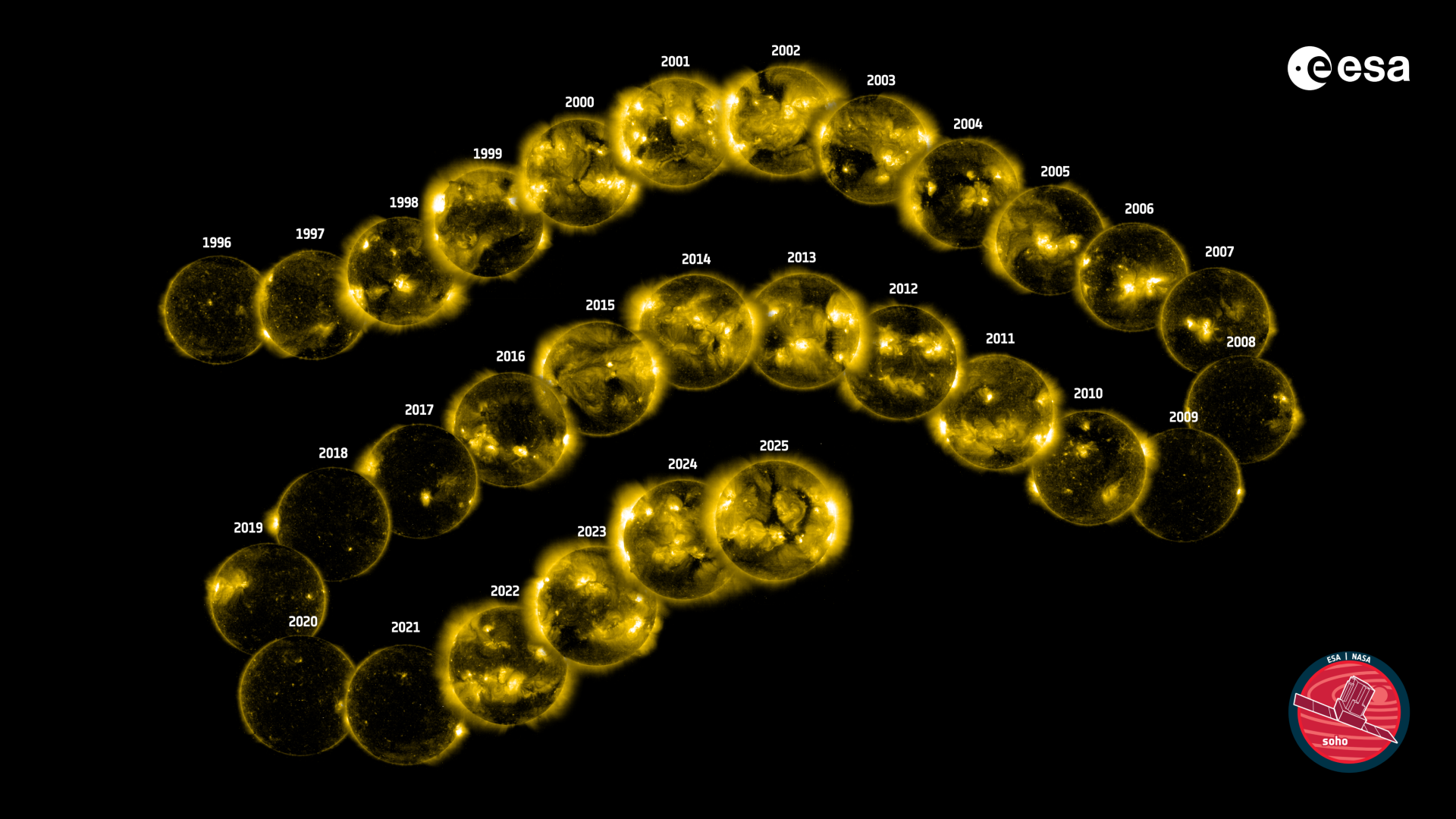
The ESA/NASA Solar and Heliospheric Observatory (SOHO) has been observing the sun for 30 years. In that time, SOHO has observed nearly three of the sun’s 11-year solar cycles, throughout which solar activity waxes and wanes. (Image credit: SOHO (ESA & NASA)/F. Auchère & ATG Europe)
On Dec. 2, 1995, NASA and the European Space Agency launched the Solar and Heliospheric Observatory (SOHO) into orbit, hoping to study the sun “from the inside out.” The spacecraft now sits in the sun-Earth L1 Lagrange point, about 932,000 miles (1.5 million km) closer to the sun than Earth, giving it an almost interrupted view of our home star, as this composite image of snapshots from throughout its three decades shows.
What is it?
Carrying 12 different instruments, SOHO was designed to study the sound waves rippling from the sun to learn about its structure and dynamics. It also measures the sun’s mysterious corona, which is hotter than the surface of the sun, yet farther away, a puzzle that still has scientists scratching their heads.
The SOHO spacecraft has also captured various solar flares and coronal mass ejections over the decades, which affect space weather and cause beautiful auroras across Earth’s poles. The sun’s solar cycle is around 11 years long and SOHO has been there for nearly three full cycles now, watching this activity rise and fall throughout the sun’s natural rhythms.
You may like
Where is it?
This image was taken from the L1 Lagrange point where SOHO is located.
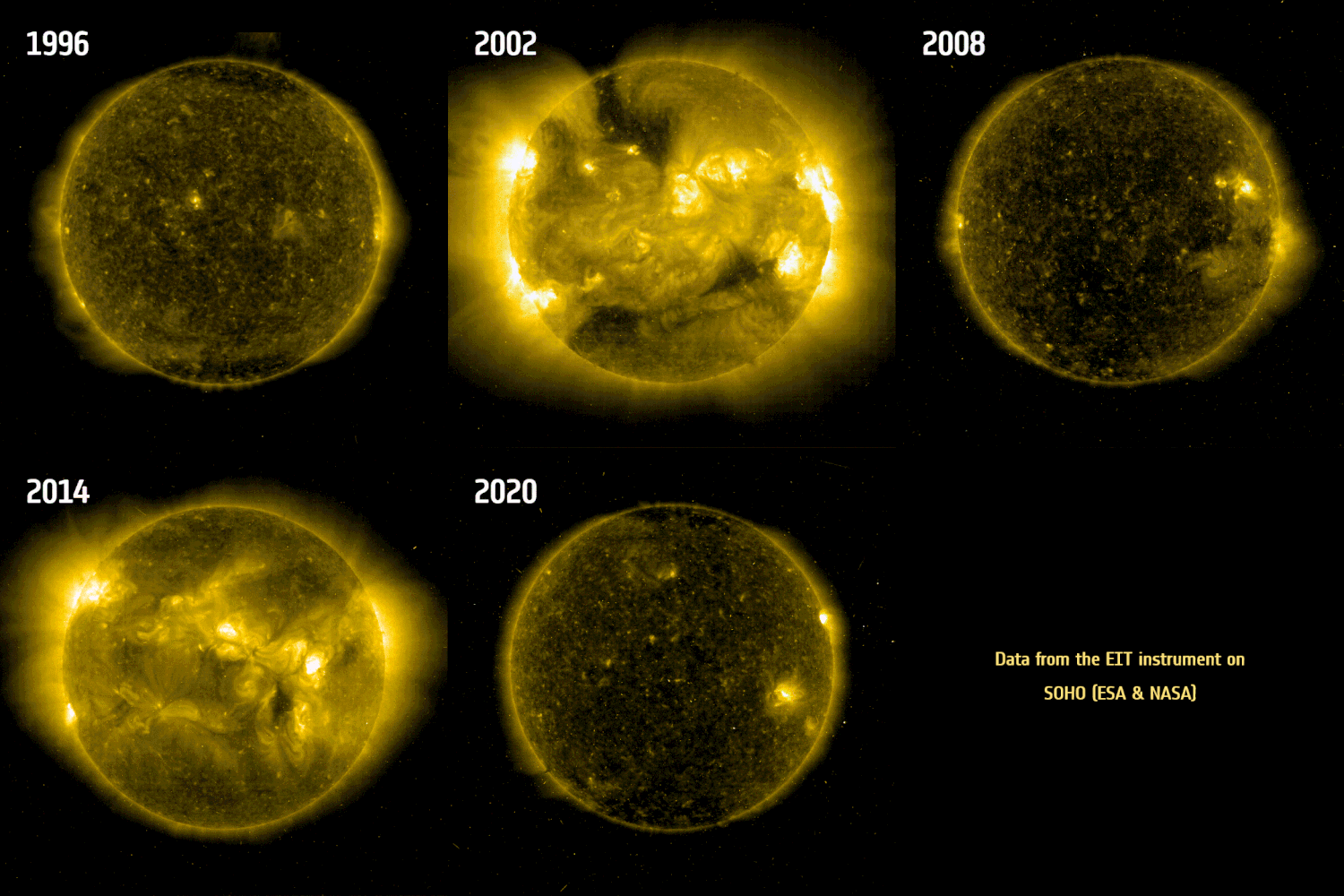
This animation shows thirty different photographs of our sun taken by SOHO throughout its 30-year career. (Image credit: SOHO (ESA & NASA)/F. Auchère & ATG Europe)Why is it amazing?
While SOHO originally exceeded expectations after its 1995 launch, the story wasn’t always smooth. A series of problems in 1998 caused the spacecraft to lose contact, spin and start freezing in space, but engineers eventually located it with ground-based radar and were able to correct the errors.
In its 30 years of activity, SOHO has transformed helioseismology and given scientists their first detailed look at the sun’s corona. Though its original design lifetime was only three years, SOHO’s mission has been extended repeatedly and remains active today.
Along the way, SOHO has also become an unexpected comet hunter. Thanks to the LASCO coronagraph, which block’s the sun’s bright disk to reveal its faint corona, SOHO has discovered over 5,000 comets, as of early 2025, more than any other observatory in history.
“SOHO has overcome nail-biting challenges to become one of the longest-operating space missions of all time,” Prof. Carole Mundell, ESA Director of Science, said in a statement announcing the milestone.
Want to learn more?
You can learn more about SOHO’s mission and the sun’s solar cycle.