
Unlock the Editor’s Digest for free
Roula Khalaf, Editor of the FT, selects her favourite stories in this weekly newsletter.
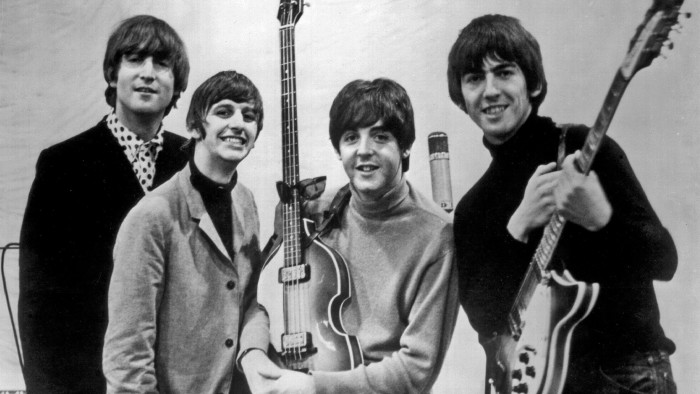
The 1960s was a time of great riff rivalry. Roy Orbison, The Rolling Stones and The Kinks had hits with songs driven by killer guitar riffs. The Beatles competed with each other. Three days after recording Paul McCartney’s “Paperback Writer”, the Fab Four went back into the studio on October 16 1965 to record John Lennon’s “Day Tripper”, which has one of the catchiest and most covered riffs of all time.
Starting in E and moving to A for the second verse line, the riff lies easily under a guitarist’s hands, the notes twisting and unwinding over two bars with hardly a note repeated (hence its unusual tunefulness). The Beatles’ arrangement squeezes maximum drama from the song, with Ringo Starr’s explosive drum fills and a thrillingly shaken tambourine ramping up the excitement.
The verse and chorus are servants to the riff, draping its robust skeleton with jokey, innuendo-laden lines that betray the influence of Bob Dylan, who went electric a few months earlier. The song disses a person who is a “day tripper”, a “one-way driver”, and, with knowing rudeness, a “big teaser”. But unlike, say, Dylan’s moody recordings of “She Belongs to Me”, or “Positively 4th Street”, the backing track actively contests the misanthropic words: “Day Tripper” is a headlong, driving rocker that anglicises the urgent whoop of 1960s Stax and Motown. Ringo lifts the chorus with a four-on-the-snare groove similar to that in the Four Tops’ “I Can’t Help Myself”, a riff-laden hit in the summer of 1965. Like Orbison’s riffy hit “Oh, Pretty Woman” (1964), the Beatles’ track has a momentum that never flags.
The song was released in December 1965 as a double A-side along with “We Can Work It Out” — an interesting title, given that Lennon and McCartney couldn’t agree which song they should release next.
 Nancy Sinatra in 1966 © ABC Photo Archives/Disney General Entertainment Content via Getty Images
Cover versions came thick and fast. Nancy Sinatra was first out of the blocks with a brassy version that reversed genders, repeating some of the tricks — for example, a slippery descending bass break — that arranger Billy Strange and producer Lee Hazlewood had used on Sinatra’s “These Boots Are Made for Walkin’”. Also in 1966, on Complete & Unbelievable — The Otis Redding Dictionary of Soul, the great singer took The Beatles’ vocal lines for a soulful walk. Mae West committed to tape one of the worst ever massacres of a Beatles song on the execrable Way Out West.
The genius of the “Day Tripper” riff is that it sounds good on almost any instrument: on sax and double bass for clever German duo Tok Tok Tok; barked out on brass for Geno Washington; and on piano for Sergio Mendes, who makes it sound like a Latin instrumental classic, with its hint of a Afro-Cuban montuno. Cuban percussionist and bandleader Mongo Santamaría cut at least two instrumental Latin versions. Yellow Magic Orchestra, one of many electronic acts championed by Rusty Egan, the “sonic architect” of the Blitz club (currently celebrated at London’s Design Museum), demonstrated how trippy the riff sounded on synthesisers (1979). Hamburg’s Punkles gave “Day Tripper” a convincing retrofit on Pistol, their album of punkified Beatles covers.
Also in Hamburg, musician and Beatles tour guide Stefanie Hempel, an authority on the group’s history, told me that “1965 was the great Beatles ‘riff’ year, with ‘I Feel Fine’, ‘Ticket to Ride’, etc, showing that they can also be the best ‘hard’ rock band if they want to.”
She points out the influence of Dylan on The Beatles at that time: “Leave the path of kitschy love songs, write in riddles, double meanings. Write about ‘emancipated’ women and put them down at the same time. They were always like sponges, soaking up everything.”
Some “Day Tripper” cover versions downplay the melodious riff. Jazz pianist Ramsey Lewis keeps it low in the mix on his groovy version (1966). James Taylor, on his album Flag (1979), teased listeners by hardly playing it at all, riding out the song with a stomping cocktail of percussion, sawing strings and falsetto vocals: Prince meets Talking Heads.
For sheer originality, it’s hard to beat José Feliciano’s passionate version of “Day Tripper”. Recorded live at the London Palladium in 1969, with flamenco-style acoustic guitar, double bass and percussion, it reaches an intensity that transforms the detached, satirical mood of the original into something ecstatic.
This article has been amended to reflect the fact that The Beatles went into the studio three days after recording ‘Drive My Car’, not as previously stated ‘Paperback Writer’
Let us know your memories of ‘Day Tripper’ in the comments section below
The paperback edition of ‘The Life of a Song: The stories behind 100 of the world’s best-loved songs’, edited by David Cheal and Jan Dalley, is published by Chambers
Music credits: Apple; Motown; Sony; Boots Enterprises; Rhino; Tok Tok Tok; Sanctuary; Universal; Concord; Alfa; Prollhead; BMG