
Sony Semiconductor Solutions has unveiled the LYTIA 901, a 1/1.12-type stacked CMOS image sensor that could fundamentally reshape smartphone camera design. By combining approximately 200 effective megapixels with an industry-first on-chip AI processing circuit, the sensor delivers high-quality 4x digital zoom from a single lens, potentially eliminating the need for dedicated telephoto modules in future flagship devices.
For years, smartphone manufacturers have stacked multiple cameras onto their devices to cover different focal lengths. Wide, ultrawide, telephoto, periscope – the camera bumps keep growing. Sony’s latest sensor challenges this approach head-on. By processing zoom operations directly on the sensor using AI, the LYTIA 901 promises telephoto-quality results without a telephoto lens. The sensor is now shipping in mass production, meaning we could see it in devices within months.
Why digital zoom has always disappointed
The fundamental problem with digital zoom is simple: cropping into an image throws away pixels, and upscaling the result creates artifacts. Software processing can help, but it typically happens on the application processor, introducing latency and limiting what can be achieved in real-time video capture. Previous high-megapixel sensors offered more pixels to crop into, but the quality still degraded noticeably beyond 2x magnification.
Sony’s solution attacks this problem at the source. The LYTIA 901 uses a Quad-Quad Bayer Coding (QQBC) array structure where 16 adjacent pixels (arranged in a 4×4 grid) share the same color filter. During normal shooting, these 16 pixels combine into one, delivering a 12.5MP output with exceptional light gathering. When zoom is engaged, the sensor performs “remosaicing” to unlock individual pixel data from the full 200MP array.
The AI processing advantage
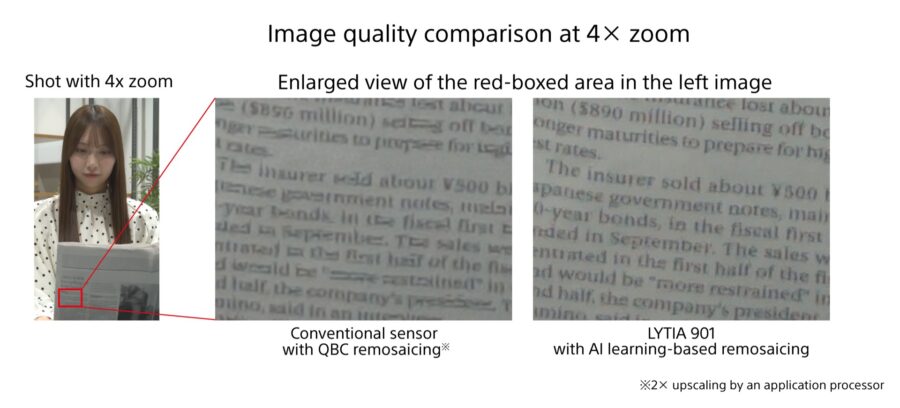
Here’s where the LYTIA 901 gets interesting. Remosaicing QQBC data back into a standard Bayer pattern requires intensive computation, and doing it well means reconstructing high-frequency details that simple algorithms mangle. Sony developed an AI learning-based remosaicing system trained to handle exactly this task, and then did something unprecedented: they built that processing circuit directly into the sensor.
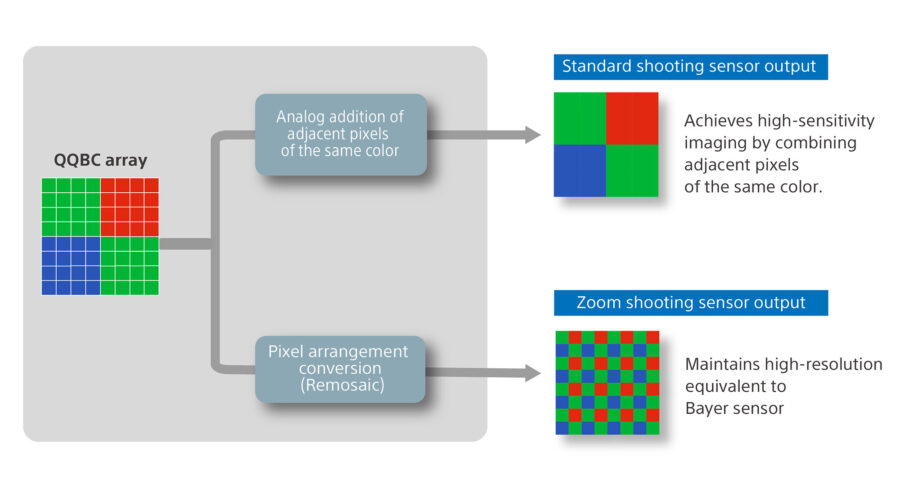 LYTIA 901’s remosaicing has advantages, according to Sony. Image credit: Sony Semicon
The result is genuine real-time performance. The LYTIA 901 captures 4K video at 30 fps while using up to 4x digital zoom, with the AI handling remosaicing on the fly. No external processor bottleneck, no frame rate compromises. Sony claims the AI approach excels at reproducing fine patterns and text that would turn to mush with conventional algorithms.
Dynamic range that rivals dedicated cameras
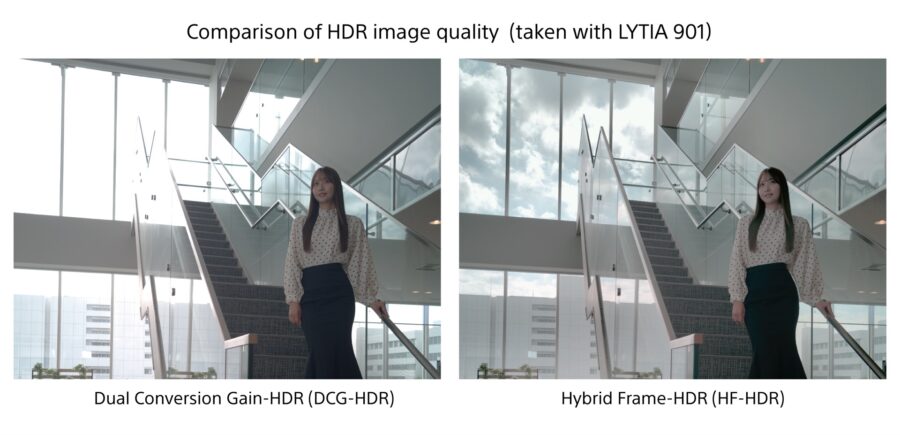
Resolution means nothing if the image falls apart in challenging light. Sony equipped the LYTIA 901 with a stack of HDR technologies designed to preserve detail across extreme contrast scenarios. Dual Conversion Gain HDR (DCG-HDR) reads data at different gain settings within a single frame, while Fine12bit ADC technology increases quantization depth from 10 bits to 12 bits for improved tonal gradation.
The headline figure comes from Hybrid Frame-HDR (HF-HDR), which composites short-exposure frames with DCG data via post-processing. Sony claims this delivers dynamic range exceeding 100 dB in 16-pixel additive mode. For context, that approaches the performance of some cinema cameras and dramatically outperforms what most smartphone sensors can achieve today.
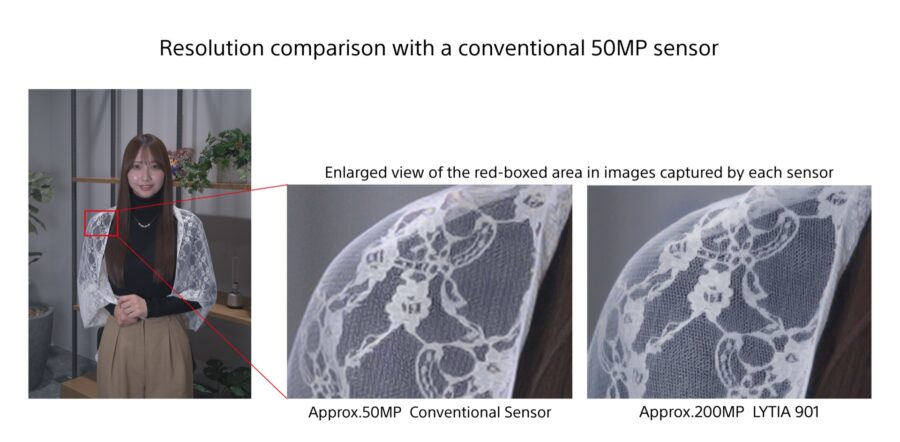 Sony shows examples where LYTIA 901 should shine in comparison. Image credit: Sony SemiconFrame rates for serious video work
The sensor’s output flexibility matters for anyone shooting video on mobile. At full 200MP resolution (4:3 aspect ratio), the LYTIA 901 captures at 10 fps using Full RAW output. More practical for motion work, 50MP output via 2×2 binning reaches 30 fps, while 12.5MP (4×4 binning) hits 60 fps.
Video-specific modes in 16:9 aspect ratio include 8K at 30 fps using 2×2 binning, and 4K at up to 120 fps with 4×4 binning. All readout modes retain all-pixel autofocus capability. These specifications put the LYTIA 901 in territory previously reserved for dedicated video-focused sensors.
 Sony shows examples where LYTIA 901 should shine in comparison. Image credit: Sony SemiconWhat this means for smartphone design
The implications extend beyond image quality. If a single sensor can genuinely match or exceed what current multi-camera systems achieve, manufacturers gain significant advantages. Slimmer camera bumps become possible. Internal space opens up for larger batteries or other components. Bill of materials costs drop. Design teams gain flexibility.
Of course, ultrawide angles still require separate optics, and true optical zoom offers benefits that computational approaches cannot fully replicate. But for the vast majority of users who zoom between 1x and 4x, the LYTIA 901’s approach could prove more than sufficient. The triple-camera formula that has dominated flagship smartphones since 2019 may be facing its first serious challenge.
 Sony shows examples where LYTIA 901 should shine in comparison. Image credit: Sony SemiconTechnical specifications
The LYTIA 901 uses a 0.7 μm pixel pitch on its 1/1.12-type format (14.287mm diagonal). Connectivity includes MIPI C-PHY with 2 or 3 trios at up to 6.0 Gsps per trio, and MIPI D-PHY with 2 or 4 lanes at up to 2.5 Gbps per lane. Power requirements span 2.8V and 1.8V for analog circuits, 0.82V for digital processing, and either 1.8V or 1.2V for the interface.
The Sony LYTIA 901 is shipping now in mass production, with flagship smartphone appearances likely in the coming months. No pricing was disclosed, as is standard for component sales to device manufacturers. If Sony’s claims hold up in real-world testing, we could be witnessing the beginning of the end for bulky multi-camera arrays.
Would you trade a dedicated telephoto lens for AI-powered zoom if the quality matched? Don’t hesitate to let us know in the comments below!