
China is charting an ambitious course for space exploration over the next decade, with new missions outlined as part of its 15th Five-Year Plan (2026-2030). The China National Space Agency (CNSA) is set to push the boundaries of scientific discovery with four groundbreaking missions targeting the Sun, the Moon, and deep space. These initiatives promise to expand our understanding of the cosmos, ranging from the search for Earth-like planets to exploring the early universe.
Exploring the Universe’s Origins: The Hongmeng Project
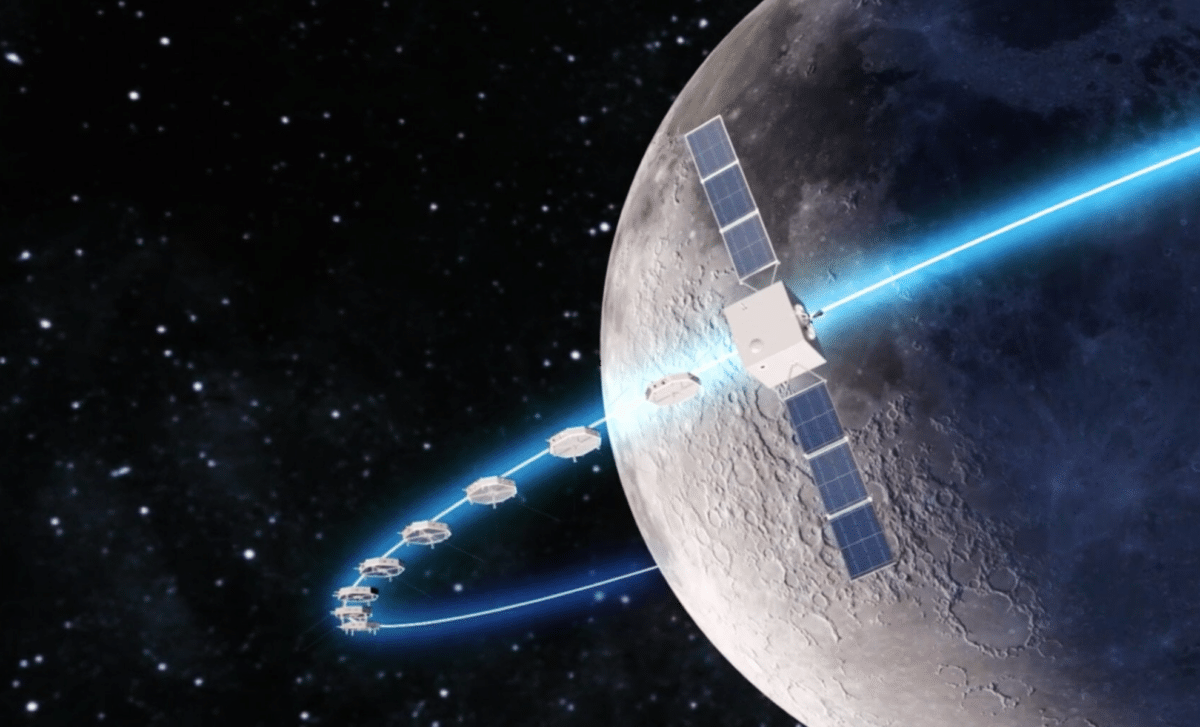
One of the most exciting missions on China’s agenda is the Hongmeng Project, which aims to deploy a network of low-frequency telescopes on the far side of the Moon. This location is crucial because it is shielded from Earth’s radio interference, making it the perfect spot for studying the universe’s early stages. The Hongmeng Project will listen for faint signals from the Cosmic Dark Ages, a time before the first stars formed. These signals, undetectable by conventional telescopes, could shed light on the formation of the earliest structures in the universe. As the video’s narrator suggests, the project is “a colossal cosmic microphone… designed to detect the Universe’s infant cries.”
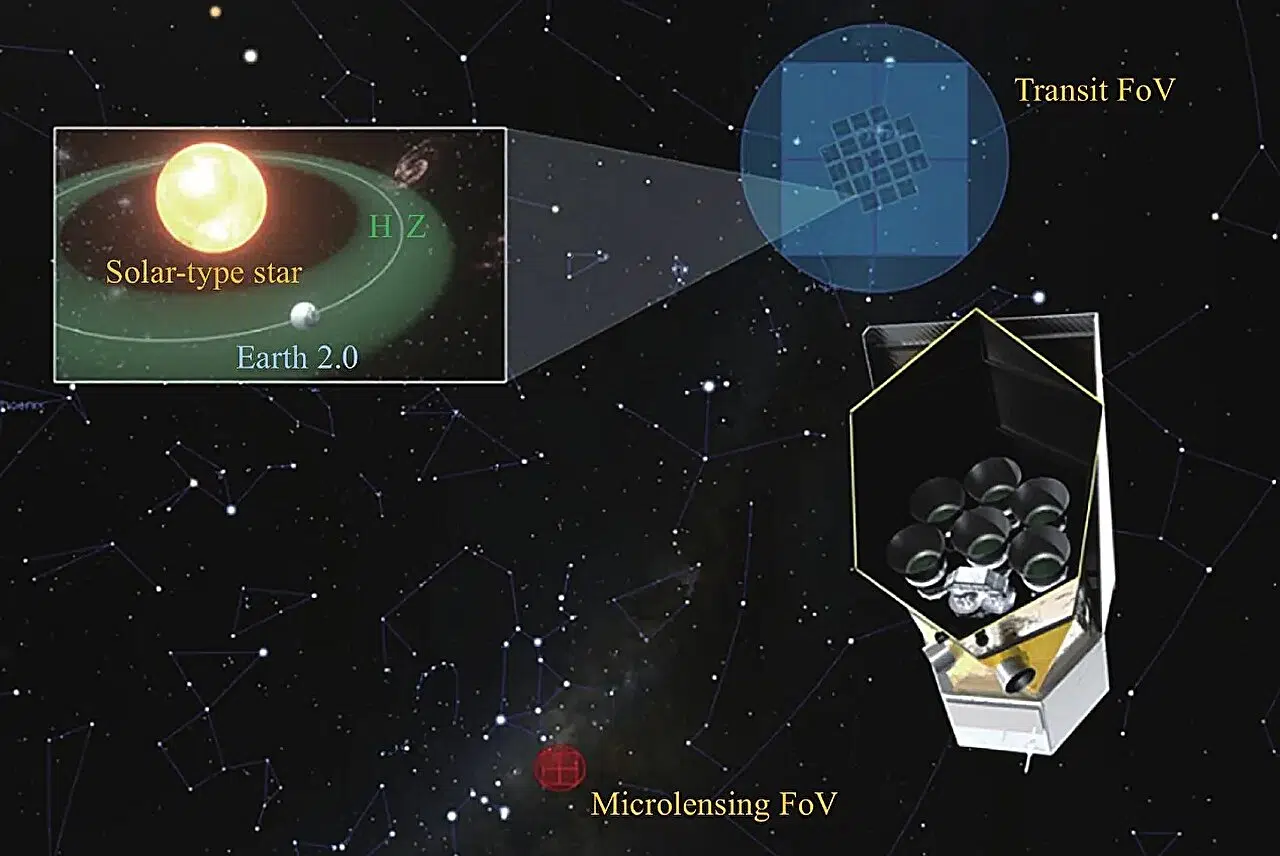 An artist’s impression of the Earth 2.0/ET observatory searching for exo-Earths. Credit: CAS
This ambitious mission complements other advanced observatories, such as NASA’s James Webb Space Telescope, but offers a unique vantage point that promises to uncover new details about the origins of the cosmos. The success of Hongmeng could reveal crucial information about the formation of the universe, potentially answering fundamental questions about the nature of space and time.
A Solar Revolution: The Kuafu-2 Mission
As reported by Universe Today, building on its predecessor, Kuafu-2 is China’s next solar mission, focusing on studying the Sun’s magnetic fields and solar activity. Set to orbit the Sun’s polar regions—an area that is difficult for previous missions to access—Kuafu-2 aims to gather unprecedented data on solar phenomena. “Like a cosmic microscope, it will peer into the Sun’s magnetic heart,” says the narrator in the video shared by CGTN. By investigating solar activity from these polar regions, the mission will provide new insights into solar storms and their potential effects on Earth.
Understanding the Sun’s magnetic behavior and solar cycles is crucial not only for solar science but also for predicting space weather events that can impact satellite communications, power grids, and even astronaut safety. The Kuafu-2 mission promises to revolutionize our understanding of solar dynamics, and its data could provide the key to forecasting space weather with greater accuracy.
The Search for Earth 2.0: Exo-Earth
Perhaps the most exciting project in China’s upcoming space endeavors is the Exo-Earth mission, a satellite designed to search for Earth-like exoplanets—dubbed “Earth 2.0.” This satellite will monitor thousands of stars in our galaxy for planets that are similar in size to Earth and reside within their stars’ habitable zones. Scheduled for launch by 2028, the Exo-Earth mission will be a key player in expanding our understanding of potentially habitable planets beyond our solar system.
The project is part of China’s push to become a global leader in exoplanet research, following in the footsteps of previous missions like NASA’s Kepler Space Telescope and the Transiting Exoplanet Survey Satellite (TESS). If successful, Exo-Earth could provide vital information about the prevalence of Earth-like planets in the galaxy, bringing us closer to answering the age-old question: Are we alone in the universe?
Exploring Extreme Astrophysics: The eXTP Space Observatory
The eXTP Space Observatory, an international collaboration led by China, will focus on exploring some of the universe’s most extreme environments, including the event horizons of black holes, neutron stars, and supernovae. This mission aims to combine X-ray observations with unparalleled timing and polarization capabilities, enabling scientists to study the laws of physics in conditions that cannot be replicated on Earth.
This observatory’s sophisticated instruments, such as Spectroscopic Focusing Arrays and Polarimetry Focusing Arrays, will provide a deeper understanding of how matter behaves under the most extreme conditions. By studying black holes and neutron stars, eXTP will help answer fundamental questions about the nature of gravity, quantum mechanics, and the very fabric of space-time. With a scheduled launch around 2030, this mission has the potential to be one of the most groundbreaking in astrophysics.