
CITES, the global wildlife trade regulation, has agreed to implement stricter rules for the trade in two sloth species increasingly targeted by the tourism industry.Thanks to its peaceful and friendly appearance, sloths are a prime target for tourists to take selfies with, and even for the pet trade, fueling trafficking in their range countries across South and Central America.The new trade restrictions were approved by the recent CITES summit and will come into force within 90 days.A dozen of the proposals presented at the summit covered wildlife species threatened by the illegal pet trade, highlighting what conservationists say is a concerning trend.
See All Key Ideas
Known for their peaceful appearance and the impression that they’re always smiling, sloths now have extra protection to prevent their exploitation by a cruel and illegal pet trade. CITES, the global wildlife trade convention, agreed at its recent summit in Samarkand, Uzbekistan, to include two sloth species in a list that imposes stringent requirements for their international trade.
This means that all 185 parties to CITES (184 countries plus the European Union) will be subject to strict rules including a requirement that exporting countries provide studies proving that the transaction will not affect the species’ conservation.
The two species newly listed in CITES Appendix II are Linné’s two-toed sloth (Choloepus didactylus), native to the Amazon, and Hoffmann’s two-toed sloth (Choloepus hoffmanni), which lives in the southern Amazon and parts of Central America. Two-fingered sloths are known to be more aggressive and faster than their three-toed relatives.
The proposal to strengthen their protection came from Brazil, Costa Rica and Panama, as a way “to prevent illegal trafficking from increasing and its populations from declining.” According to delegates from the three countries, wildlife traffickers have been tearing the sloths from the forests to be presented as attractions in tourist itineraries through South America; some tourists even buy a baby sloth to take home as a kind of exotic pet. Researchers have recorded instances of this illegal trade in public markets in Iquitos, Peru, and Manaus, Brazil.
“Demand for sloth species has increased in recent years, particularly for live animals taken from the wild and destined for the pet trade,” said Nádia de Moraes-Barros, who has studied sloths since the late 1990s and is the scientific coordinator for Freeland Brasil, an NGO that fights wildlife trafficking. The CITES approval reflects “the urgent need to regulate export and import activities,” said Moraes-Barros, who is also deputy chair of the specialist group on sloths at the IUCN, the global wildlife conservation authority.
Traffickers’ preferred targets are baby sloths, whose mothers are often killed to separate them, for exploitation in popular markets across Latin America or for exported to places like the United States, Europe, Asia and the Middle East. Few of them survive the extreme stress of being handled, confined or exposed to noisy crowds, with mortality rates reaching 99%.
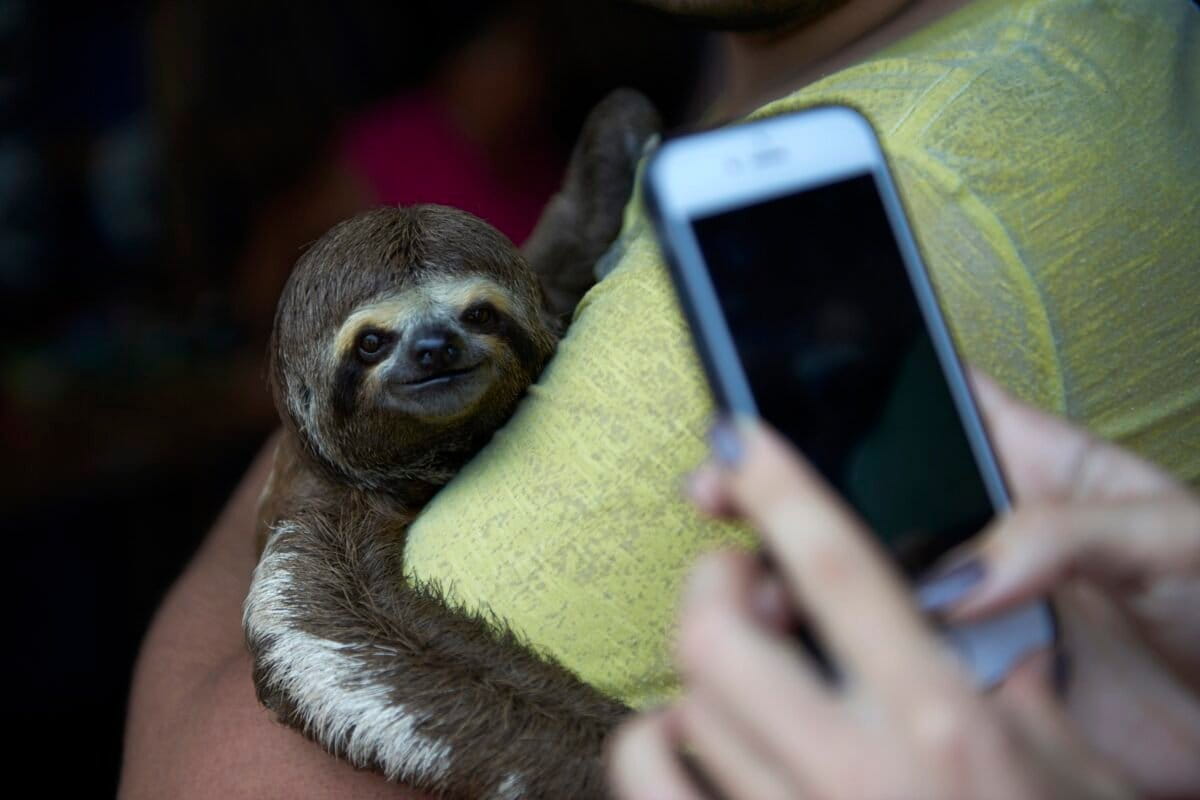 Sloths are displayed to tourists in countries like Brazil, Colombia and Peru. Image courtesy of World Animal Protection/Nando Machado.
The Sloth Conservation Foundation, a nonprofit specializing in wild sloth conservation and research, celebrated the Appendix II inclusion, calling it “an important and long overdue step for sloth protection.”
The Sloth Institute Costa Rica described the decision as “an historic win for sloths” and “a HUGE step in the right direction.” The country, whose national symbol is a sloth, launched the campaign Stop Animal Selfies to raise tourist awareness about the negative impacts of selfies and photos that show direct contact with wild animals.
The International Fund for Animal Welfare (IFAW), a global nonprofit that rescues, rehabilitates and releases animals, noted that 12 of the 51 proposals submitted by CITES members at the recent summit involved wild animals traded as pets. They covered more than 80 species, including the golden-bellied mangabey (Cercocebus chrysogaster), an endangered monkey native to the Congo Basin, and the peregrine falcon (Falco peregrinus), the world’s most widespread bird of prey. According to IFAW, the pattern highlighted in the proposals “solidifies a concerning growing trend for the demand of wild animals traded as pets, that jeopardizes the future survival of wild populations.”
The new rules will come into force 90 days after their approval at the CITES summit.
Sloth selfies are feeding a booming wildlife trafficking trade
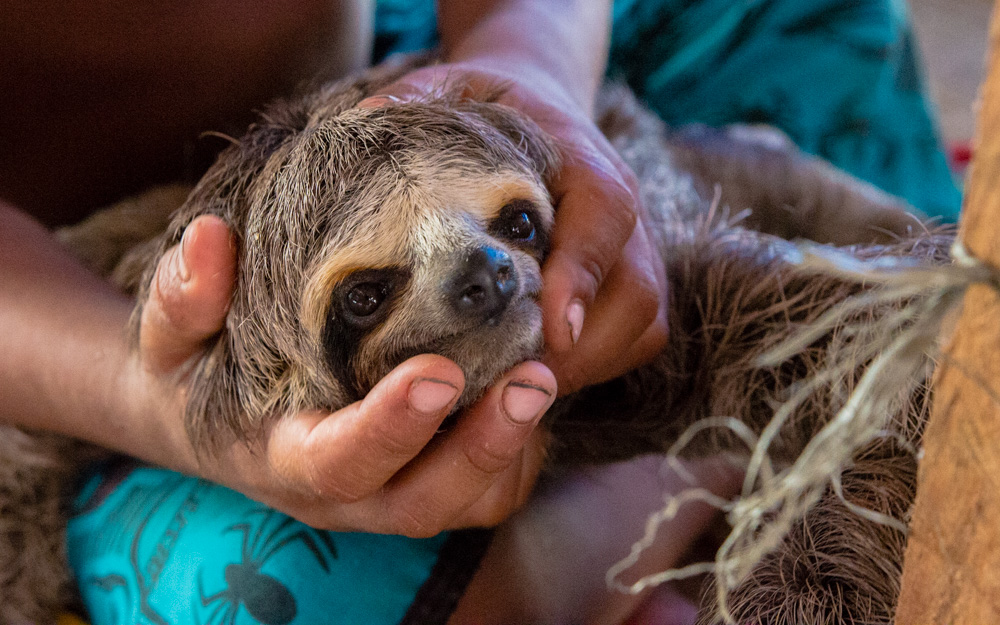
Banner image: A brown-throated sloth (Bradypus variegatus) being displayed to tourists in Manaus, Amazonas. Image courtesy of Neil D’Cruze.
