
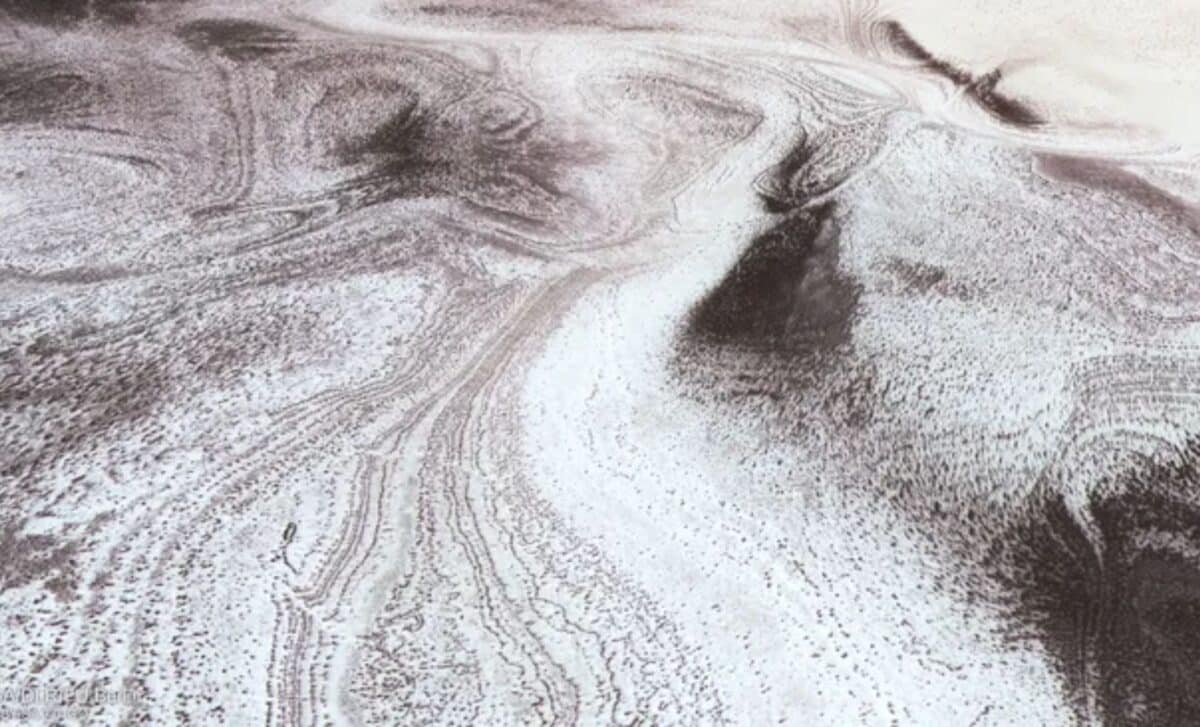
Recently released images from two orbiters have revealed carbon dioxide ice and dark dust patterns stretching across the planet’s southern region, creating a frosty illusion near the South Pole. Captured by the European Space Agency’s Mars Express and NASA’s Mars Reconnaissance Orbiter, the images show swirling white and brown textures covering the Australe Scopuli region. While the surface might appear peaceful, the phenomena behind it are anything but. What looks like frozen calm is, in reality, a dynamic and violent process caused by sunlight hitting CO₂ ice.
Carbon Dioxide Ice And The Illusion Of Snow
So, is it snow? Not quite. The white surface seen in the ESA and NASA images is composed of carbon dioxide ice, not frozen water. Unlike Earth’s snow, this type of frost is colder, more fragile, and doesn’t behave the same way under sunlight.
“Martian snow comes in two varieties: water ice and carbon dioxide, or dry ice. Because Martian air is so thin and the temperatures so cold, water-ice snow sublimates, or becomes a gas, before it even touches the ground,” as stated by the NASA.
ESA’s Mars Express, equipped with a German-built High-Resolution Stereo Camera, snapped the initial images in June 2022. A few months later, NASA’s orbiter followed up with more views using its HiRISE camera. Both sets of photos focused on the Australe Scopuli region near the planet’s southern ice cap. As reported by the Economic Times, the CO₂ ice sheet here can be up to 8 meters thick and stays frozen year-round.
On top of that ice lies a patchwork of dark dust, picked up and moved across the surface by subtle but powerful Martian winds. Over time, this dust becomes part of a visual signature that tells scientists when and how the ice has changed. The contrast between light and dark areas is striking, and also informative.
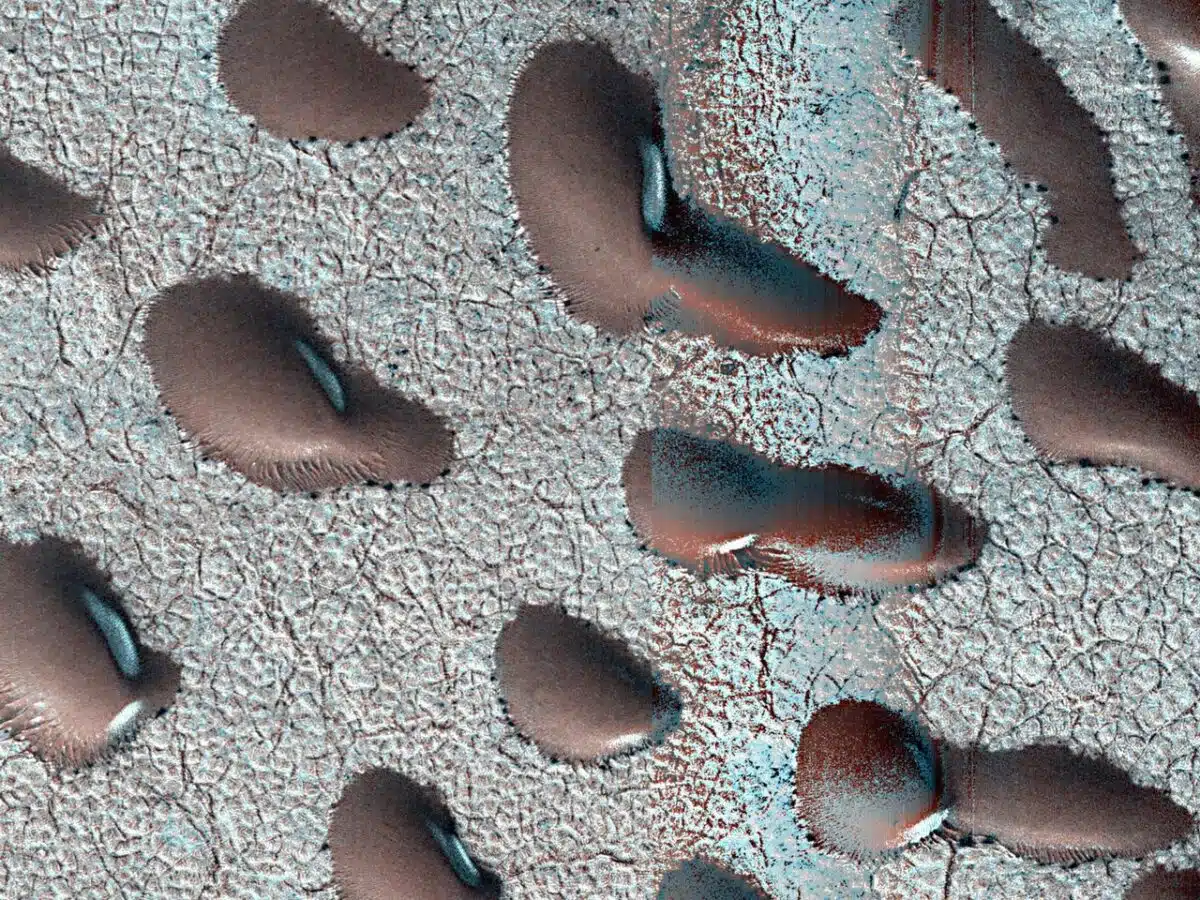 Captured from above by NASA’s Mars Reconnaissance Orbiter, these Martian dunes in the northern hemisphere. Credit: NASA/JPL-Caltech/University of Arizona
Eruptions Beneath The Ice Create Bizarre Surface Patterns
While the surface might look like a peaceful frost-scape, it’s actually being shaped by pressurized gas jets just beneath the ice. Here’s how it works: in the Martian summer, sunlight begins warming the carbon dioxide ice from below.
“The CO2 ice does not melt. Instead, it goes back from solid to gas directly in the atmosphere. That leads to the formation of really unique surface features,” explained Sylvain Piqueux of NASA’s Jet Propulsion Laboratory.
Since the gas can’t escape right away, it builds up until it bursts through, carrying dust into the thin atmosphere before it drifts back down in twisting streaks. This process, as explained by the Space.com, is responsible for the swirling dark patterns seen in the imagery. They aren’t fixed, they change with the seasons, depending on the location and timing of the gas’s escape.
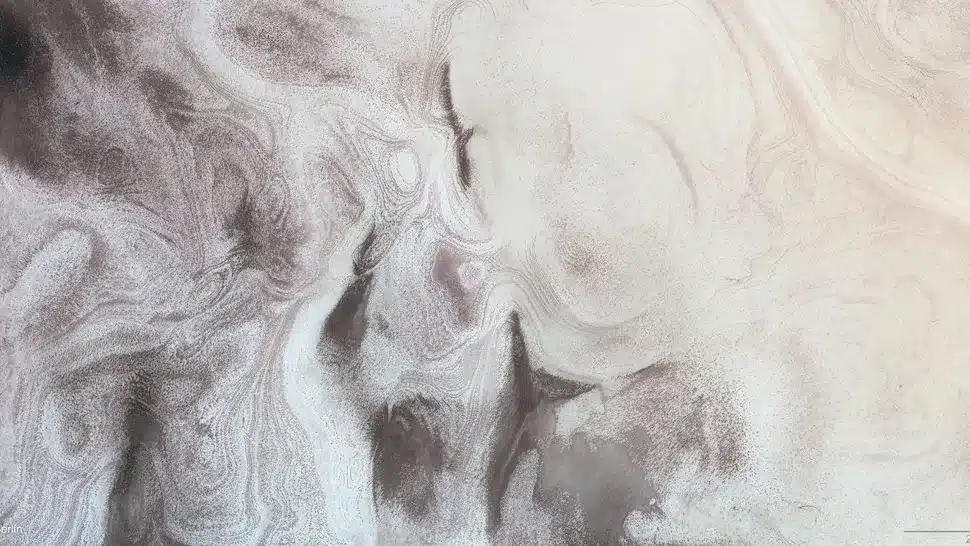 These swirling formations of carbon dioxide ice at Mars’ south pole were photographed by ESA’s Mars Express orbiter. Credit: ESA/DLR/FU Berlin
Seasonal Frost Keeps Martian Dunes In Check
Beyond the icy plains, NASA’s orbiter spotted another surprise: a layer of seasonal frost coating the sides of sand dunes. Though it might seem like a minor detail, this thin crust actually plays a big role in stabilizing the landscape. The frost acts like a temporary glue, holding dust and loose particles in place until spring arrives. Once the temperature rises, the frost sublimates, just like the CO₂ ice, and the material underneath is released, often reshaped by wind.
This subtle dynamic means Mars is home to slow, quiet processes that prevent erosion, preserve geological features, and signal how even minor seasonal changes can impact terrain over time.