
Some of the greatest movies ever made revolve around war, and Steven Spielberg’s Saving Private Ryan is frequently counted among them. Set during the Normandy landings of 1944, the film chronicles a deeply personal journey in the midst of all the death and destruction. As the title implies, Saving Private Ryan isn’t about defeating the Nazis or securing the US’ victory in World War II.
Saving Private Ryan was critically acclaimed upon its release in 1998 and earned five Academy Awards, including Best Director, Best Cinematography, and Best Film Editing. The movie would go on to inspire its genre in several ways, in addition to rekindling historical interest in wartime fiction. Despite earning praise for its realistic depictions of combat, war movie aficionados can easily find several examples better than Saving Private Ryan.
Apocalypse Now Highlights the Seductive Allure of War
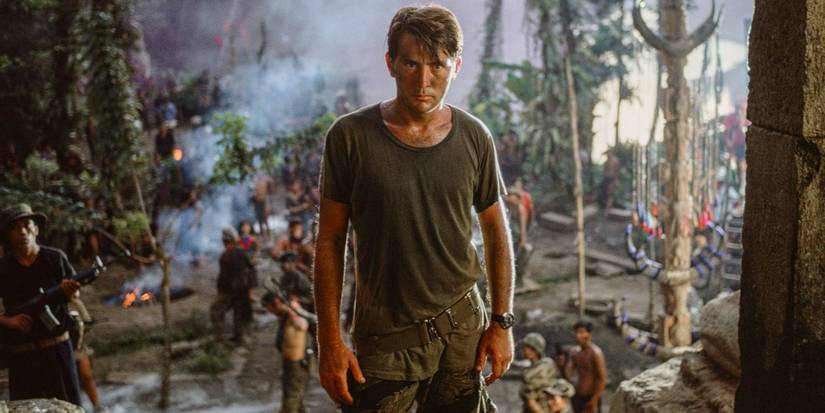
Martin Sheen as U.S. Army Captain Benjamin L. Willard in a village from the movie Apocalypse Now (1979)Image via United Artists
The Vietnam War served as a flashpoint that dramatically altered cultural attitudes toward war, and nowhere is this more evident than Francis Ford Coppola’s masterpiece. Apocalypse Now was based on Joseph Conrad’s Heart of Darkness, albeit with a Southeast Asian setting. Marlon Brando delivers one of his greatest performances as Colonel Kurtz, the quasi-unhinged renegade officer who creates a twisted cult in the middle of a tropical jungle.
Also featuring Martin Sheen, Harrison Ford, Robert Duvall, and Laurence Fishburne, Apocalypse Now quickly cemented itself as an ambitious exploration of war from the perspectives of morality and psychology. It’s not really about the actual events of the Vietnam conflict as much as the intoxicating insanity of violence, exemplified most terrifyingly by Colonel Bill Kilgore’s declaring that he loves “the smell of Napalm in the morning.”
Apocalypse Now refuses to explain the war, let alone examine the nuances. On the contrary, it plunges the audience into the same disorientation that the soldiers also experience. Ultimately, the story exposed the monstrous tendencies that lie secretly hidden within both individuals and institutions, slowly stripping away their illusions of power and agency.
The most important point made by Apocalypse Now is quite simple: the chaos of war is both destructive and seductive, transforming its participants into versions of themselves they may not agree with. In comparison to Saving Private Ryan’s raw authenticity, Apocalypse Now extracts the philosophical marrow from the bones of war. Heroism and duty fall by the wayside, making Coppola’s work one of the gutsiest critiques of American militarism — or militant Americanism; either interpretation holds water.
The Great Escape Is a Testament to Hope and Human Ingenuity
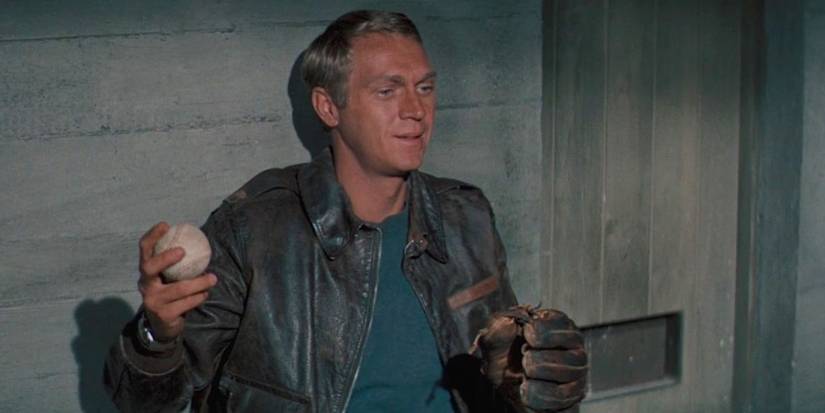
Steve McQueen as Captain Virgil Hilts in a jail cell playing catch from The Great EscapeImage via United Artists
Not every war movie needs to be harsh and depressing. Some, like The Great Escape, can showcase the aftermath without unnecessarily painful exposition. Led by the universally beloved Steve McQueen as the Cooler King, The Great Escape is an iconic example of a war comedy-adventure. In an attempt to expand its chances of commercial success, the movie chose to modify many realities in favor of heartfelt drama and some truly delightful humor.
In any case, The Great Escape was never meant to be an accurate portrayal of war, especially when considering the motorcycle chase scenes and legendary stunt sequences. Loosely based on true events, the film melodramatizes the mass escape from an Allied POW camp controlled by Nazi Germany. The Great Escape managed to balance its tone with stunning precision: fun without being frivolous and exciting without the glorification of war.
It actually feels more like a playful heist film than anything else, although the relatively bitter ending makes sense in the overarching context. The Cooler King’s victory is merely a symbol of hope and power, as The Great Escape concludes with nobody really escaping — and many of them are executed. That said, the ingenuity expressed by the “heroic” characters is the main focus of the narrative, a testament to the limitless human capacity for humor and dignity.
The Great Escape competes with Saving Private Ryan for emotional intensity, and both movies spotlight the strength of the human spirit. On the other hand, the 1963 war film captures the essence of heroism without relying on battlefield spectacle, with a conclusion surprisingly more devastating than Spielberg’s sentimentalism.
Schindler’s List Offers a Devastating Testimony of the Holocaust
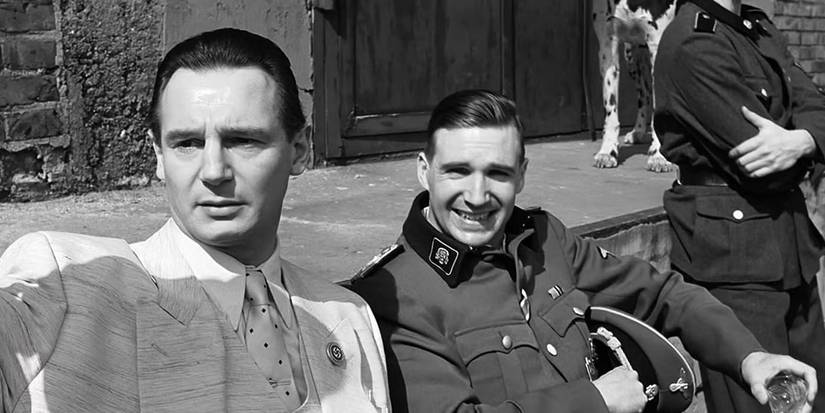
Liam Neeson & Ralph Fiennes look toward the camera while sitting down in Schindler’s ListImage via Universal Pictures
Saving Private Ryan is hardly the greatest war movie of all time; it’s not even the greatest example of the genre in Spielberg’s canon. That honor will always and forever be held by Schindler’s List, universally regarded as a pinnacle of cinematic history. Trapped within the nightmares of the Holocaust and destined for gas chambers, millions of innocent lives were torn to shreds by the Nazis.
Being oblivious to a genocide isn’t an excuse that works anymore, but the 1940s were a different era, and the Third Reich was extremely organized in terms of propaganda and cover-ups. As such, the burdens of justice often fell in the hands of ordinary folk like Oskar Schindler, who risked his life and career to save more than a thousand would-be victims during the Holocaust.
It’s impossible not to cry watching Liam Neeson’s titular protagonist breaking down in tears at the end, desperately wondering whether he could have saved more people with the few privileges at his disposal. That said, Schindler’s List isn’t exclusively about one man’s flawed heroism; it’s also about the brutal lack of apathy displayed at the heights of war. Ralph Fiennes’ Amon Göth remains the actor’s best villain role — Lord Voldemort doesn’t even come close.
Schindler’s List naturally earned the Academy Award for Best Picture in addition to six other Oscars, with the movie’s black-and-white cinematography evoking a sense of archival authenticity. Although it succeeds as both a film and a documentary, it’s best described as a heartbreaking testimony of the atrocities that should happen “never again.” And nobody in their right mind would consider Saving Private Ryan to be on the same exalted level as Schindler’s List.
The Battle of Algiers Influenced War Cinema on an Unprecedented Scale
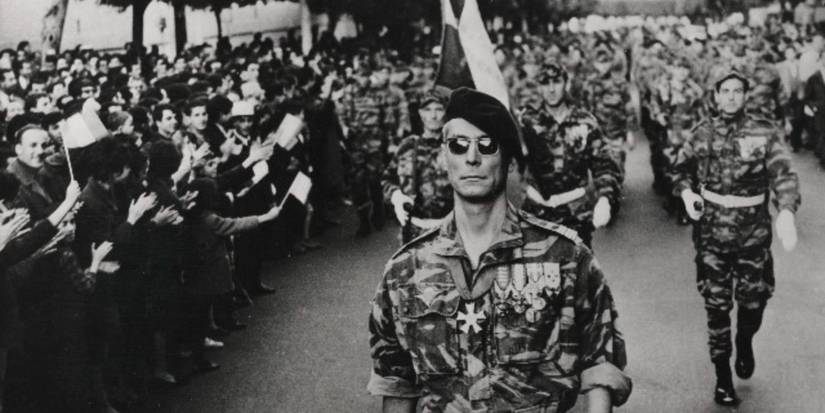
Jean Martin as Colonel Philippe Mathieu marching during a parade in The Battle of AlgiersInage via Allied Artists
The heartless colonization of Africa by the European powers of the late 19th and early-to-mid 20th centuries remains a stain upon the world. That said, many nations secured freedom from oppression by fighting tooth and nail, in stark contrast with, say, the nonviolent resistance of Mahatma Gandhi. The Battle of Algiers is an exquisitely detailed war movie that highlights the darkly heroic resistance of Algerian freedom fighters from 1954 until the North African nation’s independence in 1962.
The Battle of Algiers became an instant hit around the world, even if it was maligned in France for decades. Stylistically innovative and politically groundbreaking, the documentary-esque approach taken by director Gillo Pontecorvo ensures a level of authentic neutrality. The film focuses on a few essential characters, but weaves their anti-colonial perspectives into a messy tapestry symbolizing the ruthless randomness of guerrilla warfare.
Oppression breeds radicalization, a message that’s particularly clear in the 21st century, took its first shape in The Battle of Algiers. It forced the audience to challenge their political realities at the expense of comfort, rather than retreating into blind patriotism or simplistic morality. Ironically, however, the Pentagon would hold a 2003 screening to teach officers “how to win a battle against terrorism.”
War cinema was irretrievably shaped by The Battle of Algiers, with Roger Ebert claiming that it “has a universal frame of reference” in his 4-star review. Pontecorvo’s film may not pack the emotional wallop of Saving Private Ryan, but it’s considerably more sophisticated and carries far greater stakes than one man’s survival.
Life Is Beautiful Reframed the Holocaust Through a Father’s Love
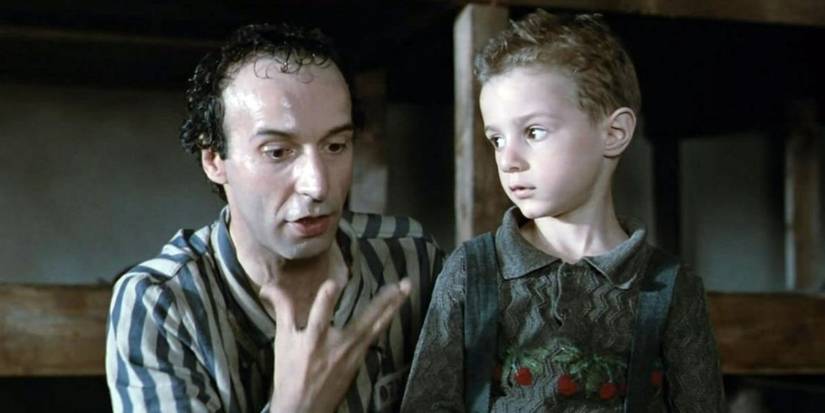
A man talks to his child in Life Is BeautifulImage via Miramax Films
When is a war movie not a war movie? Roberto Benigni answered that question with 1997’s Life Is Beautiful, a film that begins and ends on the same note: a father’s love for his child. The sunny lives of Guido Orefice and his son Giosuè come crashing down when they are shipped off to a Nazi concentration camp, exposing them to some of the worst horrors humanity has ever experienced.
Regardless of his own suffering, however, Guido routinely attempts to improve his son’s mood with various games and protect him from the psychological trauma of living where so many others had died. Even in his final moments, fully aware that he’s going to be executed, Guido continues the game so Giosuè would be spared the horror of witnessing his father’s execution.
Life Is Beautiful inevitably drummed up controversy for its humorous attitude toward the Holocaust, though critics were quick to point out the film’s refusal to simplify or minimize the delicate subject matter. Benigni took one of the bleakest chapters in human history and transformed it into a celebration of family, love, and the eternal beauty of life. The comedic acts of resistance in the movie were aimed at protecting the innocence of a child, and that’s always an acceptable reason to inject humor into pain.
The quietly tragic demise of Guido Orefice mirrors the nameless victims in countless concentration camps, many of whom were forgotten by the tides of history. But Guido lives on through Giosuè, who ultimately turns out to be the narrator, embodying the voice of those who paid homage to the greatest heroes of the Holocaust. The sheer emotional depths plumbed by Life Is Beautiful effortlessly surpass those of Saving Private Ryan, whose take on heroism isn’t nearly as profound.
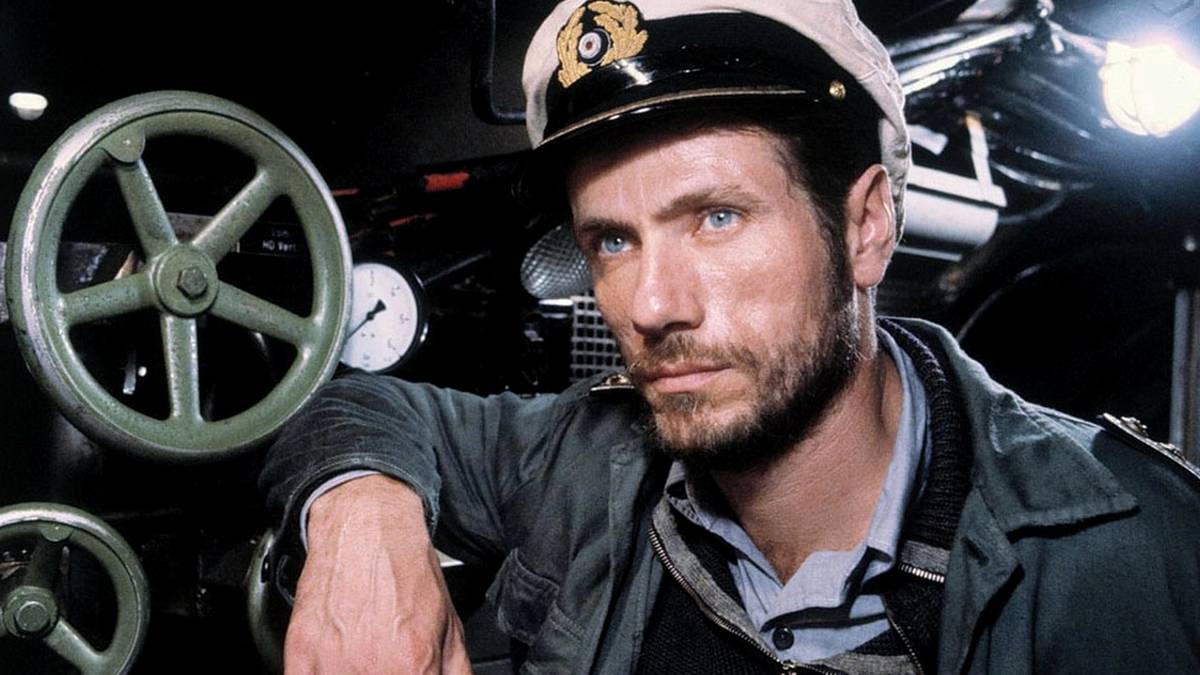
Das Boot Is a Testament to the Universal Horrors of War
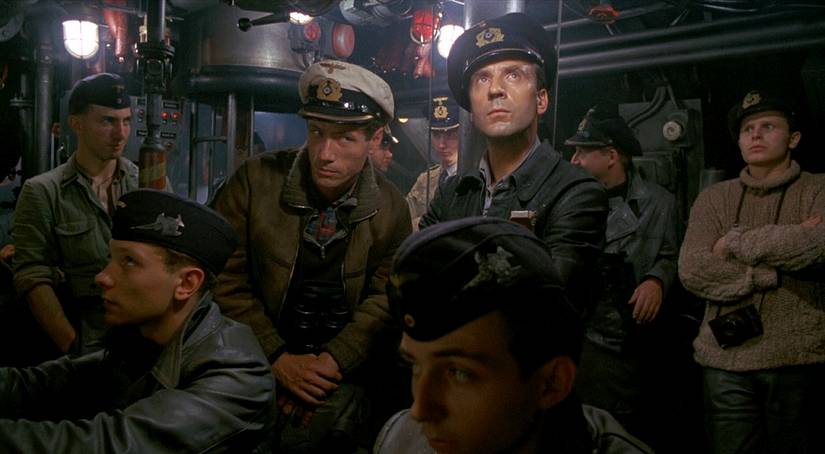
The men stand in the sub in Das Boot (1981)Image via Neue Constantin Film
The German-language Das Boot has been referenced across the pop-cultural multiverse, from The Simpsons to Will & Grace. Directed by Wolfgang Petersen, this 1981 naval war movie chronicled the U-96 German submarine during the Battle of the Atlantic. Petersen encapsulated the two major aspects of battle — thrills and boredom — that largely determined the lives of soldiers in WWII.
Das Boot impressed so much that it earned six Oscar nominations and held the German record until 2022’s All Quiet on the Western Front. Claustrophobic immersion soon leads to emotional exhaustion, with both sailors and viewers trapped inside the U-boat. The accurately depicted physical interior of a submarine forces audiences into the same perspective as the characters, emphasizing the fearful monotony of extended confinement.
While American war films set during the Second World War tend to paint German soldiers as reprobates, Das Boot is a reminder that the vast majority of combatants were just ordinary young men — frustrated, tired, and reacting to their terror with ribald jokes. The movie’s ethical neutrality allows it to shed light on shared human vulnerability, as opposed to the abstract concept of national allegiance.
Das Boot reveals the difference between constant action and constant pressure, demonstrating the overwhelming power of the latter over the former. Where Saving Private Ryan relies on dramatic heroism, Das Boot recognizes the impact of fear, fatigue, and helplessness on the battlefield — in this case, a crowded metal tube that keeps threatening to drown its inhabitants or worse.