
Paleontologists have unearthed a 66-million-year-old mosasaurine tooth in the Hell Creek Formation in North Dakota, the United States. This discovery adds to the growing evidence that mosasaurs, traditionally considered marine reptiles, hunted in rivers.
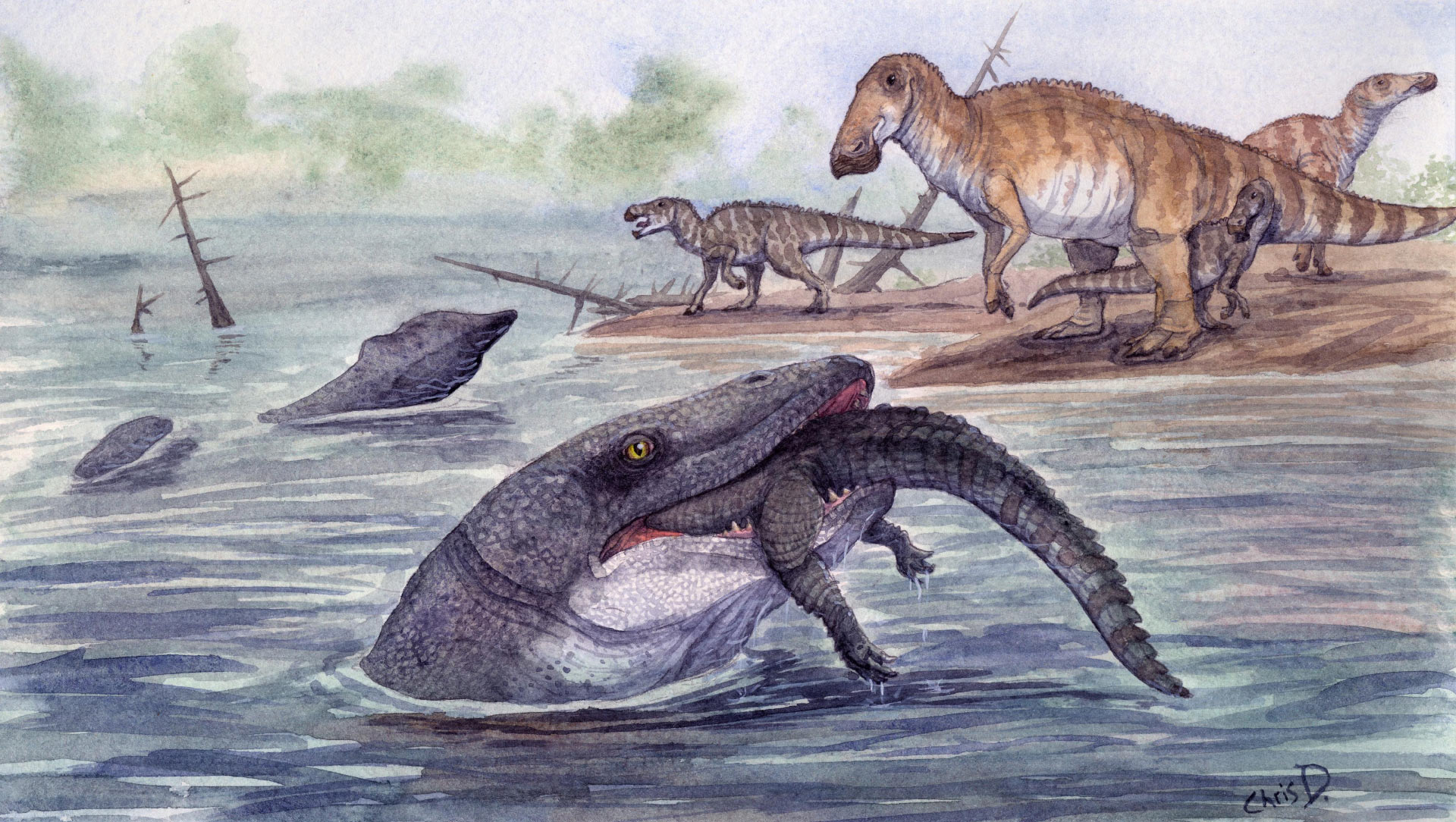
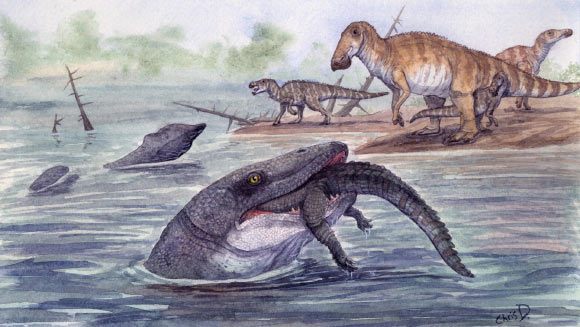
An artist’s reconstruction of the Hell Creek mosasaur. Image credit: Christopher DiPiazza.
“Mosasaurs were apex marine predators that diversified during the Late Cretaceous epoch, dominating the seas and occupying a variety of marine niches,” said Dr. Melanie During, a paleontologist at Uppsala University and Vrije Universiteit Amsterdam, and her colleagues.
“Within Mosasauridae, three subfamilies are recognized: Mosasaurinae, Plioplatecarpinae, and Tylosaurinae, each characterized by distinct morphological adaptations that allowed them to exploit different ecological opportunities.”
“Though mainly associated with shallow seas, mosasaur remains in estuarine and freshwater environments challenge their traditional strictly marine classification.”
In 2022, the researchers discovered a large tooth from a mosasaur at a multi-species fossil locality in the Hell Creek Formation.
Formerly connected to an ancient sea known as the Western Interior Seaway, this locality is notable for its lack of marine species, with fossils dominated by terrestrial and freshwater species.
The fossil was found in a fluvial deposit, together with a tooth from a Tyrannosaurus rex, and a crocodylian jawbone in an area known for remains of the duck-billed dinosaur Edmontosaurus.
The specimen belonged to a member of the mosasaur group Prognathodontini owing to similarities between textured patterns on its surface and on teeth from other members in this group.
The authors also analyzed isotopes within the tooth’s enamel to infer the conditions in which the mosasaur lived and found oxygen and strontium isotope signatures associated with freshwater environments.
They suggest this could have been caused by the mosasaur preying on freshwater animals, indicating it was able to live and hunt away from the sea.
“Carbon isotopes in teeth generally reflect what the animal ate,” Dr. During said.
“Many mosasaurs have low 13C values because they dive deep.”
“The mosasaur tooth found with the Tyrannosaurus rex tooth, on the other hand, has a higher 13C value than all known mosasaurs, dinosaurs and crocodiles, suggesting that it did not dive deep and may sometimes have fed on drowned dinosaurs.”
“The isotope signatures indicated that this mosasaur had inhabited this freshwater riverine environment.”
“When we looked at two additional mosasaur teeth found at nearby, slightly older, sites in North Dakota, we saw similar freshwater signatures.”
“These analyses shows that mosasaurs lived in riverine environments in the final million years before going extinct.”
Additional analyses on older mosasaur teeth and other animals from the Western Interior Seaway revealed a concentration of isotopes more consistent with a freshwater habit than a seawater habitat.
This indicates that salt levels in the region gradually decreased over time.
The authors propose that members of Prognathodontini may have been opportunistic predators occupying a similar niche to modern saltwater crocodiles (Crocodylus porosus) and that they may have adapted to a freshwater environment in response to falling salt levels in the Western Interior Seaway, gradually entering the river channels of Hell Creek as the seaway receded.
“For comparison with the mosasaur teeth, we also measured fossils from other marine animals and found a clear difference,” said Dr. Per Ahlberg, a paleontologist at Uppsala University.
“All gill-breathing animals had isotope signatures linking them to brackish or salty water, while all lung-breathing animals lacked such signatures.”
“This shows that mosasaurs, which needed to come to the surface to breathe, inhabited the upper freshwater layer and not the lower layer where the water was more saline.”
The team’s paper was published December 12, 2025 in the journal BMC Zoology.
_____
M.A.D. During et al. 2025. ‘King of the Riverside,’ a multi-proxy approach offers a new perspective on mosasaurs before their extinction. BMC Zool 10, 25; doi: 10.1186/s40850-025-00246-y