
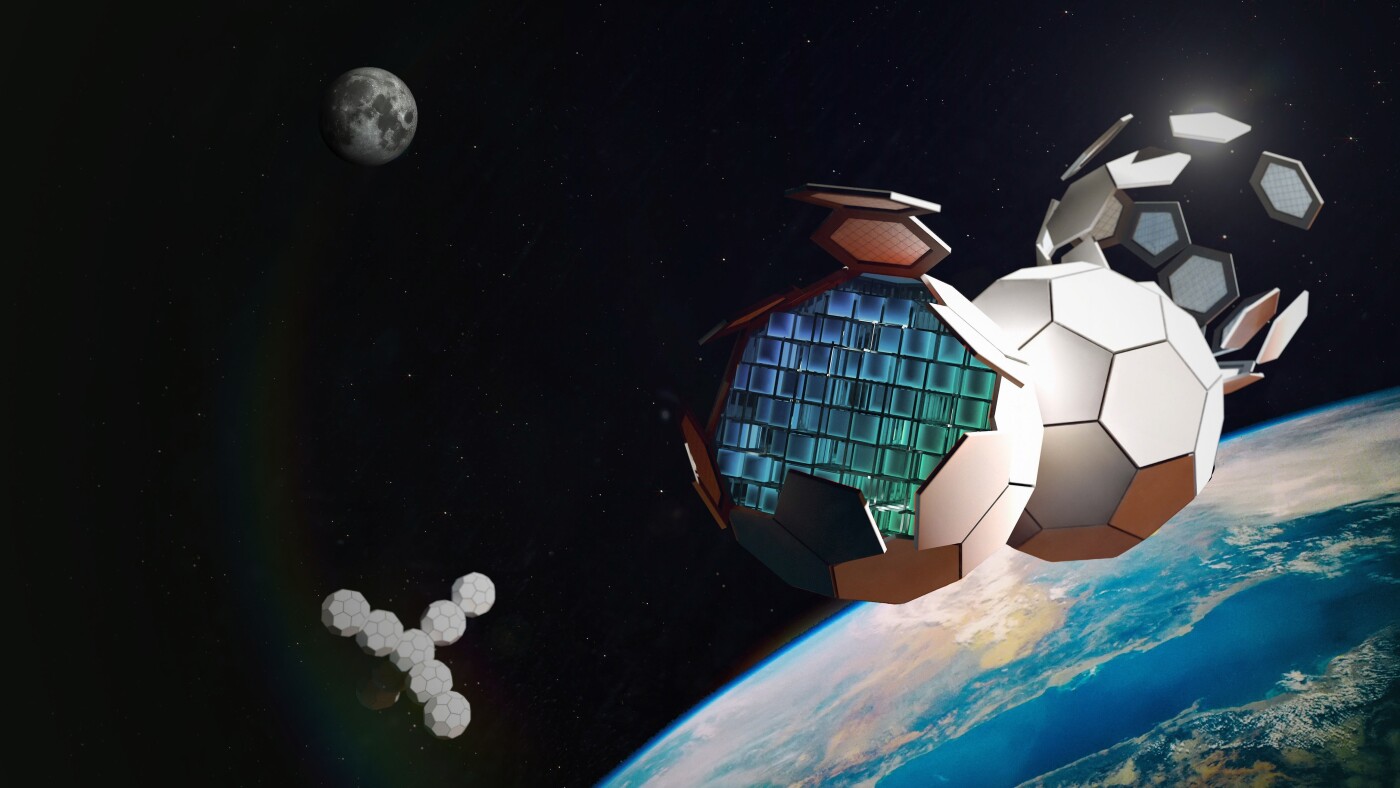
Magnetic hexagons could one day self-assemble in space to provide off-world manufacturing and agriculture as well as human habitats.
Aurelia Institute
hide caption
toggle caption
Aurelia Institute
Humankind has the technology to go to space. Space architect Ariel Ekblaw says the bottleneck now is real estate: getting larger volumes of space stations in orbit. Her company is working on the equivalent of giant, magnetic space Legos—hexagons that could self-assemble in space into livable, workable structures. This episode, host Regina G. Barber talks to her about this space architecture and why she says that the goal isn’t to abandon Earth–but to off-world industries like agriculture and manufacturing in order to build a better Earth.
If you liked this episode, check out our Space Camp series.
Interested in more space tech episodes? Email us your question at shortwave@npr.org.
Listen to every episode of Short Wave sponsor-free and support our work at NPR by signing up for Short Wave+ at plus.npr.org/shortwave.
Listen to Short Wave on Spotify and Apple Podcasts.
This episode was produced by Berly McCoy. It was edited by Rebecca Ramirez. Tyler Jones checked the facts. The audio engineer was Kwesi Lee.