
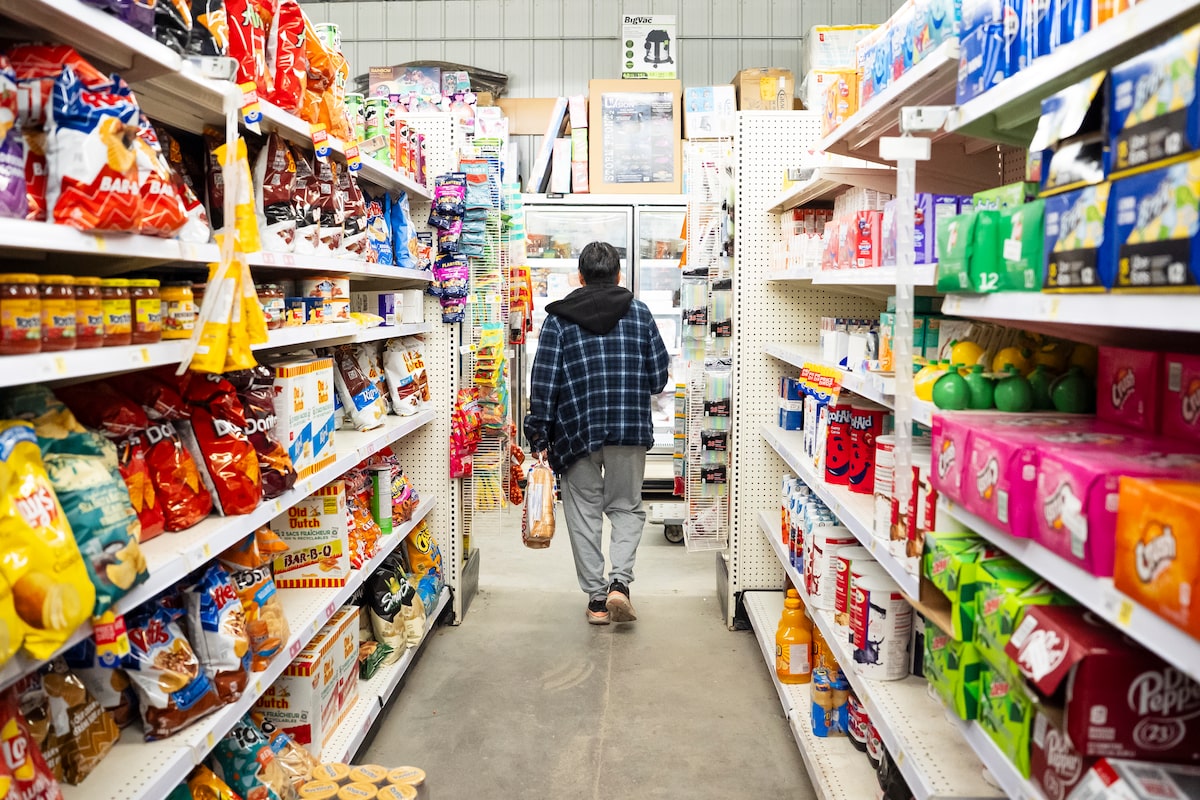
Good morning. Canada’s steady inflation rate masks a tug-of-war between rising grocery prices narrowly offset by cheaper gas, travel tours and hotels, with Taylor Swift-driven spikes to the cost of hotels and short-term stays last year still nudging slower growth this year. That’s in focus today, along with Canada’s IPO dreams.
Up firstIn the news
Mining: Anglo American has received approval from the federal government to acquire Teck Resources, clearing another major hurdle
Institutional investment: U.S. private-equity giant KKR sees Canada’s infrastructure push as an investment opportunity
Resources: American home builders warn of rising construction costs after higher import taxes on Canadian softwood
Education: Immigration cuts leave an Ontario college, and its city, feeling the strain
Christopher Katsarov/The Canadian Press
In focusThe story behind your grocery bill
Hi, I’m Mariya Postelnyak, The Globe’s consumer affairs reporter. Grocery prices are surging just as Canadians prepare to feed more mouths in one sitting than at any other time of year.
Rising costs at the grocery checkout continued to bite in November, even as Statistics Canada reported yesterday that overall inflation was holding steady.
The big picture
According to Canada’s national data agency, inflation was kept in check by a handful of factors: an 8-per-cent drop in gas prices; slower rent growth; and falling costs for travel tours and hotels (and yes, Taylor Swift).
The cost of travel tours fell 8.2 per cent year over year, owing to fewer Canadians making a trip down south.
Rent rose 4.7 per cent compared with October, down from a 5.2-per-cent bump the month prior. That said, affordability hasn’t caught up everywhere – renters remain hard-pressed to find larger, more livable units, where prices have barely budged, if at all.
Despite some prices easing up, Canadians paid 4.7 per cent more for food this November than the same month last year, marking the sharpest spike since December, 2023, even as headline inflation remained unchanged from the previous month at 2.2 per cent.
What’s the deal at checkout?
While Canada rolled back most of its retaliatory tariffs on U.S. food by the end of September, the effects of Donald Trump’s trade war – combined with severe weather and persisting supply-chain disruptions – continue to push grocery prices higher.
As many of us look for alternatives to more expensive foods, it’s also creating ripple effects across the grocery aisles.
Canadians paid 4.4 per cent more for fresh fruit in November compared to the previous November, with berries spiking more than 7 per cent. Food experts put some of the blame on droughts in Nova Scotia, which have cut blueberry crops by more than 50 per cent.
But Sadaf Mollaei, the Arrell Chair in the Business of Food at the University of Guelph, told me that we might still be seeing the lingering effects of supply disruptions on packing production. Many Canadian-grown products are shipped to the U.S. for packaging before returning to shelves in this country, leaving prices vulnerable to any cross-border interruptions, she said.
“When there is a disruption and then the price increases, it happens really fast,” she said. “But then when it wants to come down or stabilize, it actually takes longer.”
The usual suspects
Beef and coffee prices posted some of the steepest spikes, rising 17.7 per cent and 27.8 per cent respectively.
Drought conditions and shrinking cattle inventories across North America have pushed up beef prices. Meanwhile, coffee has been hit by the double-whammy of U.S. tariffs on key producing countries such as Brazil, alongside disruptions to production brought on by severe weather.
The result? As the price for a basic brew at many go-to Toronto cafés goes up from $2.85 to $3-a-cup, coffee machine sales are bound to grow.
But curbing beef costs gets more complicated. Many Canadians have turned to chicken, creating a new pressure point.
Poultry prices rose 7.5 per cent in November as consumers swapped chicken for higher-priced beef while domestic production struggled to keep up. “We didn’t meet our targets, so chicken prices are going to be high as well,” said Dr. Mollaei.
Why it matters
Canadians are already heading into the holiday season under a lot of financial strain. Many are taking on extra jobs to manage holiday spending, relying more heavily on buy-now-pay-later platforms or maybe they are the one in five who are getting help from grandparents.
Despite the surge in prices in the grocery aisles, economists say the broader inflation picture remains largely in line with expectations. The figures will feed into the Bank of Canada’s interest-rate decision-making, and for now, the people whose job it is to look at graphs for a living expect the central bank to keep holding its rate steady.
In the meantime, a growing list of businesses are trying to provide consumers with alternatives for some of the food putting the biggest strain on household budgets. A bunch of new companies have cropped up to create bean-free alternatives to ease up pressure on our coffee budgets, for example.
No word yet on alternatives for the $5-cookie.
UnchartedThe future will be wearableOpen this photo in gallery:
Bio medical physiology and kinesiology student Ellie Thompson runs on a treadmill in the motion capture lab at Simon Fraser University’s WearTech Labs at City Centre 2 in Surrey, B.C.Jennifer Gauthier/The Globe and Mail
A new facility at Simon Fraser University aims to be an industry test bed for a revolution in wearable technology.
Quoted
When Bay Street gets back from the holidays, the bankers may be joining Wall Street in an IPO blitz.
— Andrew Willis, columnist for the Report on Business
Canadian banks see the long IPO drought in this country finally coming to an end. However, a few deals in the new year still can’t mask the stark contrast in sentiment between U.S. and Canadian markets.
Up nextMore files we’re following
On the move: Canadian engineering firm WSP Global is set to acquire TRC Companies in a $4.5-billion all-cash deal. It’s expected to be completed in the first quarter of next year, pending regulatory approvals and closing conditions.
At the table: Bank of Canada Governor Tiff Macklem speaks in Montreal at 12:45 p.m. ET on Tuesday with a press conference to follow.
In the numbers: Statistics Canada says total manufacturing sales fell 1 per cent to $71.5-billion in October. The Canada Mortgage and Housing Corp. says the annual pace of housing starts rose 9.4 per cent in November.
Morning update
Global markets were lower as traders took a cautious position ahead of a slate of U.S. data, including the jobs report, that may help signal the path for Federal Reserve policy next year.
Wall Street futures were in negative territory after major North American markets closed down yesterday. TSX futures followed sentiment lower amid slumping oil prices.
Overseas, the pan-European STOXX 600 was down 0.11 per cent in morning trading. Britain’s FTSE 100 declined 0.45 per cent, Germany’s DAX gave back 0.33 per cent and France’s CAC 40 was flat.
In Asia, Japan’s Nikkei closed 1.56 per cent lower, while Hong Kong’s Hang Seng dropped 1.54 per cent.
The Canadian dollar traded at 72.58 U.S. cents.