
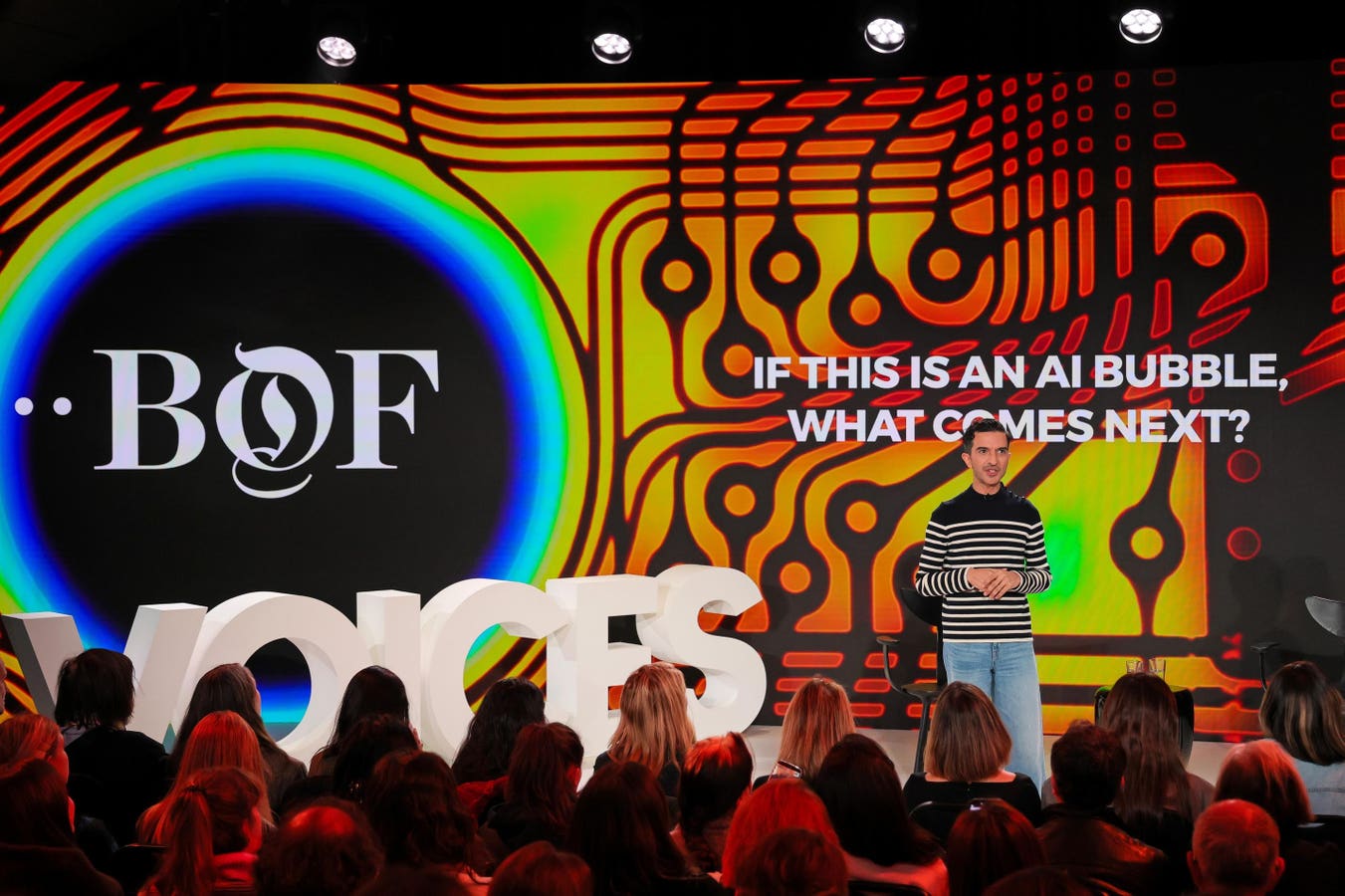
CHIPPING NORTON, ENGLAND – NOVEMBER 19: Imran Amed, Founder & CEO, The Business of Fashion speaks onstage during Session 3: TECHNOLOGY AND INNOVATION “If This Is an AI Bubble, What Comes Next?” at The Business of Fashion Presents VOICES 2025 – Day 2 at Soho Farmhouse on November 19, 2025 in Chipping Norton, England. (Photo by Vittorio Zunino Celotto/Getty Images for Business of Fashion)
Getty Images for Business of Fashion
Shares of AI neo cloud operator CoreWeave plunged 62% and shares of database and cloud-services provider Oracle have fallen 47% since the two stocks peaked earlier this year, according to Google Finance.
The generative AI bubble that propelled these two stocks in 2025 may now be contributing to their fall.
Two months ago, I wrote about three scenarios:
GenAI keeps booming;There’s a soft-landing in which valuations decline somewhat; The OpenAI bankruptcy scenario, which brings it all down abruptly should the ChatGPT provider fail to raise more capital to fund its money-losing operations.
CoreWeave, which leases data centers, fills them with GPU-heavy clusters and then rents out the processing capacity, and Oracle are likely to suffer the most damage should the pessimistic scenario come to pass.
This raises many questions:
Why Have Their Stock Prices Fallen?
Their growing debt levels and dependence on a small number of customers – one of which (OpenAI) is losing billions of dollars – are making investors nervous.
Will They Keep Dropping?
There are many reasons their shares could fall more.
If So, What Should Investors Do?
Options include avoiding the shares, selling them short, or buying credit default swaps on their debt.
CoreWeave and Oracle’s Responses
CoreWeave sees itself as misunderstood. “When you introduce new models, introduce a new way of doing business, disrupt what has been a static environment, it’s going to take some people some time,” CoreWeave CEO Michael Intrator said at the Fortune Brainstorm AI conference. More people are beginning to understand the CoreWeave business model, he added.
Oracle is taking action to protect its credit quality. The company “is committed to maintaining its investment-grade debt rating,” said one of Oracle’s co-CEOs Clay Magouyrk, reported Bloomberg.
Read on for more detailed answers to the questions above and the eye-popping increases in the price of insurance – called credit default swaps — for CoreWeave and Oracle debt.
The State Of The Generative AI Bubble
When the dot-com bubble burst, it wiped out trillions of dollars of stock market value and prompted the bankruptcies of money-losing fiber optic network companies and internet startups that had gone public during the boom.
The parallels with the generative AI bubble are imperfect. For example, very few generative AI startups have gone public. What’s more, many of the companies building out AI data centers – such as Amazon, Google, and Microsoft – are solidly profitable.
The risks of the generative AI bubble include a projected $3 trillion investment by 2028 to support a six-fold expansion in data center capacity, according to Morgan Stanley analysis reported by Reuters, a 95% failure rate for enterprise AI pilot projects, and OpenAI’s substantial cash burn and reliance on continuous capital raises.
In the last two months, I think the likelihood of the three scenarios I outlined in October have shifted to higher risk.
The Soft Landing (Estimated Probability Drops From 35% To 15%)
In October, I thought AI valuations might decline 60% to 70% over a two to three year period without panic. Strong growth and earnings at Microsoft, Google, and Meta could provide cushioning while enterprise adoption of AI would continue at realistic valuations.
As of today’s writing this middle path is disappearing as high borrowing and larger capital expenditure requirements are making a gentle correction unlikely while a boom-or-bust outcome is becoming more probable.
The OpenAI Bankruptcy Cascade (25% to 50%)
The most pessimistic scenario – which has grown more likely since October – started with OpenAI failing to raise enough capital to cover its $14 billion annual cash burn – leading to emergency measures. Under this scenario CoreWeave could lose 60% of its revenue and file for bankruptcy. Nvidia might suffer a 6% reduction in its revenue and take a $100 billion investment write-down.
Oracle and Microsoft would likely mark down their OpenAI investment. This could lead to an abrupt curtailment of AI capital expenditures – resulting in a recession, a drop of 40% to 50% in Nvidia’s stock price and a 20% to 30% decline in the S&P 500 – since AI stocks provided 75% of gains.
The likelihood of this scenario has increased as CoreWeave’s CDS prices have spiked, implying a 42% probability of default over five years, according to Investing.com, while Oracle’s debt is now trading like junk bonds.
The Continued Boom (40% to 35%)
In this optimistic scenario, companies discover ways to use AI to achieve efficiency and growth improvements – making current investments profitable. Revenue growth accelerates to match valuations and the bubble inflates further before any reckoning.
While OpenAI’s revenue growth is approaching a $20 billion run rate, this positive development is overshadowed by a reported $207 billion funding gap through 2030, noted Seeking Alpha.
Why CoreWeave And Oracle Shares Have Tumbled
Rising concerns about a bursting of the generative AI bubble have contributed to the decline in CoreWeave and Oracle shares.
However, they each have their unique challenges. CoreWeave’s stock has fallen because of its high cost of borrowing, operational challenges, and confusing communications about the company’s prospects, reported the Wall Street Journal. Here are key details:
High cost of borrowing. CoreWeave’s cost of borrowing – 7.5% — is way higher than what profitable hyperscalers like Google pay (from 2% to 2.5%), noted the previously linked Reuters report.Operational challenges. Earlier this year, rain in Texas delayed for three months the completion date for “a huge data-center cluster, consisting of about 260 megawatts of computing power that CoreWeave plans to lease to OpenAI,” the Journal wrote.Confusing communications. Although the delay was in several data centers, Intrator repeated the “one data center” message he had given the previous day before correcting himself after host Jim Cramer prompted him in a CNBC interview featured by the Journal.
Oracle stock has fallen because the company lacks the cash flow to build the capacity required to fill its $500 billion cloud services backlog. Therefore the company is borrowing more money, noted Dow Jones.
Indeed, Oracle – which in September borrowed $18 billion – will likely have to boost its debt from $100 billion earlier this year to $290 billion over the next three years, according to a note from Morgan Stanley analyst Lindsay Tyler featured by Dow Jones.
What Analysts Are Saying About The Future Of CoreWeave And Oracle
Analysts are growing more cautious about CoreWeave and Oracle.
One analyst sees CoreWeave as good at building big AI data centers even as investors worry about AI’s payoff.
“They’re exceptional at getting large workloads up at maximum utilization and replacing underperforming nodes rapidly without interrupting workflow,” founder and chief investment officer of hedge fund Two Seas – which is long CoreWeave stock – Sina Toussi told the Journal. “But right now the market is concerned about the long-term value of AI,” he added
Another analyst expressed concern about CoreWeave’s financial structure. The company has the “ugliest balance sheet in technology, by far,” D.A. Davidson analyst Gil Luria told the Journal.
CoreWeave’s operating margins “of about 4% are less than half of what the company pays in interest on most of the debt it uses to deploy computing power for customers, making it hard to see how the company will generate profits going forward,” added Luria.
“The bull case is that they’ll scale into it, and that a lot of companies have low margins to start, but this is a company at scale. There is no scaling going on here,” he concluded.
Oracle is also seen as weaker than peers – with less cash flow, higher debt levels and lower credit ratings. Oracle also “has significantly higher counterparty risk from OpenAI,” said Columbia Threadneedle Investments fixed-income research analyst Nathan Liddle, according to Dow Jones.
The Rising Price of Their Credit Default Swaps
Investors are increasingly seeking financial protection as concerns over an AI debt bust grow. CDS trading has surged by 90% since September, noted a Financial Times article featured by the previously linked Seeking Alpha report.
Last week, after Oracle reported unexpectedly high capital expenditures on chips, networking equipment and other infrastructure, the bond market “convulsed, raising the cost of capital for many large tech companies. CoreWeave’s cost of insuring against default on its debts soared to 7.9 percentage points,” reported the Journal.
On Dec. 11, the cost of protecting Oracle’s debt against default for five years rose as much as 0.17 percentage points to around 1.41 percentage point a year, the highest intraday level since April 2009, according to ICE Data Services data featured by Bloomberg.
Moreover, trading volume on Oracle’s CDS surged 21.4-fold in the last year to about $9.2 billion over the 10 weeks ended Dec. 5, according to Barclays credit strategist Jigar Patel analysis featured by Bloomberg.
Unless CoreWeave and Oracle experience a surge in positive cash flow or curtail their expansions, it would not surprise me if these CDS prices keep rising.