
Tiger conservation in Thailand is a rare success story, bucking the trend of regional declines of the Indochinese subspecies across Southeast Asia.Thailand’s Western Forest Complex is at the core of the country’s success, with its tiger population growing from about 40 in 2007 to more than 140 today.Conservation nonprofits are working to protect a network of corridors that will help usher younger tigers into the southern part of the complex, chiefly through the Si Sawat Corridor, a designated non-hunting area.Scientists have recently discovered tigers reproducing in the southern WEFCOM for the first time.
See All Key Ideas
KANCHANABURI, Thailand — Following the path of the tiger isn’t easy. Yet the three rangers, clad in camouflage, move lithely through the steep bamboo thicket, tracking the muddy hoofprints of a sambar deer. Out of the snagging vines, they emerge on a forested ridgeline overlooking a landscape that swells and shrinks in watercolor hues of indigo. A breeze rustles the stone oak trees as the sound of grasshoppers pierces the silence. It’s easy to imagine the tiger slinking confidently across this terrain, the master of its Thai kingdom.
Another 2 kilometers (1.2 miles) down the ridge, the rangers stop in a small clearing. Members of Panthera, a wildcat conservation NGO, pull out a toolkit to check two camera traps. It was here, in early 2024, that a camera picked up a female Indochinese tiger (Panthera tigris corbetti) moving through this protected corridor known as Si Sawat. She had never been detected in any other protected area. Maybe, they say, the tiger will have returned in the past three months.
But the camera’s memory card reveals only smaller species: a leopard cat (Prionailurus bengalensis) and an Asian golden cat (Catopuma temminckii), as well as a porcupine (Hystrix brachyura) and a pig-tailed macaque (Macaca leonina). Still, the team is in good spirits. Hopefully, they say, the tiger has taken up residency to the south, in Salakpra Wildlife Sanctuary. After all, this swath of forest is too small to support a large tiger population — maybe four, at best. Yet as a corridor, cutting through the hills of Kanchanaburi province, it can help to funnel cats into more suitable habitats, forging a pathway of hope for the imperiled species.
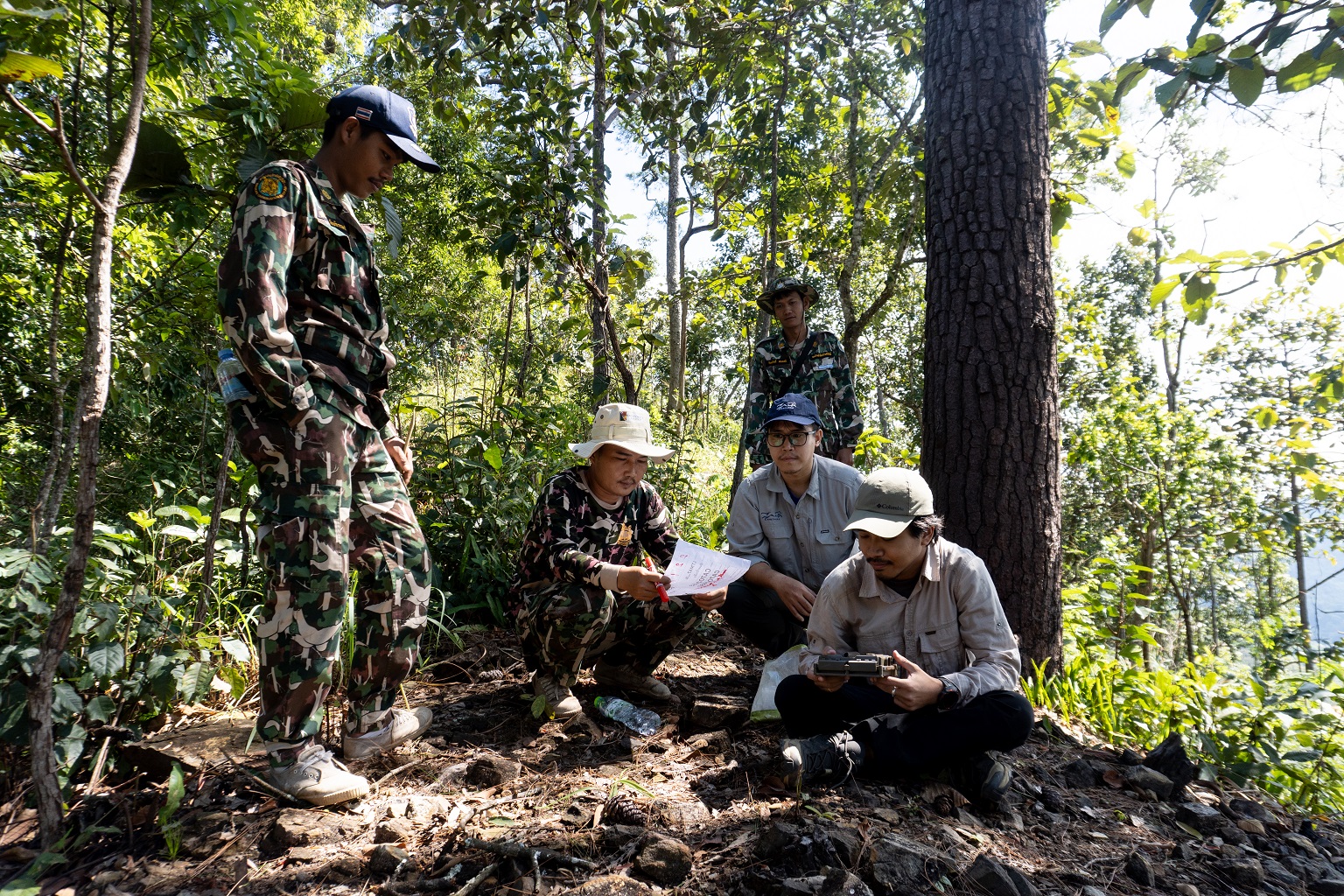 Panthera’s tiger team checks a camera trap in the Si Sawat Non-Hunting Area in November 2025.
Tigers today are a shadow of their former selves. Over the past century, the species has been decimated by hunting and habitat loss, pushing the animal into just 7% of its historic range. The situation in Southeast Asia has been especially dire, with the extirpation of the Indochinese subspecies in Cambodia and Laos in just the last decade.
But, biologists say, the situation could be worse. In October, the IUCN, the global wildlife conservation authority, published an assessment of Panthera tigris that took stock of recent conservation actions — painting a fuller picture beyond just the big cat’s globally endangered status. The report found that while tigers as a whole are critically depleted, they would be in worse shape if not for herculean conservation efforts. Without such measures, tigers today would be considered critically endangered, instead of endangered.
“The tiger is completely reliant upon conservation,” says Luke Hunter, executive director of the Wildlife Conservation Society’s Big Cats Program and lead author of the IUCN assessment. “It needs big landscapes. It needs investment in these landscapes. It needs really targeted conservation interventions.”
He adds, “We’re kind of dead in the water unless there’s government commitment to it.”
In 2010, the global tiger population fell to an all-time low of around 3,200 individuals. Since then, the population has rebounded to an estimated 5,574 as of 2023, according to data from the Global Tiger Forum. Much of that success has been seen in India, Nepal and Russia, thanks to strong antipoaching efforts and habitat restoration. But Thailand, too, has emerged as a unique success story in an otherwise declining region, with as many as 223 tigers now living in its wilderness. The country is finally beginning to see payoffs for its investments.
“Thailand’s department of national parks has for a couple of decades put serious resources into tiger conservation and protection of tiger landscapes,” Hunter says. “But tigers don’t recover overnight. It takes a long time — in some cases it’s a 20-year process.”
Recent successes, he says, prove “you can bring tigers back. You can catalyze recovery. And we’re still in the early stages of it in most places, but we see it’s possible.”
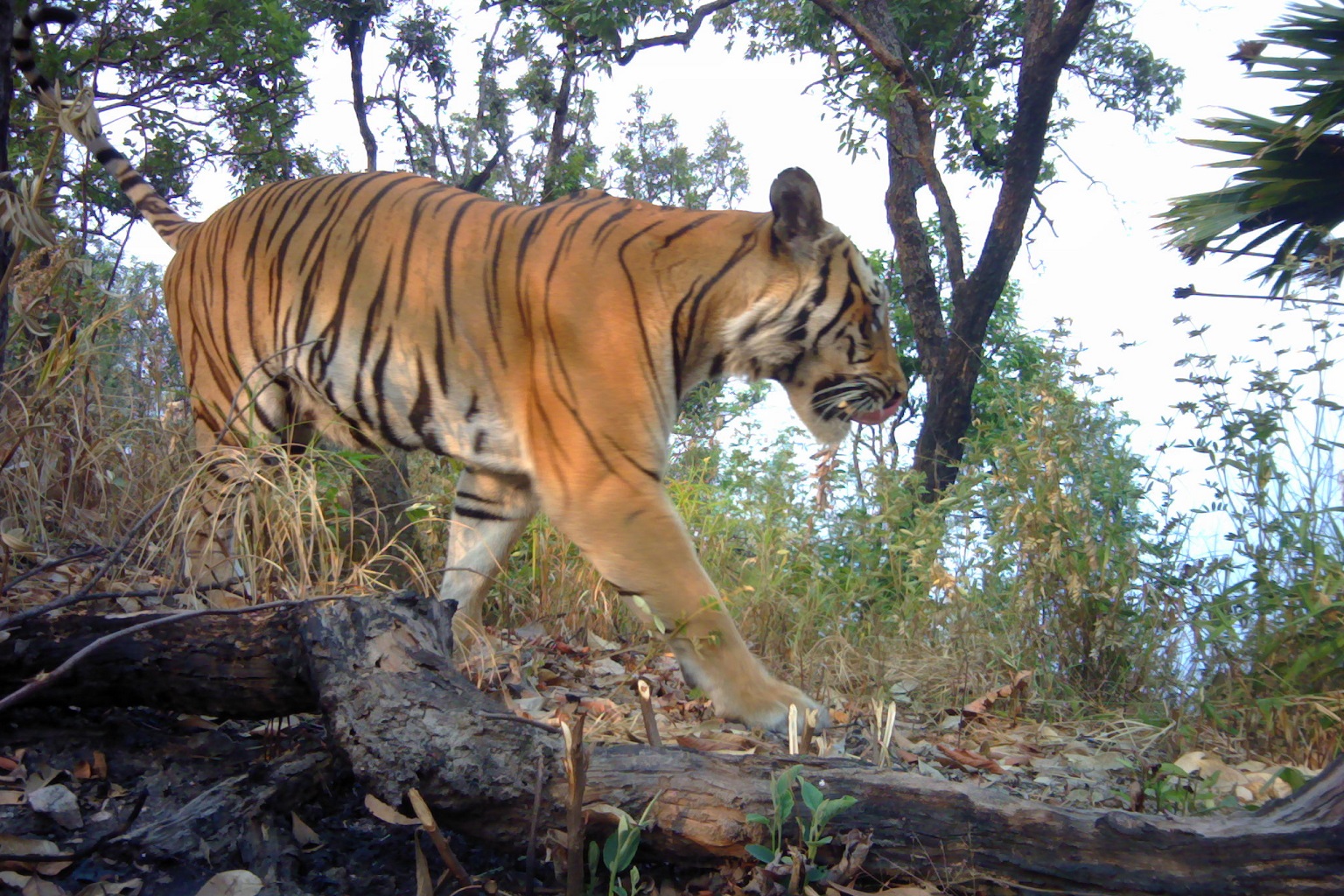 In 2020 a tiger was found by camera trap at Sisawat Non-Hunting area. He was identified as TWT130M, a tiger that traveled from the north. This finding showed us that tigers use the Sisawat Non-hunting area to move south to the southern part of the Western Forest Complex (WEFCOM). This image served as important evidence demonstrating how important this region is to tiger conservation and movements. Image by Panthera.
Thailand’s success with its top predator
In Thailand, the tiger’s comeback is largely playing out in a region known as the Western Forest Complex, or WEFCOM. The largest remaining tract of forest in mainland Southeast Asia, WEFCOM encompasses 17 contiguous protected areas that span an area roughly the size of Kuwait. It begins just a three-hour drive northwest of Bangkok and sweeps hundreds of kilometers toward the border with Myanmar.
To date, the tiger’s recovery in this green oasis — a mix of dry evergreen forest, dipterocarp forest, deciduous forest, and grassland — has largely unfolded in the region’s upper reaches, far away from the villages, roads and tourist fare that intrude on southern WEFCOM. Millions of conservation dollars have flowed into the core conservation area — largely Thung Yai Naresuan-Huai Kha Khaeng Wildlife Sanctuary — through nonprofits like WCS and WWF working to bring the tiger back from the brink.
The region’s tiger population has more than tripled in response, increasing from a low of just 40 tigers in 2007 to more than 140 of the big cats prowling WEFCOM today. But as tiger numbers grow, space is getting tight in the jewel of WEFCOM’s crown.
“It’s natural that when we have new tigers, the young tigers will have to find their territory,” says Kristana Kaewplang, director of Panthera Thailand. “They will come down, because it’s already crowded in the core. It means we have to prepare for that.”
In 2014, scientists first discovered tiger tracks in Salakpra Wildlife Sanctuary — a sign that at least one intrepid animal had ventured 100 km (60 mi) south of Huai Kha Khaeng. Vital to the tiger’s expansion, scientists say, is the Si Sawat Corridor — a 350-square-kilometer (135-square-mile) once unprotected area owned by Thailand’s Treasury Department and used by the Royal Thai Army for military drills. This corridor, which skirts the eastern side of Sinakharin Reservoir, connects upper WEFCOM to the south, chiefly Salakpra Wildlife Sanctuary.
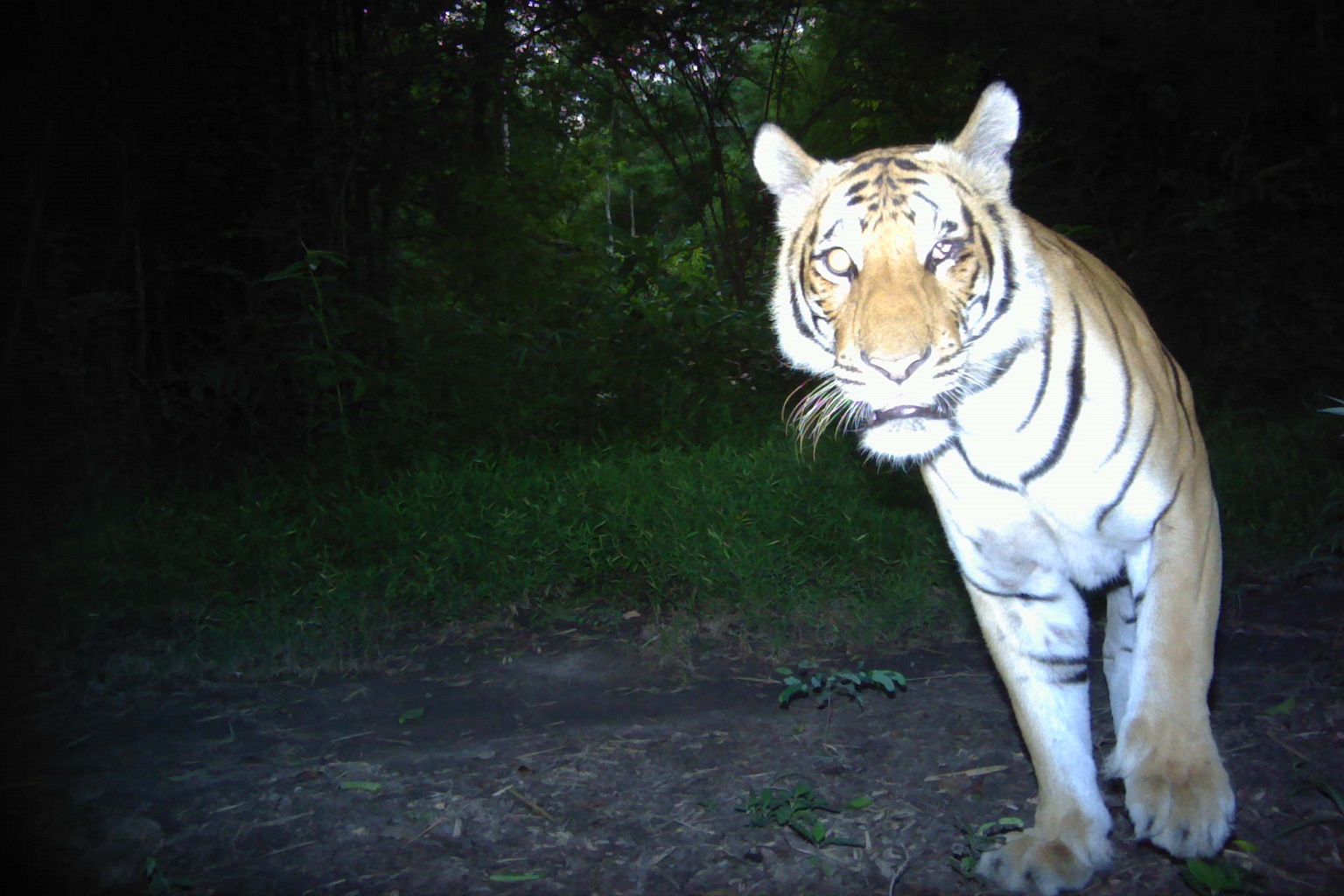 HKT197F in the Salakpra Wildlife Sanctuary. HKT197F is a tiger from the Huai Kha Khaeng Wildlife Sanctuary that has moved down to live in the Salakpra area. Image by Panthera/DNP.
Until recently, there were no protections for tigers here. But through camera traps, big cat biologists could point to tigers using the corridor. For more than a decade, they worked to conserve the Si Sawat Corridor, with the movement gaining traction in 2021 when Panthera received a nearly $1 million grant from the Rainforest Trust to help protect Si Sawat and an adjacent extension site, closing the gaps in tiger habitat.
Finally, in August 2023, the Thai government agreed to designate the corridor as a non-hunting area, transferring jurisdiction to the Department of the National Parks, Wildlife and Plant Conservation. Unlike national parks and wildlife sanctuaries in Thailand, which enjoy a higher degree of protection, non-hunting areas still allow for public access and human activities, but prohibit hunting of any kind. Killing tigers was, of course, already forbidden, but the designation would help to protect their prey: sambar deer (Rusa unicolor), gaur cattle (Bos gaurus), wild boars (Sus scrofa) and muntjac deer (Muntiacus spp.). Large infrastructure projects and land conversions are also banned under NHAs.
Since the protection of Si Sawat, individual tiger detections in southern WEFCOM have soared, jumping from 20 in 2021 to 54 this year, says Rattapan Pattanarangsan, Panthera Thailand’s conservation program manager. A former wildlife veterinarian, Pattanarangsan began working with the nonprofit after treating dozens of tigers rescued during the 2016 Tiger Temple scandal.
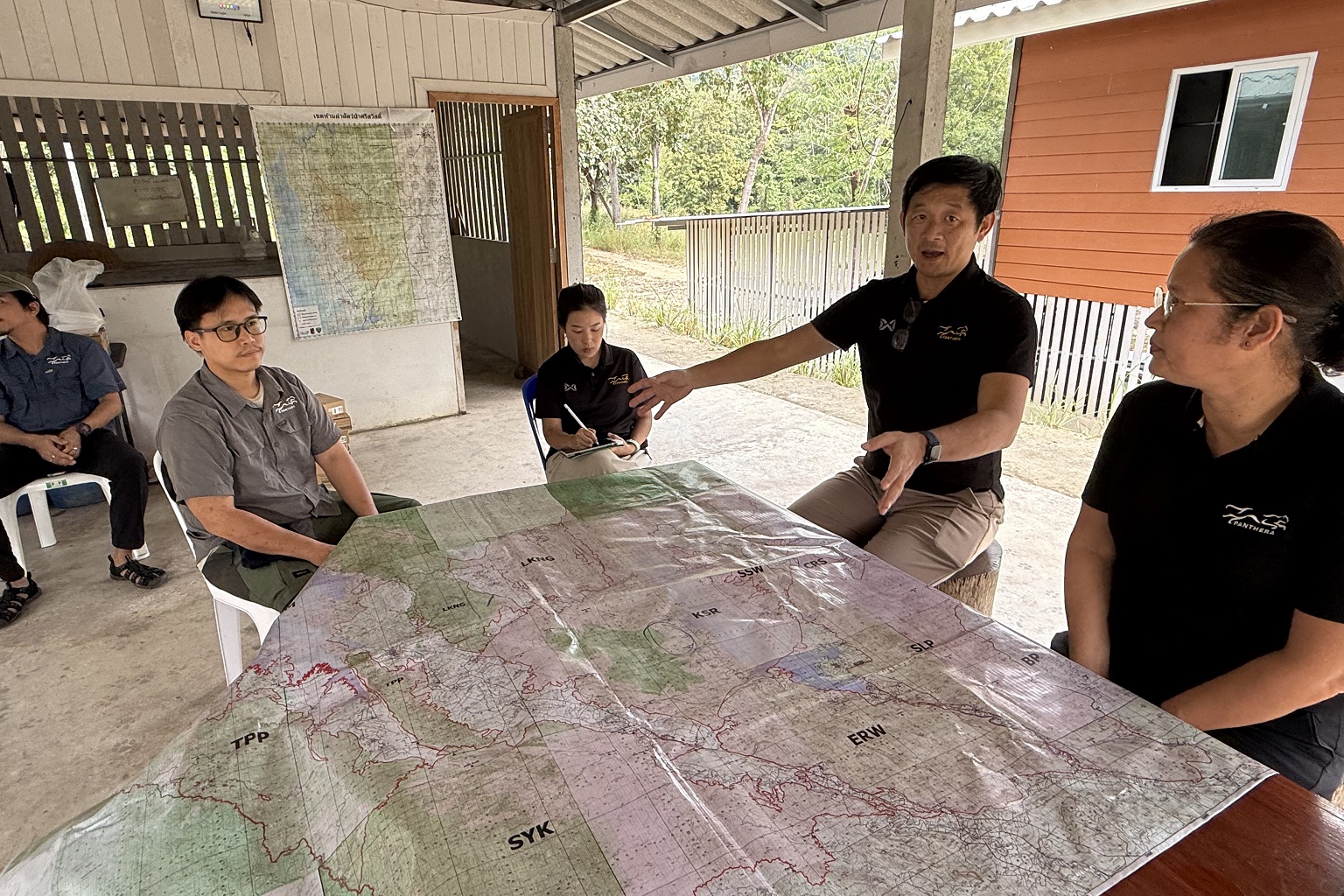 Panthera’s Rattapan Pattanarangsan discusses the protection of Thailand’s southern Western Forest Complex at a new ranger checkpoint in Si Sawat Non-Hunting Area.
Panthera is now working with the government to also declare an additional 140-km2 (54-mi2) extension site as a non-hunting area, widening the tiger’s path. That process, it says, is about 30% complete.
One male tiger is even using Si Sawat as part of his home range. More critically, Pattanarangsan says, “for the most recent year, we found that now the tigers are reproducing in south WEFCOM. It used to be the sink. But now we are the source.”
In late 2023, a camera trap picked up three new tiger cubs in south WEFCOM. Scientists suggest the lower ranges could permanently support about 47 tigers, with an estimated 26 tigers currently living in the area.
“But that is why we are worried,” Pattanarangsan says. “Because compared to the core WEFCOM we have high human density [in the south]. The young and stupid tigers move around. The older tigers are wise.”
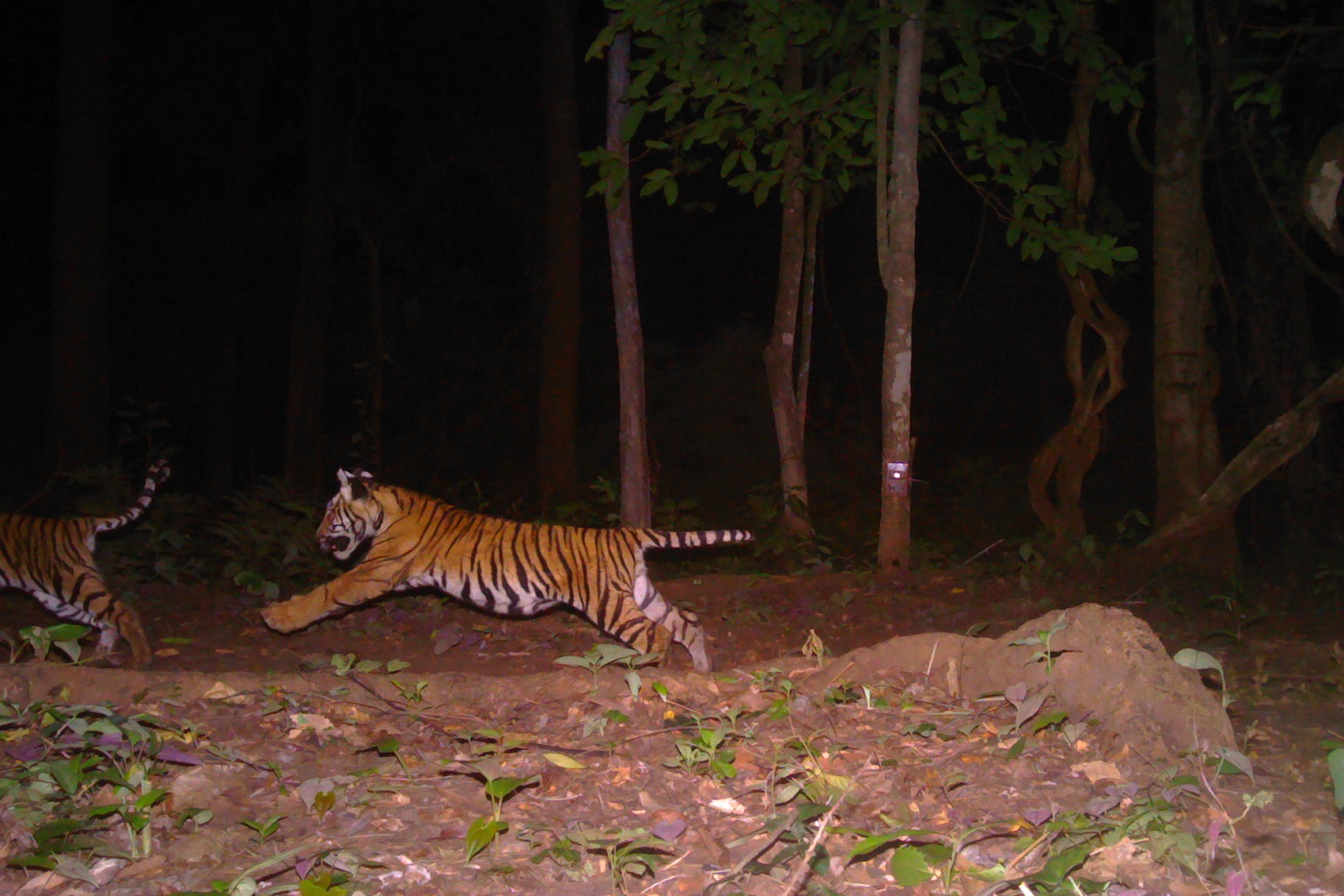 The cubs of tiger TWT128F playfully running around in the Salakpra Wildlife Sanctuary. Image by Panthera/DNP.
Of tigers and elephants
Somnuek Sawatchotidet, 72, has lived in the forests of Si Sawat his entire life. Two years ago, while walking through the forest about 10 km (6 mi) from his home in the village of Ong Sit, he glimpsed a tiger.
“I was around a bee’s nest. The nest fell and [the tiger] was eating the small bees,” Sawatchotidet recalls, sitting on the porch of his wooden home. “I wasn’t scared. I felt like we were friends.”
Sawatchotidet says he’s seen many tigers throughout his life, especially when he was young, traveling with his father through the forest. Once, in his childhood village of Na Suan, a tiger killed someone’s pig and the villagers killed the tiger in revenge. Its carcass was left to rot because tigers were so common at the time that they were seen to have little value, he says.
But since then, tigers — and their prey — have become scarce. Sawatchotidet says he used to hunt small mammals for food in the forest, and only stopped after his son became a ranger with the national parks department.
Sawatchotidet says he’s happy about having more tigers in the landscape; he says he hopes they’ll be able to control the elephant population — a common refrain among those living in the Si Sawat area. “Sometimes they eat the baby elephants,” he says. “Tigers have principles. If we don’t bother them, they don’t bother us.”
When it comes to coexisting with wildlife, Asian elephants (Elephas maximus) are the core concern for people living near WEFCOM. In Si Sawat, sweeping fields of maize abut the forest, with elephant patrol towers stationed every few hundred meters for farmers to keep watch over their crops at night. Every so often, someone is gored or trampled by an elephant in Kanchanaburi.
Because wildlife management in Thailand is governed in part by Buddhist beliefs, the national parks department won’t kill elephants deemed by locals to be a problem. Tigers, villagers say, might be able to do the job instead.
“Karen people have certain beliefs not to [harm] the tiger,” says Panthera’s Pattanarangsan. “Even if a tiger eats your cattle, nothing is done. This is favorable for the tiger.” The challenge, he adds, is that the Karen people, a diverse ethnic group, also rely on consuming animals from the forest, often the same prey as the tiger’s.
With Si Sawat officially protected from hunting, the focus now is to boost the tiger’s prey to sustain a growing southern population.
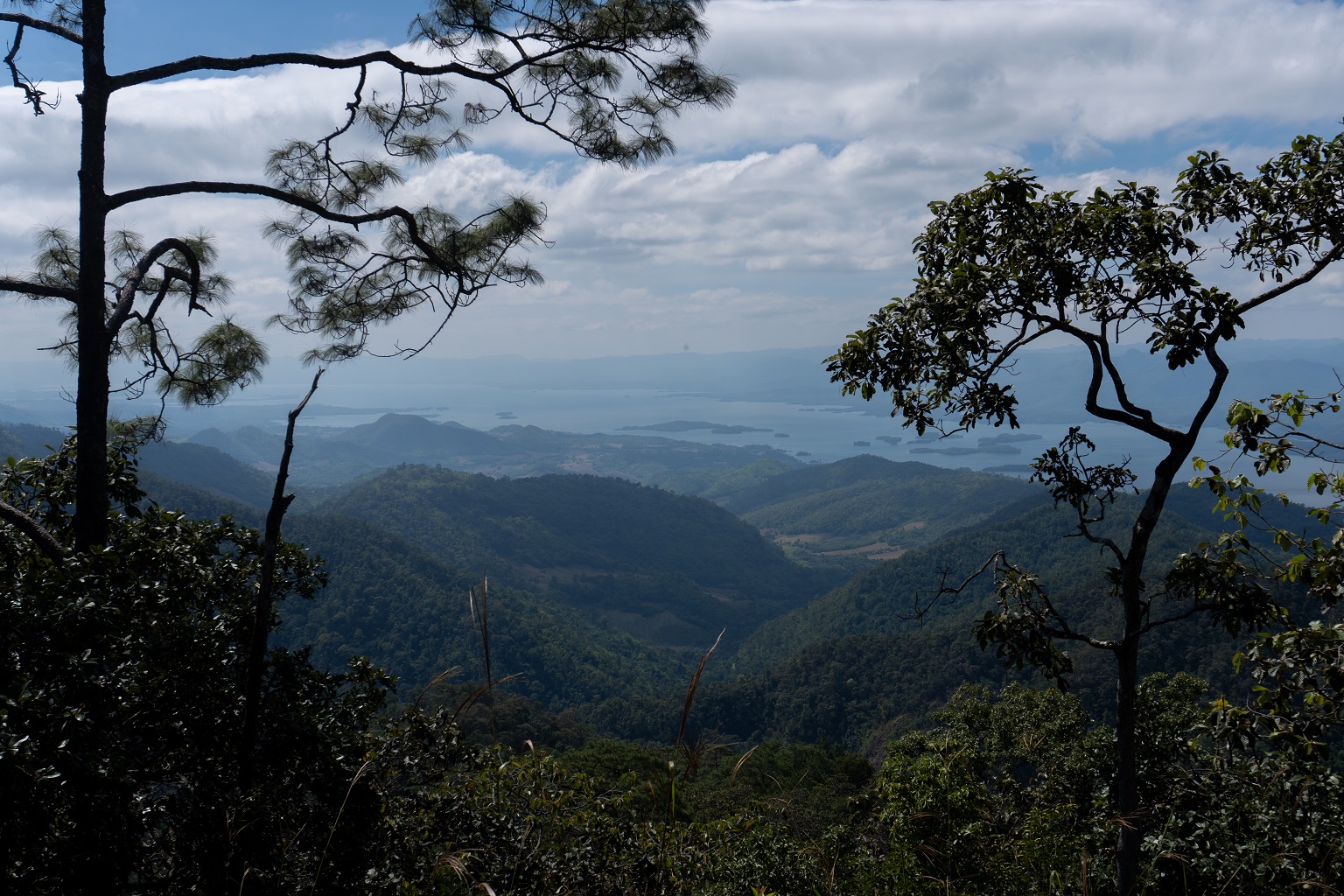 Tigers traverse the grassy ridgelines of Si Sawat Non-Hunting Area, which overlook Sinakharin reservoir.
Future tigers — and prey
At a newly constructed ranger checkpoint in the Si Sawat Corridor, Prawut Prempree, the national parks department’s founding chief for the area, lays out his vision for the future. A half-dozen rangers mill around the bunkhouse and kitchen, fresh off their latest antipoaching patrol through the forest.
“We try to look through the eyes of animals. If we think about what tigers want the most and what sustains them, it is prey,” Prempree says. “If we look through the eyes of the prey — deer, gaur and banteng — we must consider the forest conditions they need to thrive.”
Prempree has championed the Si Sawat Corridor from within the government for more than a decade; in many ways, this is his life’s work. Hunched over a large map of WEFCOM, he describes the next steps to make the tiger feel at home in the southern part of the range.
In northern WEFCOM, conservationists have been breeding sambar deer in captivity and releasing them into the core of the habitat for years. In 2024, the department began to do the same in southern WEFCOM, starting up a five-year project. So far, Prempree says, about 20 sambar have been released into the area’s forests. But those animals were trucked in from breeding stations in other provinces. Banteng (Bos javanicus), a species of wild cattle closely related to gaur, are also being reintroduced into Salakpra Wildlife Sanctuary.
Prempree says he hopes to one day have a sambar breeding center and reintroduction program located within southern WEFCOM. In the meantime, Panthera has found that populations of smaller tiger prey are still increasing. The abundance of wild boar, lesser mouse-deer (Tragulus kanchil) and two species of muntjac deer were all found to be increasing in recent surveys in the area.
Reflecting on the work to protect this corridor, Prempree says he is grateful for Karen peoples’ willingness to coexist with the forest and the animals.
“I’m touched by the condition of the forest and how fertile it is,” he says.
“Higher tiger numbers — that is our hope.”
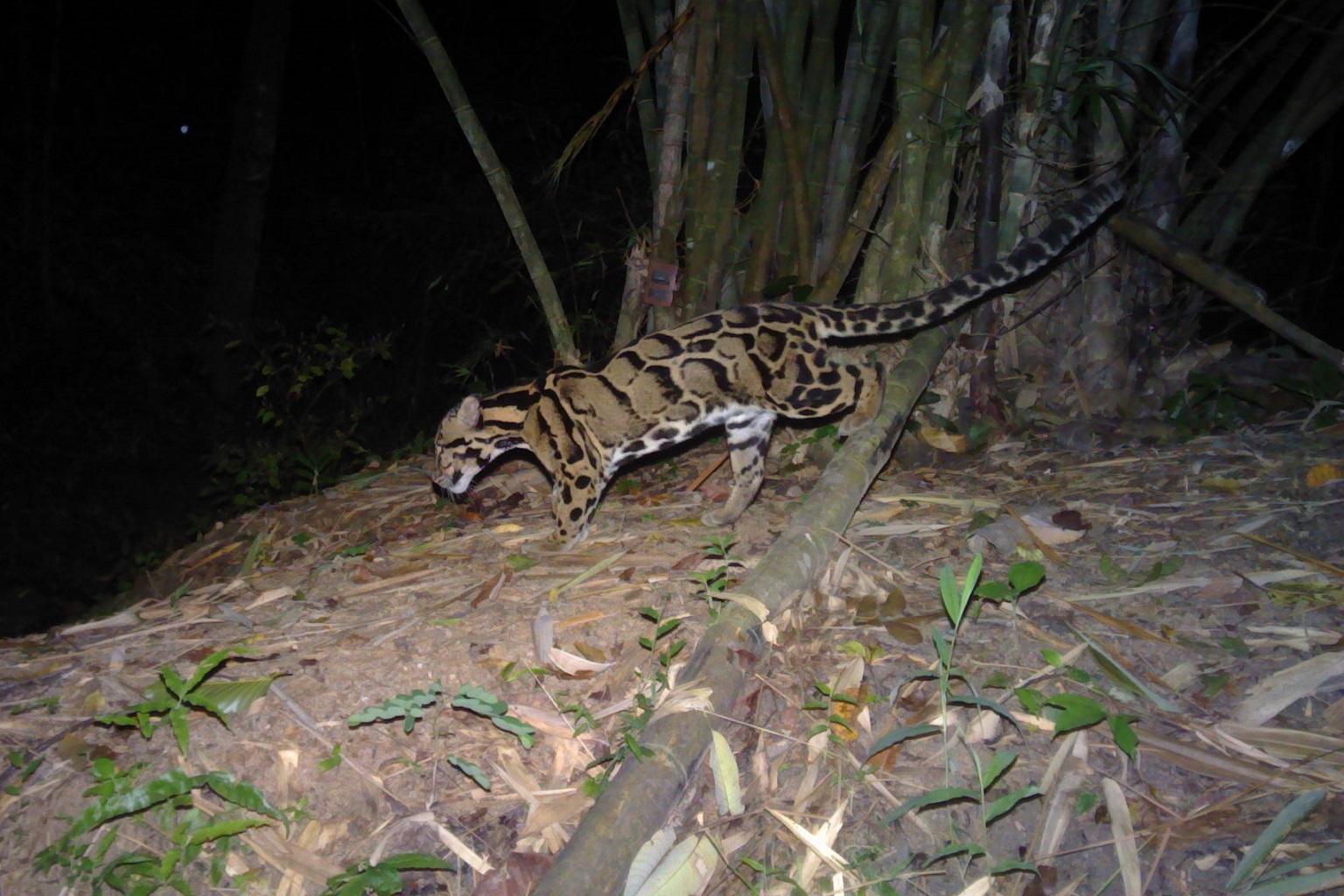 Male clouded leopard SWC005 in the Sri Sawat Non-Hunting Area roams in search of food at night. Image by Panthera/DNP.
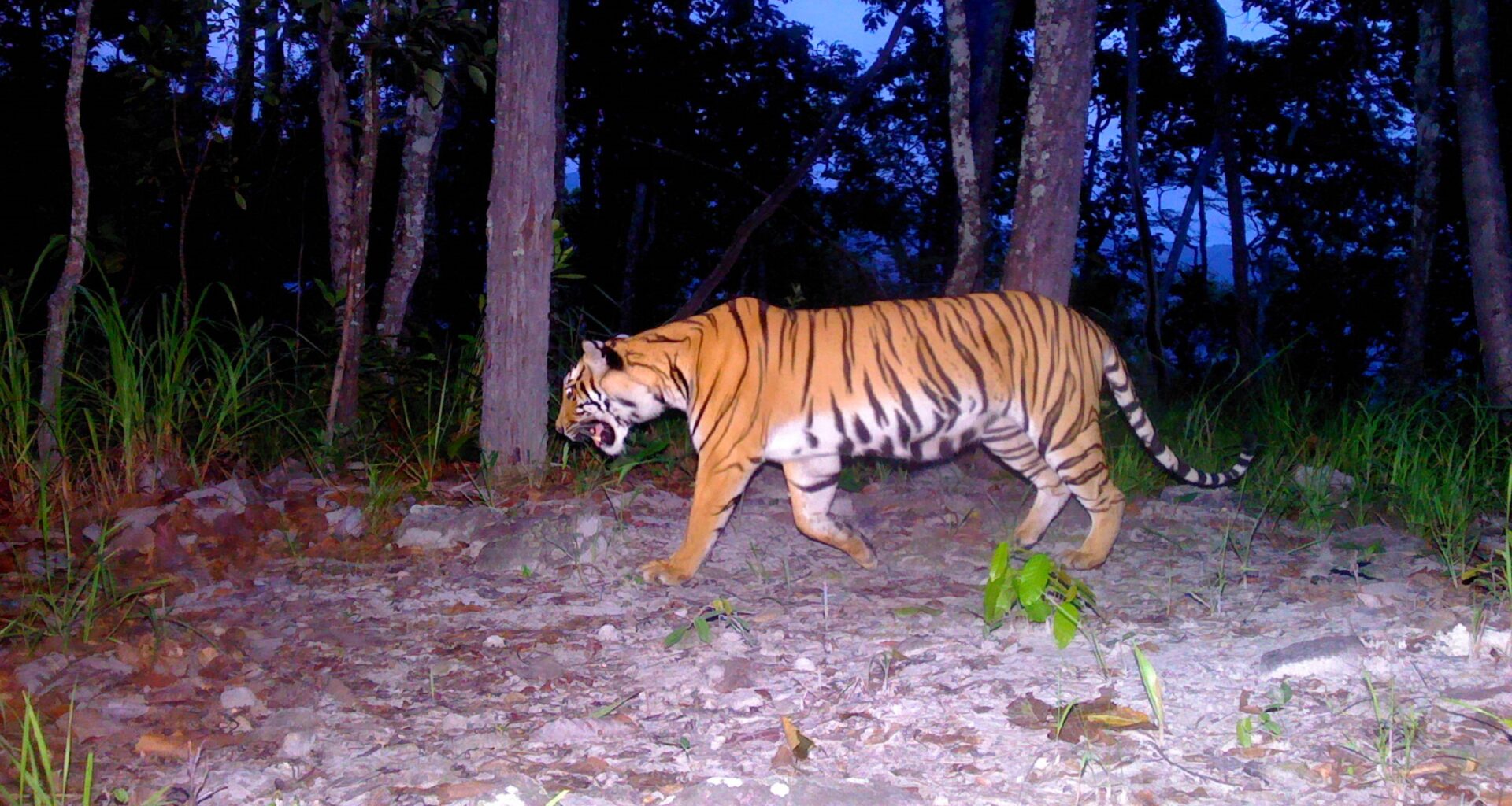
Banner image: Previously undetected in other protected areas, a tigress known as SWT001F was the first individual tiger captured on camera in Thailand’s Sisawat Non-Hunting Area in 2024. Panthera, Thailand’s DNP and other partners are working to monitor and protect Indochinese tigers and their prey in this region where camera traps have shown tigers are using Sisawat forest as a corridor. Currently plans exist to propose the adjoining forest area to the east as an extension of Sisawat. Image by Panthera.
Citations:
Ash, E., Cushman, S. A., Kaszta, Ż., Redford, T., & Macdonald, D. W. (2025). Can Southeast Asia’s tigers break free? The connectivity, constraints, and recovery of the region’s remaining tiger populations. Animal Conservation. doi:10.1111/acv.70021
Duangchantrasiri, S., Sornsa, M., Jathanna, D., Jornburom, P., Pattanavibool, A., Simcharoen, S., … Karanth, K. U. (2024). Rigorous assessment of a unique tiger recovery in Southeast Asia based on photographic capture-recapture modeling of population dynamics. Global Ecology and Conservation, 53, e03016. doi:10.1016/j.gecco.2024.e03016
Phumanee, W., Steinmetz, R., Phoonjampa, R., Weingdow, S., Phokamanee, S., Bhumpakphan, N., & Savini, T. (2021). Tiger density, movements, and immigration outside of a tiger source site in Thailand. Conservation Science and Practice, 3(12). doi:10.1111/csp2.560
Jornburom, P., Duangchantrasiri, S., Jinamoy, S., Pattanavibool, A., Hines, J. E., Arnold, T. W., … Smith, J. L. D. (2020). Habitat use by tiger prey in Thailand’s Western Forest Complex: What will it take to fill a half-full tiger landscape? Journal for Nature Conservation, 58, 125896. doi:10.1016/j.jnc.2020.125896
Simcharoen, A., Simcharoen, S., Duangchantrasiri, S., Vijittrakoolchai, C., & Smith, J. L. D. (2021). Exploratory dispersal movements by young tigers in Thailand’s Western Forest Complex: The challenges of securing a territory. Mammal Research, 67, 21-30. doi:10.1007/s13364-021-00602-6
