
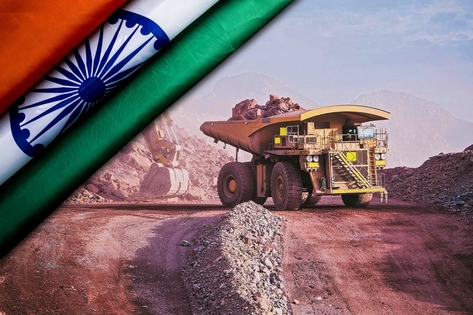
In today’s global scenario, where geopolitical events and their economic impact are uncertain, it is unsurprising that minerals such as lithium, cobalt, nickel, graphite, and rare earth elements are no longer viewed merely as raw materials. They are now seen as strategic and pivotal instruments that determine industrial competitiveness and national resilience.
This situation makes it important for a rising economy like India to focus on accelerating its commitments towards critical mineral security. Such an approach aligns with the country’s objectives of clean energy transition, defence modernisation, and high-tech manufacturing goals.
At present, India relies on imports for most crucial minerals and remains fully dependent on external suppliers. This dependence exposes the country to hegemonic global supply chains and makes it susceptible to price volatility and unprecedented geopolitical eventualities.
Hence, mineral security is a core economic and strategic priority, crucial for India’s long-term economic growth, technological progress, and security. To meet these priorities, the Government of India approved the National Critical Mineral Mission (NCMM) in 2025, which aims to support the exploration, mining, processing, and recycling of critical minerals.
Critical Minerals Shaping India’s Strategic and Economic Landscape
India imports almost all of its requirements for several key critical minerals. For at least ten minerals, the country is entirely dependent on foreign suppliers, while for others the dependence ranges from 60 to 80 per cent. This extensive reliance on imports is detrimental, as the global processing and refining of many critical minerals is concentrated in only a handful of countries.
In this context, China’s massive footprint in the processing of lithium, cobalt, nickel, graphite, and rare earth elements could culminate in supply chain interruptions. Such disruptions would unequivocally affect India’s energy transition goals, electronics manufacturing, defence production, and emerging sectors such as electric mobility.
This vulnerability became evident on 4 April 2025, when China placed seven medium and heavy rare earth elements and related magnets under its dual-use export control regime. As a result, several rare earth materials and magnet products became subject to stricter export controls and licensing requirements, causing delays in international shipments and immediate uncertainty for dependent industries. China added more items to this list in October 2025.
India requires a steady supply of essential minerals to support its technological ambitions, sustain economic growth momentum, and reduce exposure to geopolitical risks. As a remedial measure, the Union Cabinet approved the National Critical Mineral Mission in 2025 with an expenditure of Rs. 16,300 crore. State enterprises and private companies are expected to invest Rs. 18,000 crore, bringing the total planned investment to approximately Rs. 34,300 crore between 2024 and 2031.
The mission focuses on strengthening every level of the critical mineral value chain. This includes large-scale exploration, mining, refining, processing, recycling, and the development of skilled labour. An estimated 1,200 exploration projects will be supported by national geological agencies, and several mineral blocks have already been discovered and auctioned to accelerate commercial development. The mission also aims to establish dedicated processing parks for industries that depend on refined materials.
A key issue in India’s mineral landscape is that although the country processes minerals such as copper, graphite, rare earths, silicon, titanium, tin, and zirconium, the quality of processing often does not meet the standards required for advanced applications. High-purity materials are essential for industries such as electronics, renewable energy, and defence, and Indian facilities still have scope to expand expertise in this domain.
Globally, processing capacities remain heavily concentrated in China, which controls nearly 90 per cent of the world’s rare earth processing. Such dominance creates vulnerabilities if alternatives are not developed in time. To reduce these risks and bridge technological asymmetries, India requires stronger midstream processing capabilities, modern refining technologies, and skilled personnel. The NCMM seeks to address these gaps by promoting technology development, expediting clearances, and encouraging greater private sector participation.
The government has designated major national research institutes as centres of excellence under the NCMM, including the Indian Institute of Science (IISc). Several IITs are responsible for developing novel methods and pilot-scale processing facilities, including solvent extraction, separation, and high-purity oxide technologies. These institutions are also improving battery recycling techniques, recovering valuable metals from industrial waste, and producing high-quality materials for advanced applications.
These centres are expected to integrate laboratory research with industrial application, with a focus on technologies relevant to defence, aerospace, clean energy, and semiconductor production. Developing such strategic research infrastructure will help India reduce its dependence on external technologies, highly specialised equipment, and premium supplies.
For semiconductor-related applications, research teams working under the NCMM are developing rare earth-based polishing materials, phosphors, and specialised optical compounds for chip manufacturing. These efforts align with the India Semiconductor Mission (ISM), which aims to increase the number of chip fabrication and assembly and testing facilities in India.
Recycling has been prioritised as a key mechanism for securing essential minerals. Recovering minerals from industrial waste, spent batteries, and electronic waste can reduce mining pressure and deliver environmental benefits. The government has introduced a Rs. 1,500 crore incentive programme to support the recycling industry, with a target of recovering up to 40,000 tonnes of critical minerals from secondary sources.
Customs duties on scrap and other waste containing critical minerals have been removed to encourage domestic recycling units. Pilot projects are also testing the recovery of mining waste, red mud, fly ash, and tailings. These initiatives support the development of a circular economy and help minimise import dependence while promoting sustainable resource use.
India recognises that domestic reserves alone will not meet future demand. As a result, the NCMM promotes strong international partnerships, with a particular emphasis on research and innovation. Start-ups, MSMEs, and research institutions will receive support to develop processing and recycling technologies. Overseas investments and partnerships through Khanij Bidesh India Limited (KABIL) are intended to secure access to minerals not available in sufficient quantities domestically.
India is working with countries such as Argentina, Australia, and Chile through KABIL to secure lithium and other mineral resources. These partnerships will enable supply diversification and help cushion potential geopolitical shocks. As global demand for critical minerals rises and competition intensifies, international collaboration will become a cornerstone of India’s strategy. Long-term agreements and overseas assets will help balance domestic shortages and sustain industrial growth.
Augmenting Strategic Manufacturing: Increasing Relevance of Rare Earth Magnets
A significant shift in India’s approach to critical minerals occurred in November 2025, when the Cabinet approved a Rs. 7,280 crore initiative to manufacture rare earth permanent magnets domestically. India imported approximately 54,000 tonnes of these magnets in 2024–25 for use in electric vehicles, wind turbines, electronics, defence systems, and robotics. The new programme aims to establish facilities with a capacity of 6,000 metric tonnes per year, signalling India’s intent to move beyond raw material extraction to high-value manufacturing.
Despite these measures, several challenges remain. Some of India’s mineral deposits are of lower grade, which increases extraction costs. Processing technologies for high-purity materials are insufficient and require substantial investment, along with trained professionals in mining engineering, metallurgy, and advanced materials science.
Processing and recycling infrastructure remains at a nascent stage and must be scaled up rapidly. Environmental management is also a significant concern, as mineral processing involves chemicals, waste, and emissions that demand careful handling. Addressing these challenges will require close coordination between central and state governments, private enterprises, research institutions, and associated agencies.
If India succeeds in building an efficient framework to implement its critical mineral policy, the benefits could be substantial. Reduced import dependence would strengthen sectors that rely on steady access to specialised materials, including defence production, renewable energy equipment, advanced electronics, and electric mobility. With reliable domestic inputs, capacity for batteries, solar components, wind turbine parts, electric drivetrains, permanent magnets, and other high-value materials can expand.
This would also lower production risks for industry and generate employment across advanced manufacturing, mining, and processing. Greater recovery from electronic waste, end-of-life batteries, and industrial residues would reduce reliance on primary mining and improve resource efficiency. India would then be better positioned to supply both domestic and international producers with high-purity materials.
The NCMM represents a structural shift in how India addresses long-term resource needs. It seeks to close gaps that previously hindered scale and coordination by integrating exploration, processing, recycling, technology development, and international partnerships within a single framework. The approval of large-scale rare earth magnet manufacturing capacity indicates that implementation has begun in sectors vital to clean energy and critical industries, although notable obstacles remain.
Nevertheless, the policy direction is clear. India is establishing a comprehensive framework that can be adopted by relevant industries and ensure secure mineral supplies. This will determine competitiveness and security in the years ahead, vis-à-vis effectively circumventing chokepoints in highly concentrated global critical mineral value chains.