
Back to Article List
Visible in the early morning, Comet Schaumasse is entering a region rich with galaxies, now passing near M98, M99, and M100.
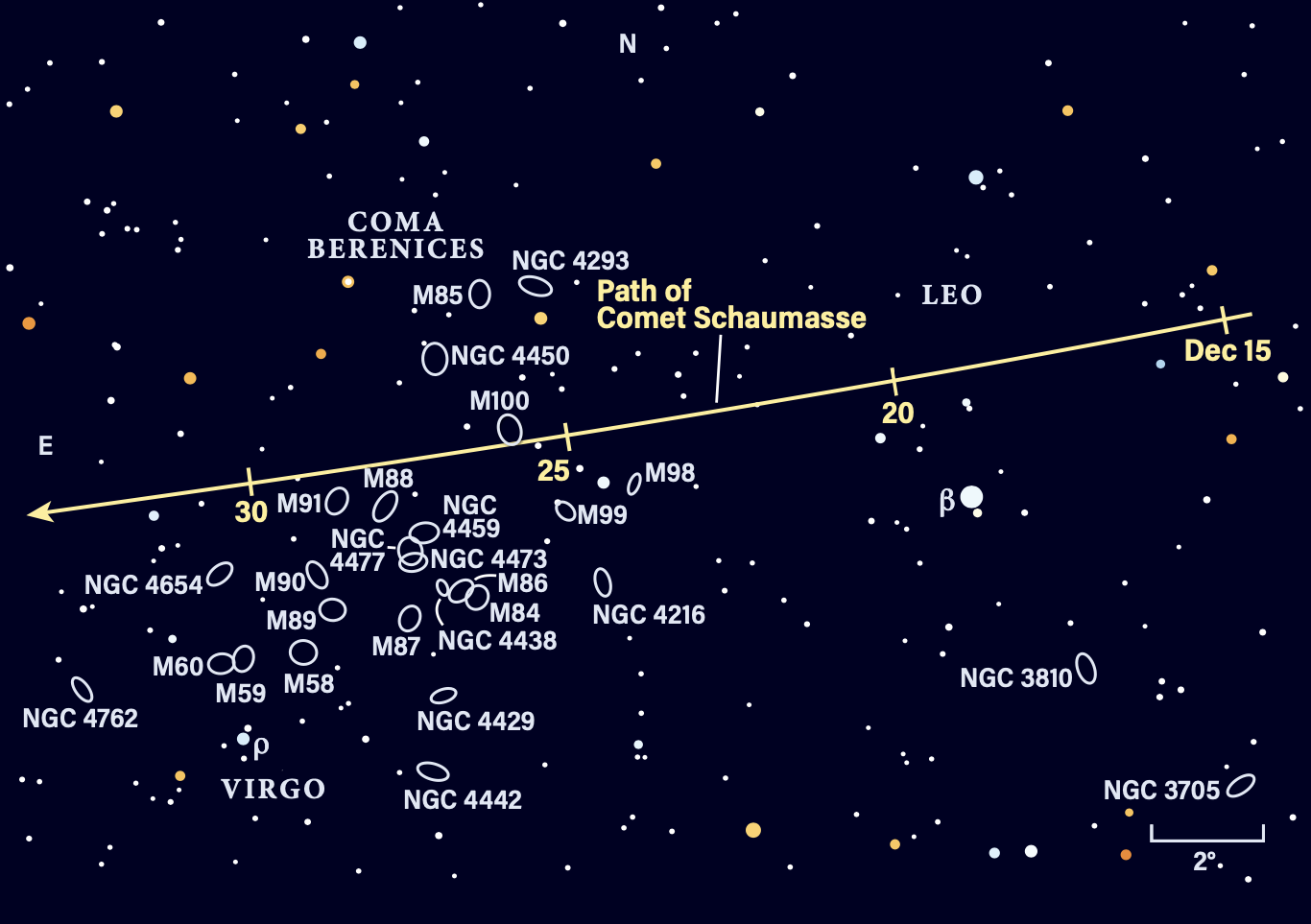
This chart shows the path of Comet 24P/Schaumasse in the second half of December. Galaxies are shown down to magnitude 11. Credit: Astronomy: Roen Kelly
The Ursid meteor shower is scheduled to peak on December 22.
Comet 24P/Schaumasse, glowing at approximately 11th magnitude, is visible in the early-morning sky as it approaches the Virgo Cluster.
The comet is positioned in far southwestern Coma Berenices, in proximity to several galaxies including M98, M99, and M100, which is described as a brighter grand design spiral within the Virgo Cluster.
Specific astronomical data for December 22 is provided, detailing sunrise, sunset, moonrise, moonset times, and the Moon’s 15% waxing crescent phase, localized for 40° N 90° W.
Looking for a sky event this week? Check out our full Sky This Week column.
December 22: The Ursid meteor shower peaks
Rising around midnight and visible in the early-morning sky, Comet 24P/Schaumasse glows at roughly 11th magnitude as it prepares to enter the rich Virgo Cluster.
Now in far southwestern Coma Berenices, Schaumasse is just 1.7° northwest of M98, an edge-on spiral galaxy that, at magnitude 10.1, glows slightly brighter than the comet. Not far away are M99 (a little farther southeast of Schaumasse) and M100 (about 3.4° east of the comet). M99 is a face-on spiral that contrasts nicely with M98, glowing at roughly the same magnitude (9.9). M100 is brighter at magnitude 9.3 — in fact, it’s one of the brighter galaxies in the Virgo Cluster, offering a lovely example of what astronomers call a grand design spiral, with well-defined arms wrapping around its bright nucleus.
Take your time with this region, enjoying the scene as the faint, fuzzy comet approaches the galactic gaggle. Schaumasse will be passing through this rich region for the rest of the month — hang onto the chart provided above to help you identify both the comet and the galaxies it’s passing over time.
Sunrise: 7:20 A.M.
Sunset: 4:39 P.M.
Moonrise: 10:03 A.M.
Moonset: 8:10 P.M.
Moon Phase: Waxing crescent (15%)
*Times for sunrise, sunset, moonrise, and moonset are given in local time from 40° N 90° W. The Moon’s illumination is given at 10 P.M. local time from the same location.