

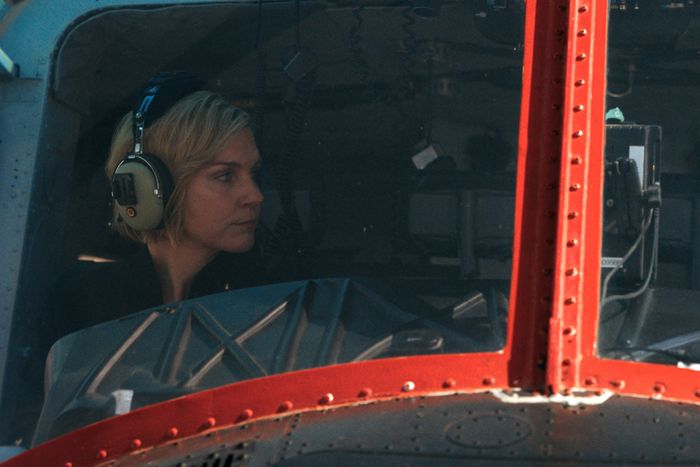
The Pluribus star explains her understanding — or lack thereof — of the season finale: “I’ve gone through a lot of possibilities.”
Photo: Apple TV+
This season of Pluribus ended with nearly as much mystery for its star as its audience. Rhea Seehorn, who plays Carol Sturka in Vince Gilligan’s Apple TV series, has no idea what will happen after the season ends on a massive cliffhanger. In the show’s ninth episode, Carol embarks on a relationship with Karolina Wydra’s Zosia, a representative of the hive that has united nearly all of humanity, but then discovers the hive has taken the eggs she had frozen prior to the beginning of the series, back when she was (not entirely) happily married to Miriam Shor’s Helen. They’re planning to use the genetic material in those eggs to find a way to join Carol with them, seemingly whether she wants to or not. Zosia estimates that they’ll have a solution ready in about a month. Carol reacts to the betrayal with shock, disappointment, and some very Carol rage. “That scene is brutal,” Seehorn told me. “When I read that, I called Karolina. I was like, ‘Man, that is low.’”
But that’s not the end of the episode: Once Carol learns about the hive’s plans, we cut to a scene with Manousos back at the cul-de-sac where Carol lives. He’s studying English and writing in his notebook about the hive. He looks up and sees a helicopter, piloted by Zosia with Carol in the passenger seat, carrying a large shipping container. Zosia drops off both Carol and the package and leaves. “You win,” she tells Manousos. “We save the world.” What’s in the container?, you might wonder. It’s an atom bomb.
”And I don’t know what she does with it, because I asked!” Seehorn said. According to her, show creator Vince Gilligan, who was fond of writing himself into corners on Breaking Bad and Better Call Saul, said he wasn’t sure where Pluribus would head next either. But Seehorn is both baffled and excited about what Carol might do with that bomb. “I’ve gone through a lot of possibilities,” she said. “She wouldn’t kill everybody — that would be opposite to her point. Is she going to threaten them with it? And threaten them how?”
There’s also the question of how Carol will work with Manousos on her plan. Seehorn doesn’t have an answer there, either, but she enjoyed the process of working with Carlos Manuel Vesga on the characters’ long-awaited meetup. For much of the season, Carol has seen herself as stepping, reluctantly or just spitefully, into the position of a lone individual holding out against the hive. But when she meets Manousos, she discovers a person who has an even more radical position than her own. “It was a really interesting question to bring up for Carol: Oh, you think you’re an extremist? What about this guy?” Seehorn said. “Carol’s in a place where she is reminded that, however altered, these are still humans. He keeps saying, No, they’re not even human. That’s closer to what Carol was telling Laxmi when she said her son wasn’t her son. But Manousos’s extremism could be violent and without care. Carol cared from the beginning that she killed people by screaming and yelling.”
The conversations between Carol and Manousos presented a tricky and exciting technical challenge, because the characters are speaking to each other through a handheld automatic translator, and the actors had to determine when exactly their characters might understand each other. “Carlos Manuel speaks perfect English. I do not speak Spanish, but I’ve rehearsed the scene enough times to know what he’s saying,” Seehorn says. “We both had to stop each other from picking up the cue, to not let your face react before we listened to the translator. But of course, they’re both intelligent people, so there’s still a few words they would understand.”
In addition to those insights into the finale, Seehorn discussed some of the details Pluribus fans have fixated on throughout the first season. For one, she thinks Carol’s dismissal of the readers of her sci-fi romance books, seen when Carol’s introduced in that first episode, has more to do with Carol’s own self-destructive psychology than anything else. “I find that most people that are writers have had no problem figuring out that she’s not actually mocking her fans,” Seehorn told me. “I think she thinks she’s very good at her work. She wouldn’t frame her stuff all over the house and have copies of her books everywhere. But it is that idea of, I’ll be successful when, I’ll be happy when, I’m an actual writer when. It’s also being terrified of believing the hype, of beating everyone to the punch.”
Seehorn was also involved in another crucial aspect of Carol: her hair. If you watched Better Call Saul, you’ll remember the narrative importance of Kim Wexler’s perfectly tight ponytail. For Pluribus, Seehorn felt it was important to differentiate the look of her new character. “My first thought when I got the first three scripts was that I’m supposed to look dirty, wet, or greasy for a very long time, and if we’re going to keep track of long hair through all of that, we’re going to go insane,” Seehorn said. She wanted to mark a stark difference between Kim and Carol and also allow herself to embrace a new hairstyle after so many years playing Kim. “There were still people that thought this was going to be a Kim Wexler spinoff,” she says, so she went to Gilligan with the pitch that they lop off a lot of her hair. She liked the idea that Carol would have hair she could do up into something professional for her bookstore signings and was otherwise not fussy, yet still stylish. “He was like, ‘I love it. Can I see the cut an inch at a time?’”
Eventually, the Pluribus team settled on the bob you see in the series, but there’s still a fun Wexler-ish Easter egg in the way Seehorn’s new hair is introduced. In the first scene with Carol, she’s introduced in a dolly shot from behind, bob first. Seehorn says Pluribus’s “A” camera operator Matt Credle, who filmed that shot and also worked on Saul, pointed out how much it resembled one of the many shots of Kim Wexler’s ponytail they’d filmed in the past. “I got goosebumps when I saw it,” Seehorn said. “I hadn’t thought about how clear it would be to an audience — the ponytail’s gone.”