
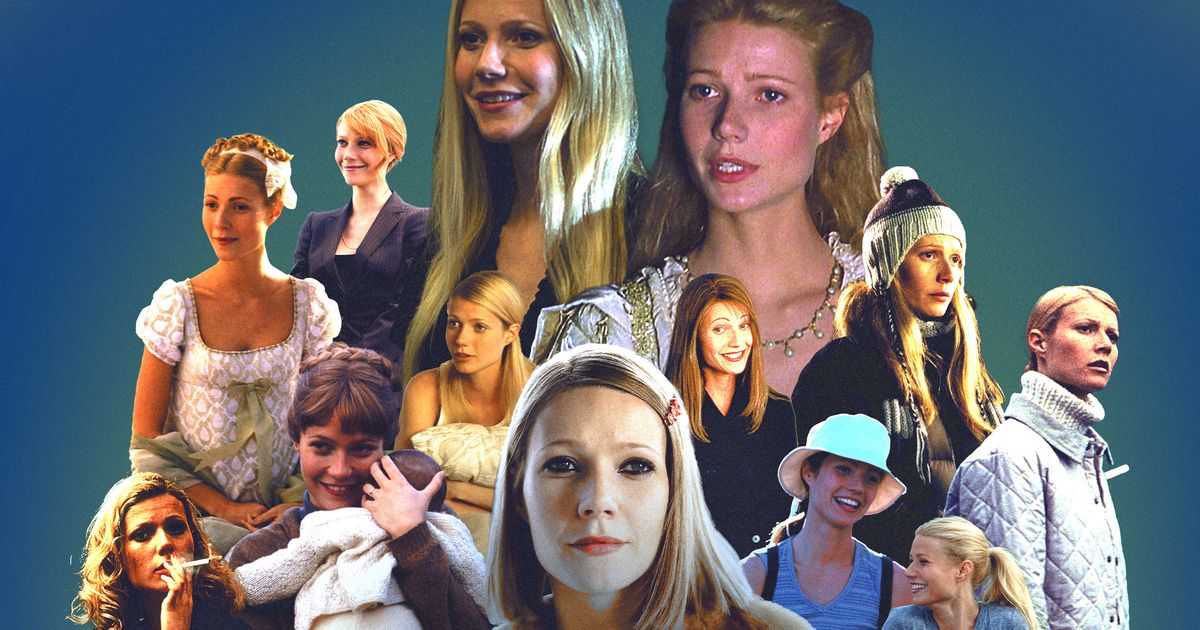
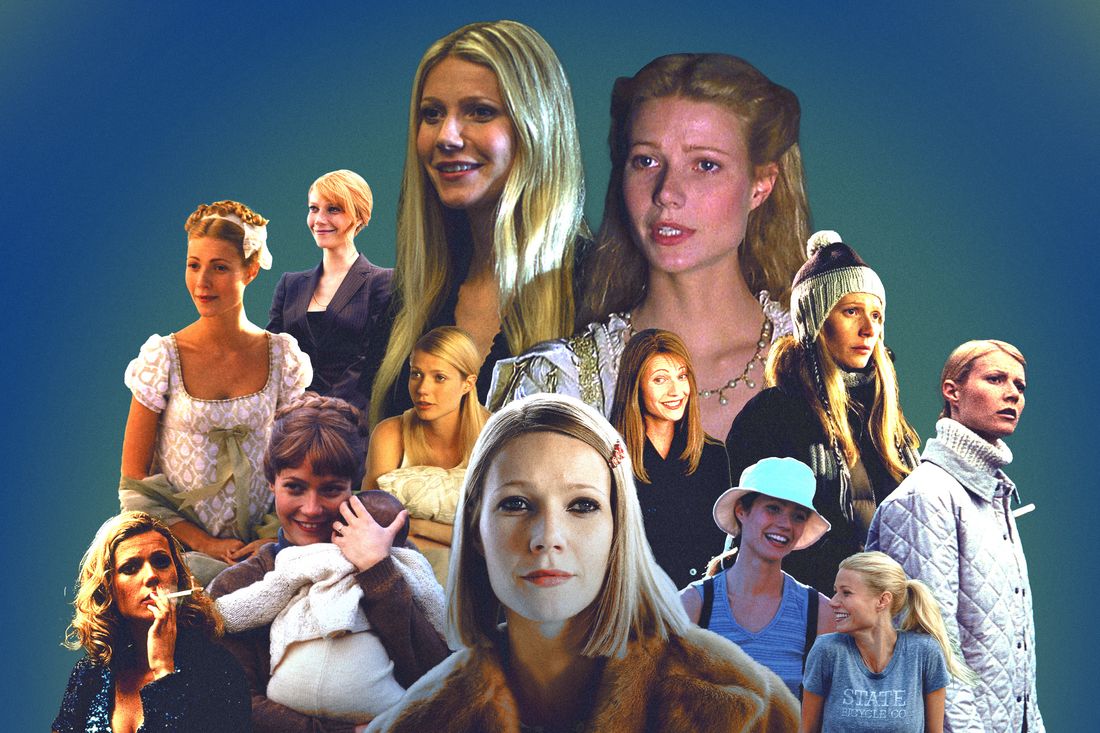
Photo-Illustration: Vulture; Photos: Everett Collection
Few names in Hollywood are more polarizing than Gwyneth Paltrow, which was the case even before she sold a $75 candle called This Smells Like My Vagina. Paltrow began her career with a baked-in narrative: Here came a well-traveled 17-year-old with famous parents (Blythe Danner and St. Elsewhere director Bruce Paltrow), a more famous godfather (Steven Spielberg), a prep-school education, and preternatural poise — all of which made her a forerunner of nepo-baby discourse. One of the central questions governing Gwyneth’s fame has been whether she’s actually a great actress. She has disputed it at times, too, saying that acting was never her true calling. Apparently, Paltrow was destined to be a wellness entrepreneur, hence the colossal cultural force that is Goop. If some people doubt her validity as a performer, still more indict her qualifications as a guru peddling coffee enemas and bee-venom facials. And yet, she remains one of the lifestyle industry’s most visible luminaries.
Wherever you fall in the great Gwyneth divide, it’s hard to deny she is a master at commanding attention. Who else is powerful enough to popularize a phrase that redefines the very idea of divorce? Who rivets a nation with every outfit, every expression, and every word uttered in the aftermath of an alleged ski-slope collision? Who forgets entire movies they’ve made? Some of the contempt directed at Paltrow is silly. Being charmingly out of touch is what celebrities are for! Then again, she did once hawk a $15,000 24-karat-gold dildo.
The thing is, Paltrow is a talented actress; she’s just not a chameleon. She seldom leaves her Gwyneth-ness behind, and it’s rare to be blown away by her choices in any given scene. Paltrow often plays characters whose refinement seems to match hers — and yet, some of her best performances come when she’s channeling women who are a bit more, shall we say, troubled. You can’t imagine Paltrow sharing their problems. Maybe that’s why she’s able to release herself to the material. No matter what, though, she is immensely watchable. Her charisma — as convincing as an Elizabethan romantic as it is an “I lost half a day of skiing” cause célèbre — cannot be manufactured.
Now, with Marty Supreme, Paltrow’s taking on her most significant movie role in a decade. We’re taking the opportunity to rank her performances, with a few caveats. We’re omitting hard-to-find TV movies and miniseries (Cruel Doubt, Deadly Relations), tiny supporting roles and cameos (Hook, Austin Powers in Goldmember, Infamous), and voice roles (American Horror Stories). That still leaves us with a compelling résumé — not a ton of films that are excellent as a whole, but more than enough solid performances to justify Paltrow’s stardom.
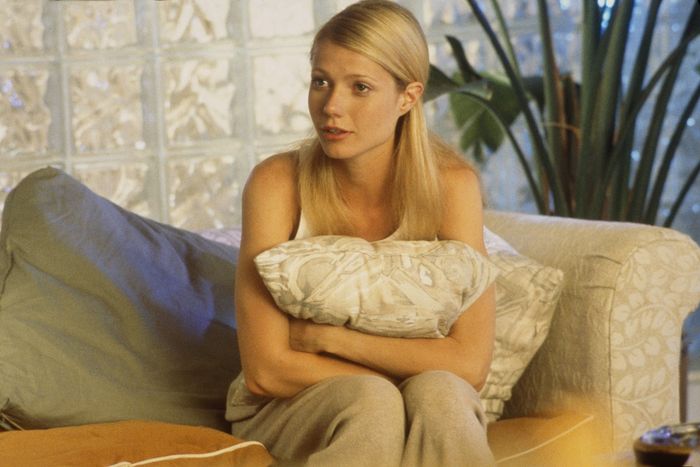
Photo: TriStar Pictures/Everett Collection
Jessica Lange called Hush a “piece of shit.” She and Paltrow shot the Kentucky-fried thriller in 1996, after which it was test-screened to death. They got called back for reshoots that changed the ending and put Paltrow in an ungainly wig. At least the hairpiece is more entertaining than the predictable cat-and-mouse contest involving a farm owner trying to off-load her pregnant daughter-in-law. Paltrow gives a curiously pulseless performance that might have impugned some of her blossoming star power had Hush opened when it was supposed to. She’s hesitant in embracing the story’s inherent melodrama, helping to turn what could be fun schlock into a witless slog.
No one makes it out of this distressingly unfunny Johnny Depp vehicle unscathed. Paltrow has pulled off many a British accent in her time but totally bungles it here, one of many indicators that Mortdecai is a waste. She and Depp overenunciate everything, seemingly for some sort of theatrical comic effect. Maybe they do it to cover up the lack of jokes, the dull plot, or the overly frantic action. Pastiche doesn’t work if everyone is sleepwalking through it.
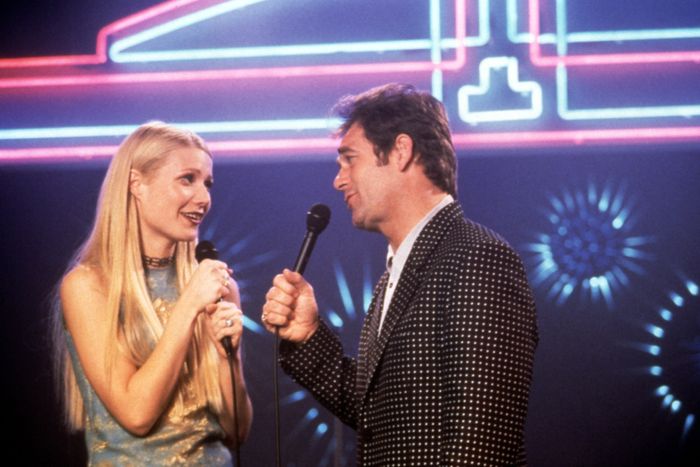
Photo: Walt Disney Co./Everett Collection
Paltrow seems to be doing a light Phoebe Buffay impression in her father’s little-seen dramedy, which merges story lines revolving around competitive karaoke bars. She’s even styled like Phoebe, at one point wearing a purple leather jacket and butterfly hair clips. But Paltrow is not Lisa Kudrow, and Duets is too shaggy to support the fusion of ditziness and vulnerability required of her. One upside: She sings “Bette Davis Eyes” in an extremely era-appropriate tattoo choker.
With Duets and The Good Night, Paltrow has more than met her family-favor quota. In this one, written and directed by her brother, Jake, she’s a frumpy New York gallerist enduring a loveless relationship with a jingle writer (Martin Freeman) who longs for his halcyon rock-star days. Said boyfriend gets really into lucid dreaming, and sometimes Paltrow’s voice emerges from the body of Penélope Cruz, who plays his fantasy woman. Jake obviously cast his sister in hopes of drawing attention to the movie, but he sabotaged her in the process — her character is naggy and annoying, and there’s not much to latch on to beyond those attributes.
Whether Sky Captain and the World of Tomorrow works depends on your appetite for its desaturated CGI, wherein every inch of every frame looks purposefully artificial. That applies to the performances, too. The actors’ stilted, exposition-heavy noirspeak, meant to emulate pulp comics and sci-fi movies from the ’30s and ’40s, is as emotionally thin as the robots and zeppelins that trigger the action. Paltrow is almost doing Barbara Stanwyck drag, and that’s kind of fun. Jude Law — Sky Captain himself! — recommended his Talented Mr. Ripley co-star for intrepid newspaperwoman Polly Perkins, comrade to his gallant mercenary. If Paltrow sometimes looks uncomfortable in the role, blame it on the blue screens she was staring at the whole time.
Paltrow simply isn’t weird enough for the menagerie of misfits who populate this meandering adaptation. Ryan Murphy turned Augusten Burroughs’s arch memoir into a chore, and his actors don’t seem to share an understanding of what its tone should be. As a frigid Bible thumper who at one point shows up in cornrows, Paltrow tries to go kooky, but she’s a bit lost. She’s not alone — the movie isn’t poignant or whimsical enough to surpass freaky-family caricature.
Paltrow said she initially couldn’t wrap her head around the volatile alcohol abuse she had to portray as a tragic country idol in this overwrought box-office dud. It shows. She resorts to histrionics, her chunky southern drawl and mascara-terrorizing tears as underdeveloped as the story. It’s a sympathetic enough role — we’re not monsters here — but Country Strong’s self-seriousness does Paltrow no favors.
All Merchant Ivory movies are not created equal. Case in point: this soggy costume drama about Thomas Jefferson (Nick Nolte) during the five years he served as French ambassador, including his liaisons with the teenage slave Sally Hemings (Thandiwe Newton). Paltrow plays Jefferson’s daughter Patsy, tormented by the memory of her late mother and the whole notion of slavery. Her Virginia accent is convincing, but, like most of the cast, she floats through the overstuffed pageantry without much spark.

Photo: Adam Rose/Fox/Everett Collection
Upon arrival, Paltrow declares that Holly Holliday isn’t “your average, run-of-the-mill substitute teacher.” She wears a miniskirt, makes weed jokes, and ditches “Don’t Stop Believin’” for CeeLo Green. It’s all good fun, but Paltrow overwhelms the five Glee episodes she’s in. Winning a Guest Actress Emmy for the role probably had more to do with her notoriety than anything else (it should have gone to Elizabeth Banks for 30 Rock). But between this, Duets, and Country Strong, it’s clear that Paltrow needs to make a proper musical at some point.
It’s pretty impressive that only a few years into her career, Paltrow could hold her own opposite supernovas like Whoopi Goldberg and Kathleen Turner. What’s less impressive is Moonlight and Valentino in aggregate. The dramedy reduces a vibrant premise — four women rally to support their newly widowed chum (Elizabeth Perkins) — to tepid treacle. Because it never sheds the theatricality of the play it’s adapted from, everything feels gauzy and artificial. Still, Paltrow seems comfortable despite being the most callow of the bunch, tapping into a curiosity still accessible to someone in their early 20s.
Thanks for Sharing is more thoughtful than people gave it credit for in 2013, but it’s a cakewalk for Paltrow. All she has to do is turn on her megawatt charm. She’s impossible to resist as the sunny new girlfriend to a recovering sex addict (Mark Ruffalo), leaning into every adorable impulse she can marshal. The movie is wise to both the melancholy and the comic foibles of adulthood, and Paltrow fits in nicely as the One Who Has It All Together.
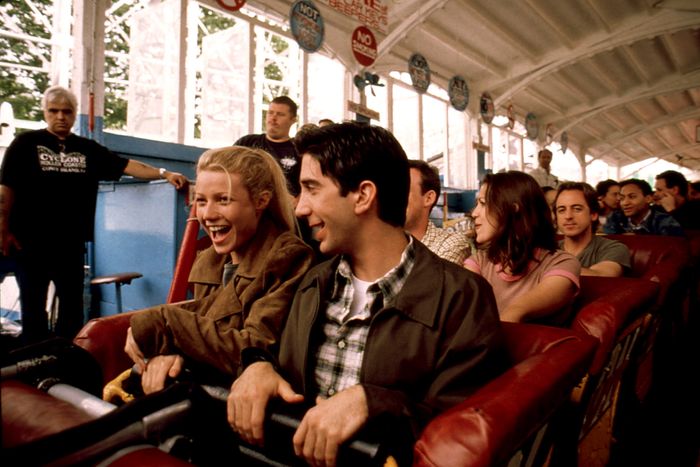
Photo: Miramax/Everett Collection
Were we ever so young? Back when the Friends cast took turns gunning for movie stardom, Harvey Weinstein, who produced this tonal mishmash of a romantic dramedy, decided David Schwimmer was … wait for it … the next Tom Hanks (or so says Gwyneth: The Biography). Then The Pallbearer bombed. Paltrow plays Schwimmer’s high-school crush, reunited through mutual friends as Schwimmer’s unemployed architect is summoned to deliver the eulogy for a classmate he doesn’t remember. Even if the sprightly-sad fusion in Matt Reeves’s directorial debut never really coheres, the film conjures a lot of affection for its characters. Patchy New York accent aside, Paltrow is winsome as the kind of vulnerable sweetheart destined for a movie that deploys “Harvest Moon” multiple times.
Paltrow flits through the periphery of this talky biopic, which is a shame because she’s intriguing as a flapper carousing with Dorothy Parker (Jennifer Jason Leigh) and her writer clique in 1920s New York. If you’re never seen the movie, picture Paltrow clutching a cigarette holder and saying “daaaarling” in a vampy mid-Atlantic cant. Catnip, right? If only she had a little more to do here.
As Estella, the wealthy love interest of orphaned painter Finn (Ethan Hawke), Paltrow exudes nonchalance. She speaks gently, moves with conviction, and seldom musters a shred of concern. But Estella is playacting, erecting a wall around herself to avoid childhood troubles. In modernizing and Americanizing the Charles Dickens novel, Alfonso Cuarón expunged many of Great Expectations’s subplots in favor of a 1998-friendly romantic drama that cemented Paltrow as an emblem of gentility. She isn’t given a ton to work with beyond Estella and Finn’s courtship, but Paltrow’s even-tempered affect aligns with Cuarón’s restrained approach.
And now we come to the fat suit. Paltrow has called the Farrelly brothers’ romantic comedy a “disaster,” which is accurate. Squint and you’ll see a moving moral about an incel-lite finance dope (Jack Black) learning that beauty comes in all sizes. Unfortunately, you have to wade through an onslaught of fat jokes that are hardly jokes at all, no matter what the movie wants us to think. Paltrow’s wish to erase Shallow Hal from her permanent record is reasonable, but she fares fine as Black’s love interest. Hers is the film’s most human character, at once steely and insecure.
There’s not a thing wrong with Paltrow’s Contagion performance, but how high can you rank a movie that kills her off in the first 15 minutes? Steven Soderbergh’s film became eerily prescient by the time March 2020 rolled around, depicting a COVID-esque outbreak that originated in China. Paltrow is patient zero. We hear her cough before the first frame, and her sickly pallor worsens from there. There’s a hauntedness to her brief appearance, a vibrancy that disappears as she grows weaker and succumbs to seizures. It almost feels like a cruel joke to torture Paltrow, whose newly Goopified career had made her a joke in some circles, in such a flagrant way. Is she in on that joke? Hard to say. But Contagion milks something out of her star power, even if it’s merely a “Drew Barrymore dying in Scream” rug pull.
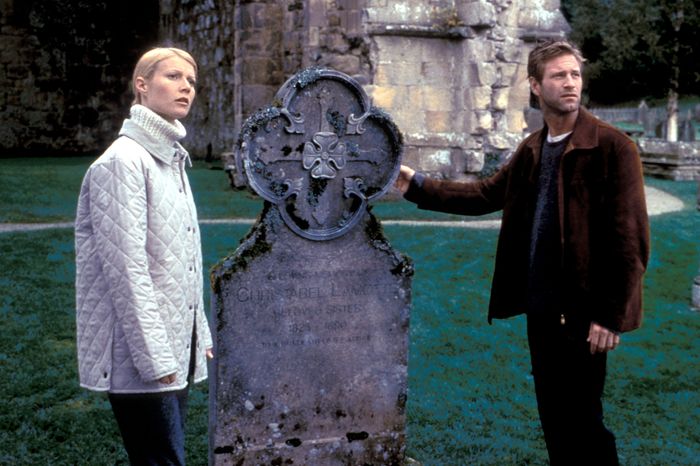
Photo: Warner Bros./Everett Collection
Possession has several Paltrow trademarks. She’s an upper-crust Brit who loves knitwear and finds herself drifting into an unexpected romance with an invigorating hunk (Aaron Eckhart). Neil LaBute’s adaptation of A.S. Byatt’s acclaimed novel about two academics researching fictional Victorian poets keeps its erotic charge at arm’s length, but there’s nary a courtship Paltrow hasn’t known how to play. Even if Eckhart’s performance needs a little zhuzh, Paltrow’s English reserve melts as the pair spend more time enmeshed in 19th-century literary lore. If you don’t already know where this movie is headed, you will when she blushes as Eckhart spontaneously strips off his shirt and dives into a plunge pool.
View From the Top isn’t great, but it doesn’t deserve all the ridicule, including from Paltrow herself. It’s a sweet little comedy that could use more focus and a less listless Mike Myers performance, and Paltrow is quite likable as a small-town girl with sky-high dreams. There’s a scene late in the movie where she delivers a teary confession to her boyfriend Mark Ruffalo’s grandmother, only for the grandmother to respond, “Who are you?!” As Paltrow laughs, she rolls her head to the side and runs a hand through her hair, charmed. For a brief second, you almost get the sense that she wished people could wonder who she is, too. Pretty good actress.
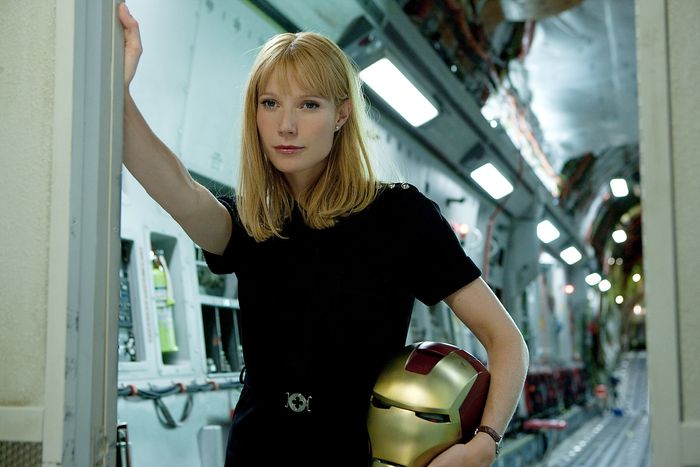
Photo: Francois Duhamel/Paramount/Everett Collection
What’s funnier, and more fitting for our Gwyn, than having no idea how many Marvel movies she’s made or that she was in a Spider-Man at all? Before Disney gobbled up the comic-book production company and turned the industry upside down, she took the role of Pepper Potts — canny assistant and love interest to Tony Stark — because (a) her old friend Robert Downey Jr. encouraged her to, and (b) the pay was good. Seven long movies later, Paltrow is actually one of the franchise’s most engaging performers. She doesn’t get a lot to do once Iron Man segues to The Avengers, but her rapport with Downey has a classic screwball verve that sets her apart in these increasingly overmythologized blockbusters.
Because she’s so defined by privilege and polish, there’s a novelty to seeing Paltrow play damaged — and she’s good at it. Proof, a movie largely lost to time, is one of the finest examples. As a fashion-resistant mathematician struggling to prove she’s responsible for work attributed to her troubled late father (Anthony Hopkins), Paltrow thoroughly captures the sunken feeling of depression. She’s dead behind the eyes in all the right ways. This was her second collaboration with Shakespeare in Love director John Madden, and though it suffers from an acute case of self-seriousness, Paltrow’s frayed nerves are captivating. She’ll even make you believe she’s never heard of jojoba oil.
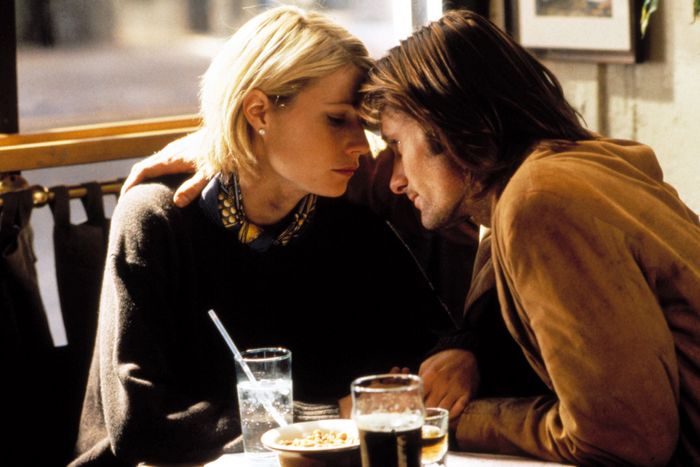
Photo: Warner Bros./Everett Collection
Paltrow’s glamour often draws comparisons to Grace Kelly, one of many reasons she makes sense in a Dial M for Murder update for the waning erotic-thriller era. Another reason: Paltrow is good at playing wealthy urbanites hemmed in by domestic turbulence. Here, her distress comes from screen husband Michael Douglas, poster child of the silver-tongued shark. You know vaguely where A Perfect Murder is headed within its first few minutes, the camera tracking Paltrow through her Fifth Avenue townhouse as she turns away from Douglas and drops the phony smile that greeted him. But awaiting the comeuppance she’s going to give her scheming spouse is half the fun, and Paltrow makes for an alluringly chilly heroine whose acumen is as pleasing as her flippy ’90s bob.
Paltrow is the best thing about this ridiculous Ryan Murphy series that starts with her leaving her husband for Martina Navratilova and ends with her becoming … president of the United States? That’s right: Paltrow finally ascends to her rightful throne thanks to television’s gayest showrunner (and her husband, Brad Falchuk, who co-wrote most of the episodes). Paltrow glides through The Politician’s two seasons with the poise of a supermodel, if supermodels delivered succinct monologues to their scheming son (Ben Platt) about the difference between ethics and morals. She’s a hoot here. Whodathunk that playing an enterprising earth-mother socialite would be such a fit?

Photo: Miramax/Everett Collection
This one hails from the period when Paltrow and Ben Affleck sometimes pretended they weren’t dating despite paparazzi photos that begged to differ. “We are NOT together. I swear on my LIFE. We’re NOT,” she said in an Entertainment Weekly cover story (capitalization theirs). Affleck isn’t always great at transferring real-life chemistry to the screen (see: Gigli, Deep Water), but he fares better opposite Paltrow in Don Roos’s contrived romantic dramedy. She shows a lot of depth as a frazzled, highly competent widow/mother/Realtor/brunette. Paltrow doesn’t specialize in characters lacking self-confidence, but the easily accessible doubt infused in both her expressions and her mannerisms gives the character a rich interiority.
The first movie to win Paltrow substantial notice (and some mild Oscar buzz) was this Texas-smoked thriller starring Dennis Quaid and Meg Ryan that cast her as one of those bad girls Hollywood so loved in the ’90s. To watch it today is to see a rare Paltrow role unencumbered by much public perception beyond being Blythe Danner’s daughter. She’s a petty thief with a raspy voice that belongs to someone who has seen far too much at far too young an age. Entangled with a snarling reprobate (James Caan), Paltrow’s character sets the film’s second half in motion, and this hardened-beyond-her-years performance did the same for her career.
Sliding Doors got middling reviews and only grossed $11.8 million domestically, but it’s left one of Paltrow’s biggest cultural footprints. Even if you’ve never seen it, you probably know the titular phrase to mean, in short, What if? Where that lexical rise started is hard to pinpoint, but it might have something to do with Paltrow’s own A-list upsurge. She’s darling in the movie, which hilariously signals its dual timelines by making her a brunette in one and a blonde in the other. Her ability to enchant makes her a great rom-com heroine and a pretty convincing modern-day Brit (at least to our untrained American ears).
This is a delectable Paltrow performance. She’s granting us ostensible voyeurism in a movie all about egos and neuroses, portraying a rising actress named Skye Davidson who savors the attention she generates from mortals who don’t command $4 million paychecks. Among an immaculate cast led by Jennifer Jason Leigh and Alan Cumming, who also co-wrote and -directed the lo-fi indie comedy, The Anniversary Party makes splendid use of Paltrow. Some critics decided she was playing herself, but that doesn’t give the performance enough credit. She’s in on the joke here, presenting Skye as someone blind to her own vampiric draw.
Paltrow’s presence in Seven is a study in contrasts. She’s soft where everyone else is hard, openhearted where they’re edgy and burdened. Of course, that means the movie kills her off in a brutal way. She’s the sympathetic woman who knows more about life than the career men who get to live. David Fincher’s breakthrough accelerated Paltrow’s name value, as well as that of Brad Pitt, whom she’d met when they auditioned for Legends of the Fall (she lost the role to Julia Ormond). The young beauties started dating during the Seven production, and there’s a real spark to the way they look at each other here. But a sadness creeps into Paltrow’s eyes as the thriller unfolds. Playing the wife of Pitt’s overambitious detective, she alone seems to predict the bleak finale.
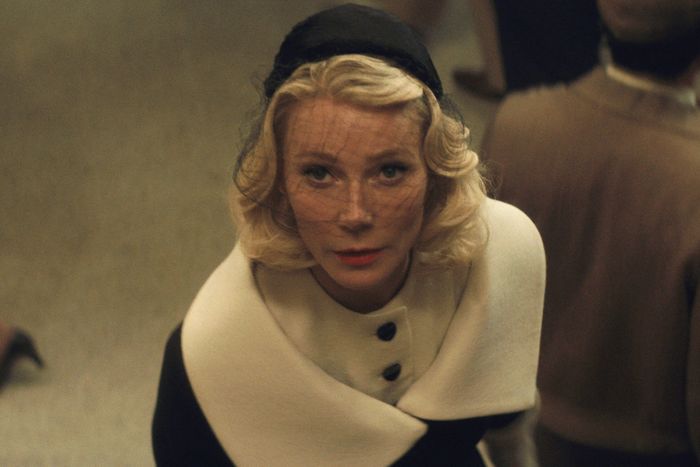
Photo: A24/Everett Collection
Josh Safdie lured Paltrow out of her acting hiatus with a fitting conceit: She’s a former movie star playing a former movie star. This Kay Stone broad was major in the ’30s, but now she glides around with her high-rolling prick of a husband (Kevin O’Leary), appears in bad plays, and hooks up with younger table-tennis barracudas named Marty (Timothée Chalamet). The washed-out look on Paltrow’s face says that retirement wasn’t entirely Kay’s choice. She’s sad, yes, but in Paltrow’s hands, she is feisty and funny, too, able to engineer her own kicks in life. You can see why Marty is drawn to her, and she to him — he makes her feel carefree, and she provides a glimpse of the fortune he’s chasing. Paltrow is radiant. The movie doesn’t adequately wrap up her arc, but it gives her a welcome return to the big screen.
In Emma, Paltrow’s shoulders are as upright as her cheekbones. The Jane Austen adaptation, Paltrow’s first lucrative starring role, established the essence that would define her career: genteel, beatific, and a little smug. As the eponymous Regency-era matchmaker, her charisma morphs into a lovelorn yearning, hinting at some of the more dramatic work that awaited her. If Paltrow has a disadvatnage, it’s that she’s out-funnied by some of the giddier supporting performers (namely Toni Collette, Alan Cumming, and Sophie Thompson). Still, it’s easy to connect the dots between this extremely British breakthrough and her casting in Shakespeare in Love two years later.
Sylvia is one of those overly grand great-artist biopics. It’s kind of a drag, especially if you already know the outline of Sylvia Plath’s life — her uneasy marriage to Ted Hughes (Daniel Craig), her struggles as a writer, her horrific death. In spite of all the melodrama, what works about Sylvia is Paltrow. The role asks a lot of her, and she rises to it thoroughly. Paltrow is hopeful but pained, determined but fragile. Most notably, she treats Plath like a full-fledged character instead of some well-worn literary archetype, almost like she built her from the ground up.
Paul Thomas Anderson’s debut grossed all of $223,000, but it’s an essential piece of the Paltrow canon. She immerses herself in the role of Clementine, a Reno cocktail waitress and part-time sex worker who galvanizes Hard Eight’s loose plot when a john fails to pay her the $300 she’s owed. This is Philip Baker Hall and John C. Reilly’s movie, and still it contains one of Paltrow’s most dimensional performances. She complexifies what could be a mascara-drenched cliché. Despite Clementine’s sweetness, there’s not much sunshine in her eyes. It’s like she’s searching for happiness that constantly eludes her. Take the scene in the diner opposite Hall’s career gambler, where she asks about his family life. When he says he hasn’t spoken to his kids in a long time, the sorrow on Paltrow’s face is genuine but matter-of-fact. In extreme close-up, with Christmas hymns on the speaker, we sense that domestic strain is familiar to Clementine. She’s a little numb inside, too exhausted and guileless to chart a different path. Paltrow used to get one of these dysthymic roles every few years, and she almost always nailed them.
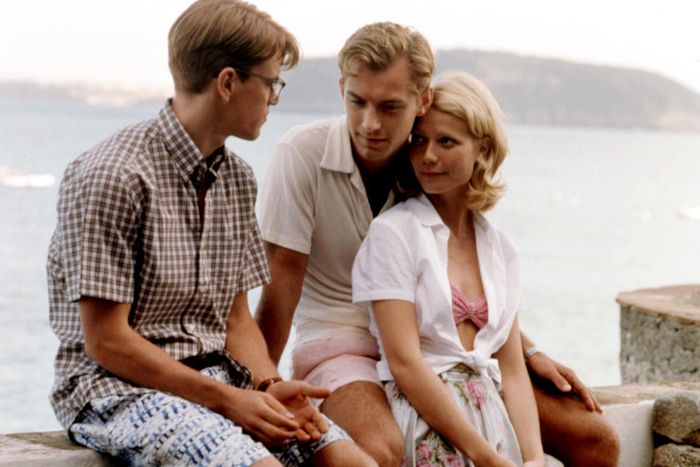
Photo: Miramax/Everett Collection
After Paltrow’s Oscar came one of her best movies, a film that seems even cooler and smarter in today’s grifter-glutted culture. The early chatter about Paltrow’s natural stardom hit its ideal as she swanned around Italian villages with the sort of mid-Atlantic accent you could imagine her affecting offscreen. In her hands, you barely notice the role is underwritten. This version of The Talented Mr. Ripley’s Marge Sherwood, girlfriend to the ill-fated scion Dickie Greenleaf (Jude Law), masks her romantic resentments with an insouciance that’s the province of the beautiful, moneyed, and ostensibly unbothered. Paltrow captures the artifice of carefree wealth. When Marge cracks, the way she buttons herself up like a heartsick mid-century housewife is at once emotionally rich and deliciously campy. And when she confronts Tom about Dickie’s unsolved murder, Paltrow explodes in anger, yelling and thrashing with overwhelming conviction.
Sometimes an actor’s contentment transcends the character they’re playing. In Paltrow’s Oscar-winning role, it’s right there on her face. You could argue that Viola de Lesseps, the headstrong protagonist of Shakespeare in Love, has a joie de vivre that Paltrow is merely tapping into. But she’s more alive here than she’s ever been onscreen. When the camera pans toward Viola as she finally gets to perform for a rapt audience at the Globe Theatre, the serenity on her face seems to apply equally to the actress portraying her. Cynics will rant about how this movie didn’t deserve to beat Saving Private Ryan for Best Picture and perhaps how Paltrow shouldn’t have gotten Best Actress over Cate Blanchett and Fernanda Montenegro, rendering both wins underrated. Paltrow understands the story’s romantic swell, and her loveliness is crucial to both the film’s success and her own.
Two Lovers was basically Paltrow’s acting sign-off: In between its Cannes premiere and its theatrical release, she launched the initial Goop newsletter. She made plenty of movies after that, sure, but most aren’t great — and certainly none compare to James Gray’s devastating romantic drama. Later, when her company had become a proper $250 million fever dream, she would say she’d spent all those pre-Goop years “masquerading as an actor.” This movie shows how little credit she was giving herself. Paltrow is so compellingly human — which is to say ragged and unpredictable — as a flighty drug addict who befriends an infatuated neighbor (Joaquin Phoenix) while dating a married man (Elias Koteas). Two Lovers weaponizes Paltrow’s image: She shows up seeming perky and urbane, only to reveal a head-spinning insecurity that makes us fall to pieces alongside her.
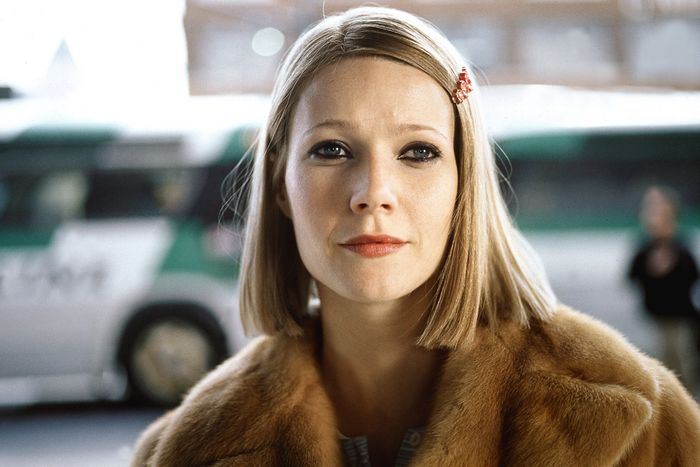
Photo: Buena Vista Pictures/Everett Collection
The image of Paltrow gliding off a city bus in slow motion, wearing that mink coat and beefy eyeliner, is seared into the cerebral cortex of every modern moviegoer and anyone who’s attended a Halloween party or seen a couture runway show in the last two decades. Wes Anderson’s magnum opus opened two short months after 9/11, its gloomy gallows humor suiting the country’s mood. Margot Tenenbaum remains the movie’s depressive-chic poster child, thanks to immaculate style and a yearning that makes Paltrow’s distant gaze so legible. The Royal Tenenbaums was a 180 from Shakespeare in Love and Sliding Doors, and yet her flat affect conveys as much life as anything Viola de Lesseps gets up to. She’s forlorn, funny, and fascinating. That’s talent.