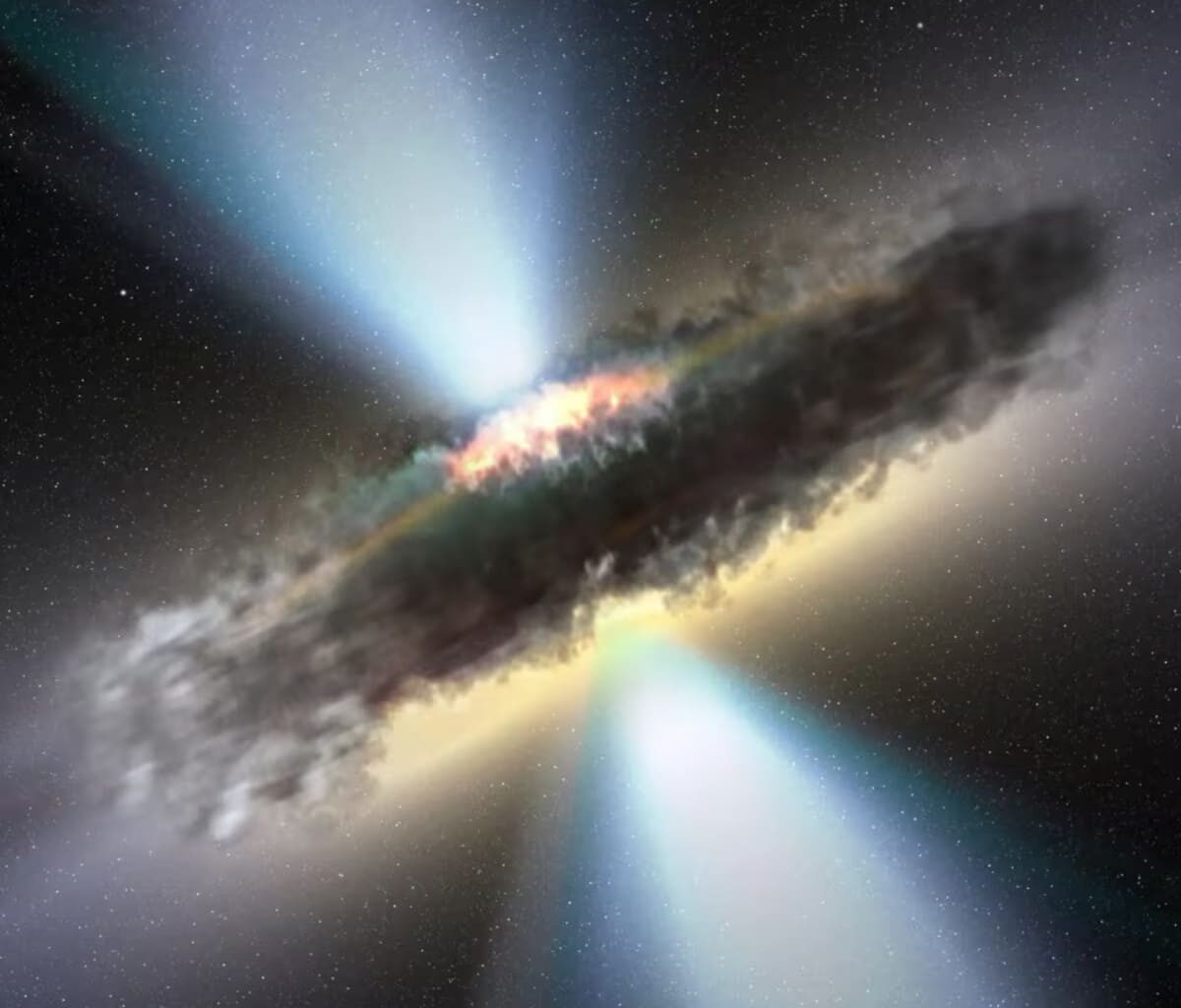
Astronomers have made a mind-bending discovery — the largest reservoir of water ever found in the universe. Containing 140 trillion times more water than all of Earth’s oceans combined, this celestial giant sits 12 billion light-years away and challenges everything we thought we knew about the presence of water in the cosmos.
Water, the element essential to life, extends far beyond our planet’s boundaries. In November 2024, researchers identified the most distant and massive collection of water ever observed in space — a finding that deepens the mystery of how this vital substance formed and spread throughout the universe.
A quasar of staggering proportions
At the heart of this extraordinary discovery lies a colossal quasar named APM 08279+5255, located more than 12 billion light-years from Earth. At its center spins a supermassive black hole so immense it defies comprehension:
A mass 20 billion times greater than the Sun’s.
An energy output equal to one thousand trillion Suns.
A quantity of water 140 trillion times that of Earth’s oceans.
As NASA astrophysicist Matt Bradford explained in Astrophysical Journal Letters, “The environment around this quasar is truly unique in its ability to produce such a tremendous mass of water.” This discovery confirms that water has been widespread in the universe since its earliest days — far earlier than scientists once believed.
A galactic oasis unlike any other
What makes this region so remarkable are the extreme conditions surrounding the quasar. The vast cloud of water vapor that envelops APM 08279+5255 is both hotter and denser than typical galactic environments.
PropertyValueComparisonTemperature-63 °CFive times hotter than the galactic averageDensity—10 to 100 times higher than normalExtentHundreds of light-years—
This immense vapor cloud glows under the quasar’s X-ray and infrared radiation. The water acts as a tracer gas, helping scientists peer into this extreme environment. According to estimates, the reservoir could continue to feed the black hole until it grows to six times its current size.

The largest water reservoir in the universe contains 140 trillion times more water than Earth. © Borchee, iStock
Water across the universe
This discovery fits into a broader pattern of cosmic findings that show water to be a truly universal substance. Recent research has detected it in several surprising places:
The Orion Nebula, 1,344 light-years away, harbors both vapor and ice.
The young star PDS 70 is surrounded by a water-rich protoplanetary disk.
Comets such as 67P/Churyumov-Gerasimenko are packed with frozen water.
The exoplanet K2-18b, 124 light-years from Earth, holds water vapor in its atmosphere.
Together, these discoveries reveal that water is woven into the fabric of the universe — from distant nebulae to forming planetary systems. They may even shed light on the origins of Earth’s own water and the potential for life beyond our planet.
A gateway to future discoveries
The detection of this massive cosmic reservoir marks a turning point in our understanding of how water shapes the universe. It raises new questions about the formation of galaxies, stars, and planets — and about water’s fundamental role in the emergence of life itself.
Future space missions and next-generation telescopes will continue to probe these quasars, seeking out more of these hidden oases scattered across the cosmos. Water, long familiar to us on Earth, is revealing itself as one of the universe’s most powerful and enduring forces — a reminder that the cosmos may be far wetter, and far more alive, than we ever dared to imagine.