
Unlock the Editor’s Digest for free
Roula Khalaf, Editor of the FT, selects her favourite stories in this weekly newsletter.
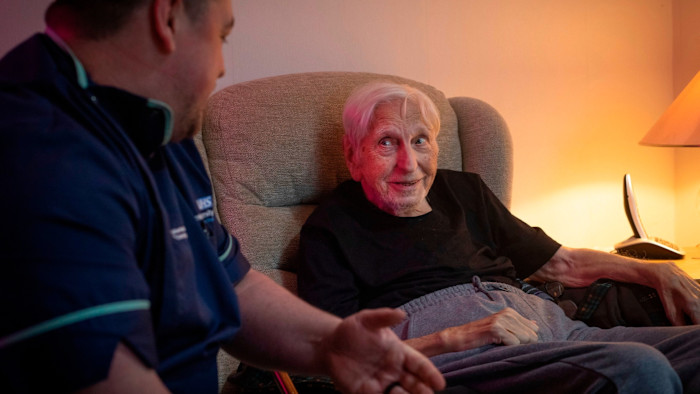
After being diagnosed with a lung infection two weeks earlier, Jim Bradford is being discharged — not from a hospital, but from the comfort of his own living room.
The 84-year-old former boxer avoided hospital altogether after being referred to a “Hospital at Home” team operating in Manchester.
In the past 10 days, Bradford has been visited by GPs, occupational therapists and nurses, and his care has been overseen by a hospital consultant.
“For the first time I have had confidence in my healthcare,” he said. “Instead of me going to the hospital, they were coming to me. Out of the blue came this team who got me to breathe again and I’ve got my life back.”
Bradford is one of 190 adults a day in Manchester who are receiving acute-level NHS care in their own beds rather than on a hospital ward.
The majority of routine investigations, including blood tests and ECGs, are carried out at home, while more complex tests are arranged through fast-track outpatient slots in hospital, allowing patients to return home the same day rather than occupy a bed overnight.
 John Wild is an advanced clinical practitioner on the Hospital at Home team © Colin McPherson/FT
“We try to do everything possible in a patient’s home,” said John Wild, an advanced clinical practitioner who has been regularly seeing Bradford. “Jim is one of the people we have managed to keep out of the hospital entirely.”
Since April, the Hospital at Home service has saved more than 32,000 hospital bed days, according to the Manchester University NHS Foundation Trust, equating to an estimated cost-benefit of more than £4mn.
The number of patients being treated under the service is set to rise to 250 by the end of December — along with the capacity to treat an extra 36 flu patients at home.
The ambition to move care out of hospitals and into the community has underpinned several NHS strategies over the years, but hospitals have continued to see far higher rises in expenditure and staffing.
The UK government’s 10-year plan, published earlier this year, pledges to reverse this trend so that the share of expenditure on hospital care will fall “with proportionally greater investment” in out-of-hospital care.
 Dr Sohail Munshi, joint chief medical officer of the Manchester University NHS Foundation Trust © Colin McPherson/FT
A key part of this change will be the creation of a “neighbourhood health service” whose guiding principle is that people should be cared for at home wherever possible.
“We aren’t just saying it, we are doing it,” said Dr Sohail Munshi, joint chief medical officer at the trust. “It’s a massive cultural change — it’s the future of the NHS.”
Munshi said the trust had found the health outcomes of people who are looked after at home were better than those being admitted to hospital with the same condition.
Evidence collected by the Hospital at Home service shows that people recover more quickly in familiar surroundings, with fewer risks of falls or further infections, as well as a greater ability to stay connected to family and carers.
“Old people become disoriented when they are admitted to hospital, they are disconnected from their family and loved ones, and they are not following their usual diet,” said Munshi.
“Simply put, admitting a patient to hospital is a good way to make an older, frail person confused, disoriented and lonely,” said Munshi.
Claire Wilson, MFT’s chief financial officer, said that traditional rigid divisions between hospitals, GP surgeries and community care had previously held back the desired shift from treating patients in acute settings and towards the community.
MFT is the largest local NHS Trust in England, made up of 10 acute hospitals, with a £3bn annual turnover and 30,000 staff.
Recommended

“There is always a reason why it doesn’t happen,” she said. “Finance is often a blocker and what we’ve got here is a much more fluid approach which has enabled that much more flexible use of resources.”
She added “You are asking acute trusts to give up resources, so if they are part of the whole thing then it is much more likely to succeed.”
“When we think about the future, it isn’t that we are going to close a load of beds and escalation capacity,” Wilson insisted. But the Hospital at Home model removes the need to build more acute wards to cope with growing demand, “which we can’t afford to do”.
For Munshi, the model should be a consistent part of the NHS offering across England. “It’s what we would all want for our families,” he said.