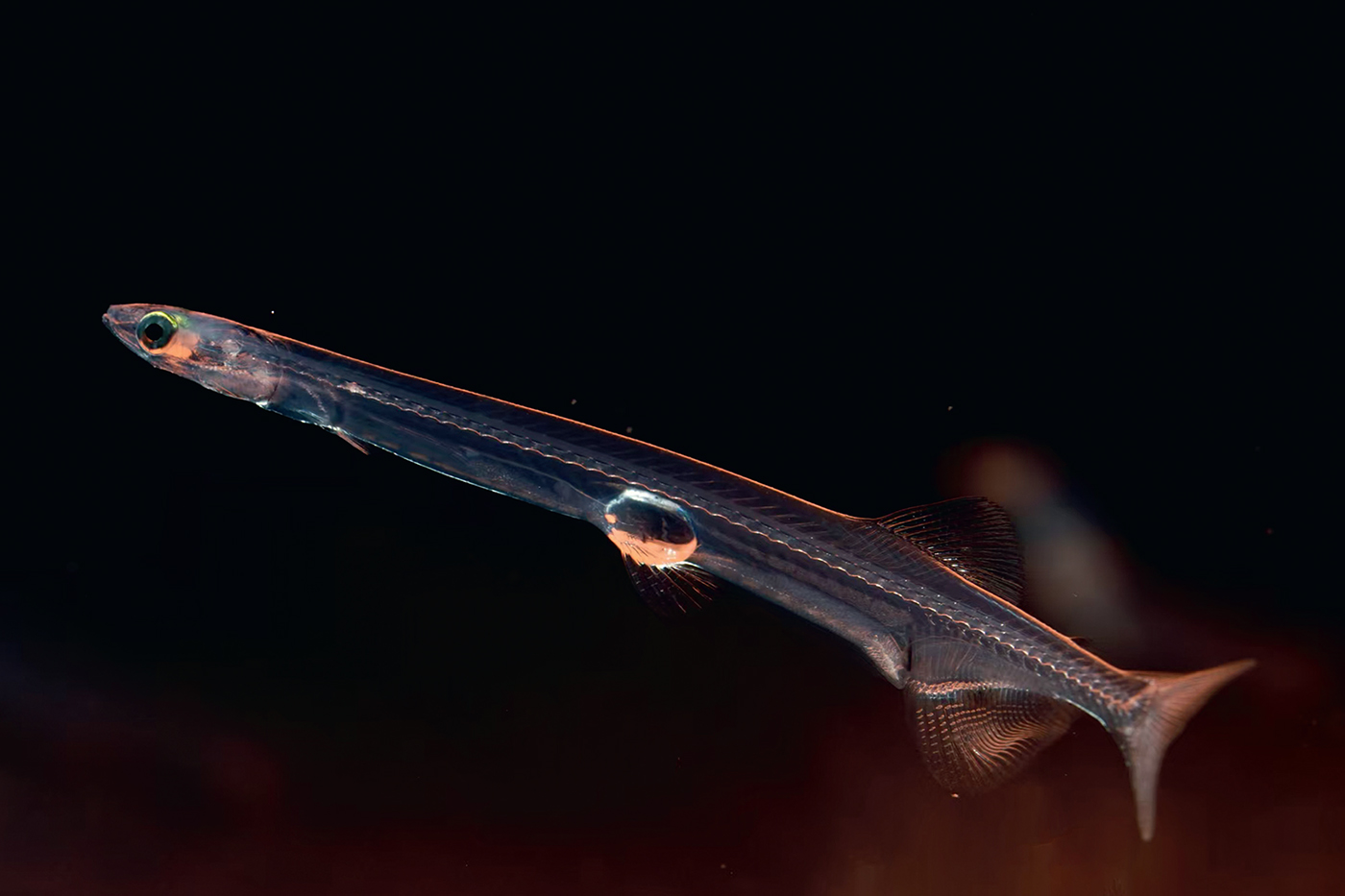
Antarctic icefish are famous for living without red blood cells, but they are not alone.
A species of needle-shaped, warm-water fish called the Asian noodlefish also lacks hemoglobin and red blood cells. Like icefish, its veins are filled with translucent white blood, said H. William Detrich, professor emeritus of marine and environmental sciences, who collaborated with Chinese scientists on a paper about the strange aquatic creatures.
“I thought the story was solved when we did our work on Antarctic icefishes,” Detrich said. “But then the noodlefishes came along and surprised me. It turns out there may be more species than we think that don’t rely on red blood cells to transport oxygen.”
Detrich’s lab at Northeastern University looked closely at the genomic structure of Antarctic icefish and discovered they had lost their ability to produce red blood cells due to the deletion of hemoglobin genes over millions of years.
The thinking is that icefish were able to survive and thrive without red blood cells carrying oxygen from gills to their tissues because the chilly seawater around Antarctica is rich in dissolved oxygen, Detrich said.
“That means that the Antarctic icefishes are able to rely on oxygen that’s physically dissolved in their blood fluid,” he said.
However, that genetic explanation doesn’t work for white-blooded Asian noodlefish, which swim in much warmer waters, from the coasts and river systems of China, Korea, Japan and eastern Russia, south to Vietnam.
“They live in a very different environment,” Detrich said. “They don’t have the advantage of a cold and oxygen-rich environment like the Southern Ocean.”
The Chinese scientists who studied Detrich’s work reached out to him, he said. “They wanted to know what was going on.”
 H William Detrich, a world-renowned professor emeritus of marine and environmental sciences, studied the ‘other’ white-blooded fish with Chinese researchers. Photo by Matthew Modoono/Northeastern University
Collaborator Jinxian Liu from the Qingdao Marine Science and Technology Center in Qingdao, China, said that after reading Detrich’s works, he wondered “whether our Asian noodlefishes … share a similar evolutionary pathway.”
In particular, the scientists wanted to know what was happening with the hemoglobin genes as well as the gene for myoglobin, which is the protein that makes red meat red and binds oxygen in the cells of the meat.
“As part of this collaborative effort, we demonstrated that Asian noodlefish — all 12 species — have lost the myoglobin gene as a single event that occurred in their most recent common ancestor,” Detrich said.
In addition, they found various mutations to their hemoglobin genes that rendered them nonfunctional, he said.
“But unlike the icefishes, they hadn’t completely deleted the hemoglobin genes,” Detrich said. “Rather, they had smaller mutations that prevented the genes from expressing a functional hemoglobin protein.”
The short life span of the Asian noodlefish holds clues about how it evolved to live without red blood cells, Detrich said. Unlike Antarctic icefish, which live six to seven years or more, Asian noodlefish measure their life spans in a year.
Although noodlefish adults can reproduce at the end of their short lives, they retain numerous juvenile or neotonic features.
“In a number of other fish species, juveniles don’t need to make red blood cells because they are small and slender and can absorb oxygen through their scaleless skins,” Detrich said.
But while most of these species have longer lives and will go on to make red blood cells as adults, Asian noodlefish don’t need to because they remain, in essence, juveniles.
“The work is important because it shows that historical contingency also plays an important role in the evolution of biodiversity,” Liu said.
Comparing the evolution of myoglobin and hemoglobin expression in Asian noodlefish and Antarctic icefish, Detrich said, “It’s a different set of environmental circumstances and a different set of molecular outcomes.
He said he was pleased that he and his colleagues in China had their research published in the July issue of Current Biology, which featured the Asian noodlefish on its cover.
“There’s more than one way for fish to lose the production of myoglobin, hemoglobin and red blood cells — that’s what we discovered in this paper,” Detrich said.
Northeastern Global News, in your inbox.
Sign up for NGN’s daily newsletter for news, discovery and analysis from around the world.