
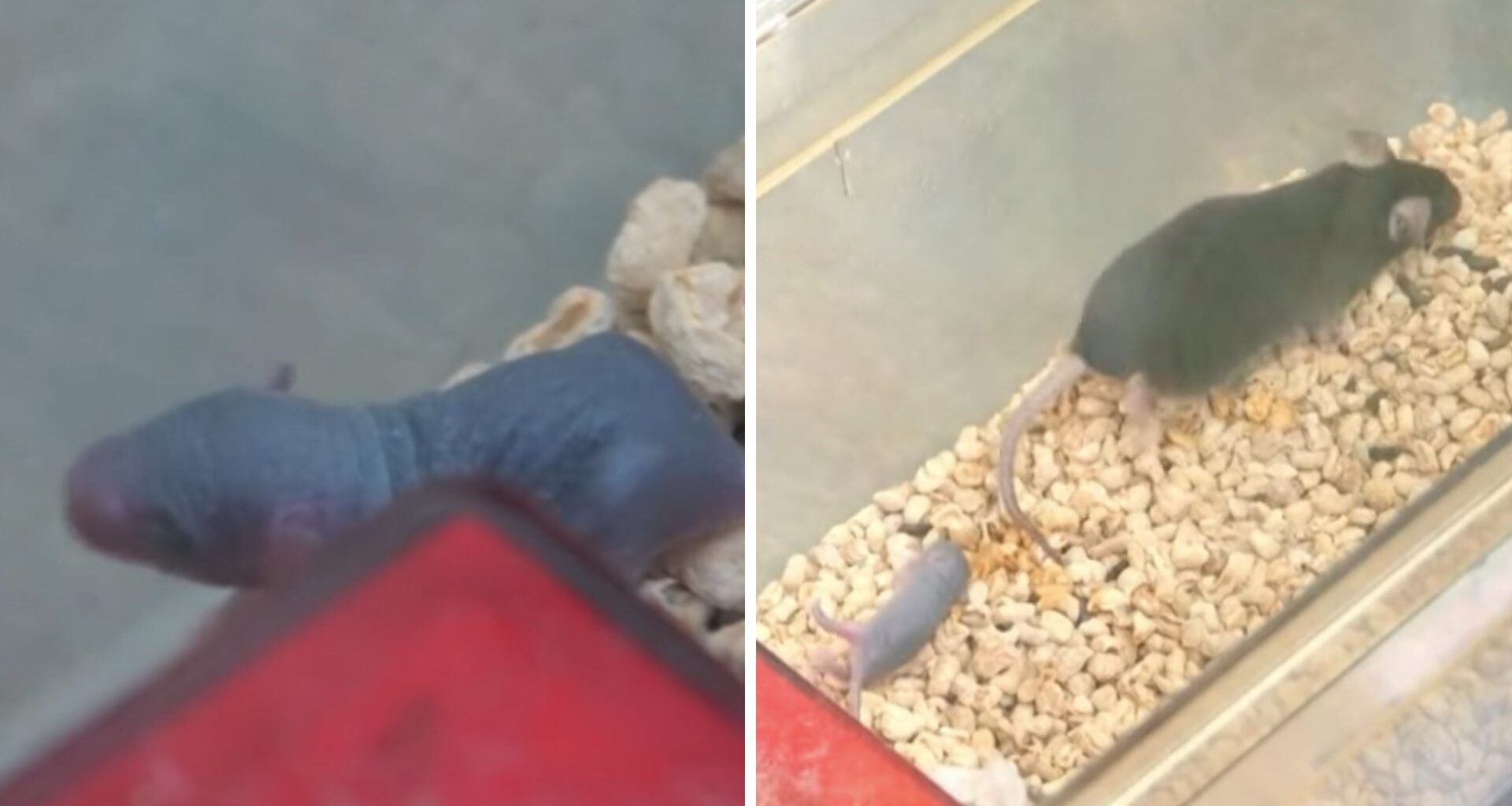
Following a 14-day mission aboard China’s space station, a female mouse has successfully delivered a litter of nine healthy pups back on Earth.
The birth, confirmed by the Technology and Engineering Center for Space Utilization at the Chinese Academy of Sciences (CAS), marks a major victory for space biology.
As part of the Shenzhou-21 mission, the four mice were sent to Tiangong Space Station on October 31. Soon after returning on November 14, one of the mice successfully conceived and gave birth to nine pups on December 10.
The mother is caring for her litter normally, and the pups are showing “strong vitality.”
With six of the offspring currently thriving, the mission confirms that short-term space travel does not negatively impact mammalian reproduction.
Survival challenge in space station
Housed in a specialized small-mammal habitat aboard the space station, the four mice served as subjects for survival and adaptation studies within the unique microgravity conditions.
CGTN highlighted that the mice faced a series of unexpected hurdles during their time in space.
Space junk forced a sudden adjustment to the return schedule of the previous crew, Shenzhou-20, leaving the rodents stranded with a rapidly dwindling pantry.
Ground teams and astronauts launched an emergency rescue mission.
By repurposing the space station’s external water interface, they successfully pumped fluids into the habitat to keep the mice hydrated while they verified emergency food alternatives.
Astronauts scanned the human food inventory for anything mouse-friendly. After frantic ground tests on Earth-based mice to check for safety, they found their winner: soy milk.
Reportedly, an “AI behavior analysis system” monitored the mice in real time, tracking every sip and snooze to ensure the emergency rations were working.
Pups’ development is being monitored
For two weeks, the mice braved microgravity and radiation while surviving on an unexpected diet.
The gamble paid off. On November 14, the mice touched down safely in Inner Mongolia. By December 10, a female mouse — having conceived shortly after her return — delivered a litter of nine.
“The mission proves that short-term space flight has not negatively affected the mice’s reproductive abilities, which also provides an extremely valuable sample for studying the impact of the space environment on the early development of mammals,” Wang Hongmei, a researcher at the CAS’s Institute of Zoology, told CGTN.
These “space mouse offspring” are the keys to understanding multigenerational heredity.
Researchers are now tracking the pups’ developmental curves to see if their parents’ time in microgravity left any hidden marks.
The ultimate goal is to see if these offspring can have babies of their own.
It’s a vital finding for the future of deep-space travel. If humans are ever to colonize the Moon or Mars, we need to know that life can carry on.
Because mice share high genetic similarity with humans and reproduce rapidly, they serve as an early warning system for biological risks. Monitoring the immediate physiological reactions could reveal whether space travel compromises reproductive health before we send humans on long-term missions.
Meanwhile, the four original mice have already become celebrities, recently receiving the names Wangtian (Gaze at the Sky), Lanyue(Reach for the Moon), Zhuiyun (Chase the Clouds), and Zhumeng (Follow the Dream).