
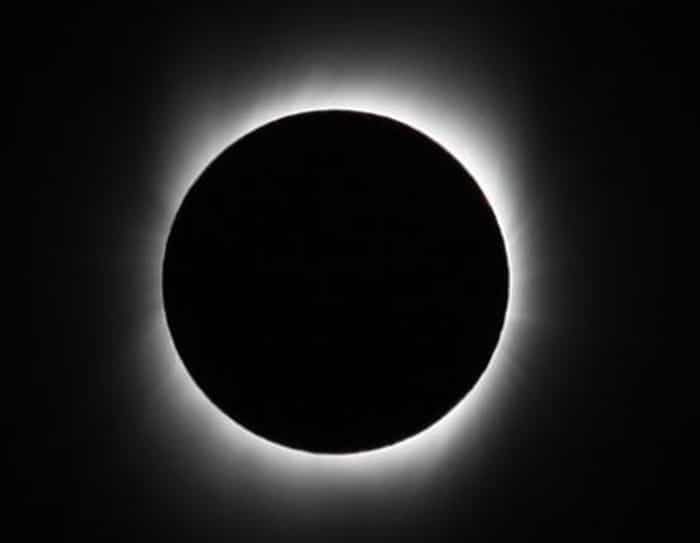
Total solar eclipse of July 22, 2009, from Bangladesh. Credit: Lutfar Rahman Nirjhar, CC BY 3.0/Wikipedia
It has been over 25 years since mainland Europe last witnessed a total solar eclipse. The year was 1999 when the Moon obscured the Sun, plunging parts of the continent into midday darkness.
Now, twenty-seven years later, totality returns to Europe on Wednesday, August 12, 2026.
The path of the total solar eclipse
The eclipse will begin its journey in northern Russia, crossing the Arctic Ocean and eastern Greenland before reaching its maximum off the coast of Iceland. Finally, it will reach northern Spain shortly before sunset. Spanish cities will experience up to one minute and fifty seconds of darkness.
While North America, West Africa, and other parts of Europe will see a partial eclipse, the phenomenon will be practically unobservable in Greece, where only a tiny fraction will be visible in the northwestern regions (Corfu, Igoumenitsa, Kastoria).
This event marks Spain’s first total eclipse since 1905 and Iceland’s first since 1954. Fortunately, Europe won’t have to wait long for the next one; on August 2, 2027, another total eclipse will pass through southern Spain, North Africa, and the Middle East. During the 2027 event, southern Greece will be treated to a significant partial eclipse.
The scientific stakes
Fiori Metallinou, an astrophysicist at the National Observatory of Athens and National Outreach Coordinator for the IAU, explained to AMNA that these Mediterranean eclipses offer southern European scientists a rare window into solar physics.
“During an eclipse, solar physicists can observe the Sun’s outer atmosphere, known as the solar corona, which is revealed only when the solar disk is darkened,” Metallinou explains. “By photographing and studying its composition, we can better understand solar activity and compare these processes with previous eclipses.”
Enthusiasm is already building, with professional and amateur astronomers, including members of the Friends of Astronomy Club, already planning expeditions to Spain to witness the event firsthand.
2026: A year of celestial wonders
Beyond the total eclipse, 2026 offers a packed astronomical schedule:
February 17, 2026: An annular solar eclipse (the “Ring of Fire”) will be visible over Antarctica, with a partial view for southern Africa and parts of South America.
The Aurora Borealis: Although the “solar maximum” peaked in 2025, solar activity remains high through 2026, promising spectacular Northern Lights displays.
Lunar cycles: Following the rule that solar eclipses are usually paired with lunar ones, a Total Lunar Eclipse (a “Blood Moon”) will occur on March 3, 2026, visible across the Americas and Asia.
August 28, 2026: A Partial Lunar Eclipse will be visible from Africa, Europe, and Asia. In Athens, it will peak at 6:50 AM.
Supermoons and Blue Moons
The year 2026 will feature three Supermoons (January 3, November 24, and December 23), appearing larger and brighter as the Moon reaches its perigee. May 2026 will also feature a “Blue Moon”—the rare occurrence of two full moons in a single month (May 1 and May 31).
Finally, the Perseid meteor shower is expected to be particularly stunning this year. Peaking on August 12 and 13, the shower coincides with a New Moon, providing perfectly dark skies to view the “shooting stars,” which will be active from mid-July through early September.