
Back to Article List
Asteroid Harmonia reaches opposition in Gemini the Twins, near the bright planet Jupiter in the evening sky.
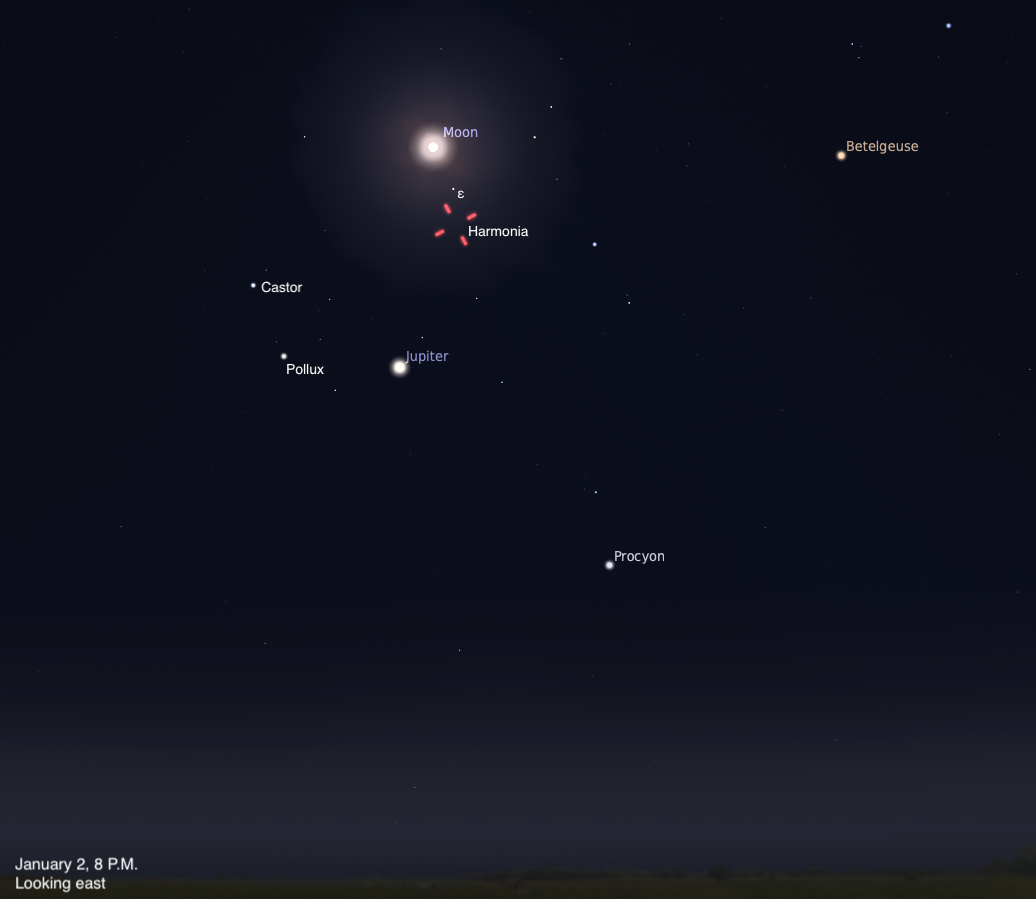
Asteroid Harmonia reaches opposition in Gemini near the star Epsilon (ε) Geminorum. The red cross marks its position. If the nearby Moon is too bright to find the main-belt world tonight, just return to the area in a few days. Credit: Stellarium/USGS/Celestia/Clementine
Asteroid 40 Harmonia will reach opposition at 10 A.M. EST on January 1st, becoming observable with binoculars or a telescope in Gemini, positioned approximately 2.5° southeast of Mebsuta.
Observation of Harmonia may initially be hindered by a bright, nearly Full Moon in Taurus; however, the asteroid’s slow celestial movement allows for successful viewing after the Moon wanes and rises later in the evening.
On the evening of January 1st, the Moon will appear over 99 percent illuminated, achieving an essentially Full phase, and is identified as a Super Moon due to its proximity to perigee, potentially appearing larger and brighter than average.
Key ephemeris data for 40° N 90° W on January 1st includes a sunrise at 7:22 A.M., sunset at 4:46 P.M., moonrise at 3:50 P.M., and moonset at 6:57 A.M., with the Moon phase designated as Full.
Looking for a sky event this week? Check out our full Sky This Week column.
January 1: Follow Saturn to Neptune
Asteroid 40 Harmonia reaches opposition at 10 A.M. EST. You can catch the 9th-magnitude main-belt world in binoculars or a telescope this evening in Gemini, where it lies just under 2.5° southeast of 3rd-magnitude Mebsuta (Epsilon [ε] Geminorum) and above bright Jupiter as the constellation rises in the evening sky. Note that the bright, nearly Full Moon is nearby in Taurus, which may hinder the view. However, Harmonia will remain in roughly the same part of the sky for a while, moving slowly against the background stars — so you can come back and search for it again after the Moon has begun to wane and rises later in the evening, providing some darkness after sunset.
Although the Moon does not officially reach Full phase until early tomorrow morning, our satellite will appear essentially Full (more than 99 percent lit) to the naked eye by late this evening. It may also appear slightly bigger and brighter than average, as it is still close to perigee and this month’s Full Moon is considered a Super Moon.
Sunrise: 7:22 A.M.
Sunset: 4:46 P.M.
Moonrise: 3:50 P.M.
Moonset: 6:57 A.M.
Moon Phase: Full
*Times for sunrise, sunset, moonrise, and moonset are given in local time from 40° N 90° W. The Moon’s illumination is given at 10 P.M. local time from the same location.