
Sometimes, there’s something about a news story that feels uniquely northern.
It can be the subject matter. It can be the tone or the people involved. It can just be something the story evokes.
On this page, we’ve collected Cabin Radio stories from 2025 that felt particularly northern to us in one way or the other. See if you agree.
The date is Tuesday, January 26, 1971. The temperature outside is -37C. That’s when a Yellowknife hydro plant caught fire.
It takes a lot to outdo 2025’s hours-long power outage across the NWT capital, but January 1971 beats it in the minds of residents old enough to recall.
Five residents contacted Cabin Radio about this specific incident in response to an article in which we asked about the worst outage Yellowknifers could remember.
Though recollections of dates were a little fuzzy, all five pointed to the same event: the Bluefish hydro plant catching fire. In this article, we retold the story of that fateful day more than 50 years ago.
Yellowknife-born Inuvialuk actress Olivia Iatridis played Nancy this year in a new film about an Inuk who starred on the big screen more than a century ago.
Nancy focuses on the story of Nancy Columbia Palmer Eneutseak, an 18-year-old woman who wrote and starred in her own film, The Way of the Eskimo, in 1911.
Iatridis, in 2025, appears in a short film depicting Nancy seeing her film in theatres for the first time.
Cabin Radio’s Jasmine Nasogaluak met Iatridis to learn more about how it felt to embody that role.
They call it the Midnight Sun Fun Run. While one of those ingredients went missing on June 21 this year, the rest were intact.
The sun disappeared behind cloud for the first time in a week and rain fell steadily for periods, but the weather – and the bugs – didn’t deter 87 people who started the 2025 fun run.
Eight of the hardiest souls began the half-marathon at 10pm, including one man attempting to race that distance in every province and territory. Ten-kilometre and five-kilometre participants started a little later.
Ollie Williams was there to take photos.
Dozens of residents gathered on Yellowknife’s 54 Street in the middle of the night on Canada Day after a large explosion left a debris field strewn across the road.
Residents from Con Road to School Draw Avenue – spanning half the city – reported hearing the sound of something detonating.
RCMP later attributed the blast to propane huffing.
Here are our photos from the scene of an incident that literally shook most of the territorial capital.
West Point First Nation’s newest chief, Devon Felker, has been attending council meetings since before he could remember.
“My mom was chief of West Point First Nation years ago, in the early 2000s, when I was just a baby. She would take me to the assembly meetings all around the Dehcho,” Felker told Cabin Radio.
Felker, a 26-year-old from Hay River, was elected as chief on July 3. He has served as a member on the First Nation’s council since 2019.
Jacksen Friske spent some time talking with one of the NWT’s youngest chiefs.
As Hay River’s Harry Camsell School unearthed a 25-year-old time capsule, it reconnected some parents with their late children.
Yvette Schreder’s son, Christopher Mailloux, was nine years old when he filled out a questionnaire on October 1, 2000, as part of a school activity that asked students to imagine their future.
What do you like to do most? Playing hockey, responded a fifth grade Mailloux. The people most important to him? His parents. The thing he was worried about back then? His dog Riley running away.
“He said in 10 years from now, he hoped to have a kid,” Schreder told Cabin Radio. Aastha Sethi brought us more about the capsule and its contents.
Just when Godson’s triumphant comeback looked to be July 19’s big Folk on the Rocks highlight, along came a contender: an on-stage proposal.
Lightning had ripped through the air on July 18. The following day brought a different kind of electricity to the Yellowknife festival’s main stage.
“My heart is still beating a mile a minute,” Daylen Weber confessed to Cabin Radio moments after proposing to Jocelyn Kierstead.
Kierstead said yes – a fact relayed to hundreds of festivalgoers by the main stage announcer. We interviewed the couple moments later.
Prime Minister Mark Carney spent July 23 in Fort Smith, the NWT town in which he lived until the age of six and where his father was a school principal.
Carney began the day with a visit to Fort Smith’s community centre, where he briefly indulged in some baking and smoothie creation with town children, supervised by town staff Emily Colucci and Emily Prescott.
Carney then strolled the short distance, under a cloudless NWT summer sky, to Fort Smith pizzeria Berro’s for lunch.
Berro’s celebrated Carney’s return to his hometown by creating the “Carney-vore.” He ordered one, and so did we. Watch our video review of the PM’s pizza.
Set your dial to 93.9. Cabin Radio is getting a licence to broadcast in Yellowknife.
On July 30, federal regulator the CRTC awarded Cabin Radio the right to operate a commercial FM station in the city, ending a six-year battle.
“Yippee-ki-yay, Yellowknifers,” Cabin Radio’s owners said in a statement after the decision was announced.
It’s a bit awkward when we make the news ourselves but, as you can imagine, this was a fun article to write. (The transmitter is on the way and our 93.9 FM debut is coming soon.)
Niko Helm says his favourite moment on a recent patrol of the Mackenzie River was attending a fish camp in Tsiigehtchic.
“When we got there, they were smoking and drying white fish and inconnu,” he said, adding the patrol group just happened to arrive in the community during the event.
“They just let us join in on that, and had dinner for us when we arrived in Tsiigehtchic. We got to help clean and cut the meat too.”
Helm, from Carcross, Yukon, was one of nine Canadian Rangers from the three territories who set off in canoes on the Mackenzie River from Fort Providence on June 26. Here are photos from the trip.
Two pigeons from Yellowknife were found far from home, much to the surprise of some Ontario residents.
Judy Thompson, who spends her summers on a houseboat at the Reach Harbour Marina in the Kawartha Lakes region, confirmed to Cabin Radio that a pigeon with a band connected to Yellowknife had visited earlier this month.
“It just flew into somebody’s boat and was kind-of hungry. So they fed her/him,” she said.
There was more to this feathered mystery, as Emily Blake reported.
As northerners know, fireweed is a fuchsia-coloured flower that thrives in burn areas and can be used in jellies, syrups and salads.
It’s inspired plenty of art and is even in the name of a local band: Flora and the Fireweeds.
Here’s a question. How many people in Yellowknife have permanently inked the iconic pink-purple perennial on their bodies?
Two Yellowknifers, Sukham Dhindsa and Keelen Simpson, organized a meetup in the city for people with fireweed tattoos.
A K-pop group started during the pandemic has evolved into an active part of Yellowknife’s dance scene.
Mich Chui, founder of YK-Poppers, moved to the city about three years ago and quickly realized dance options were limited. Wanting to share her enthusiasm for K-pop, she set out to find like-minded people.
Since its launch, the group has performed at venues like Yellowknife’s multicultural gala, the Ptarmicon pop culture and gaming festival, and the city’s Pride parade.
YK-Poppers appeared on Cabin Radio’s own YK-Pop show to tell us more.
The Weaver family has decided the time is right to sell its Yellowknife general store, which has been a part of the community for nearly 90 years.
Harry Weaver and Bud Devore arrived in the new and tiny community in 1936 to set up a trading operation. Devore sold his interest to the Weavers in 1955 and the family has owned and operated the store since.
Weaver and Devore remains a grocery stop for Old Town and Latham Island residents, a distributor of camp and bush necessities, and an outfitter carrying winter gear relied on by residents and tourists alike.
Now, it’ll be run by Curtis Dunford, Cherish Winsor and their sons, Micah and James.
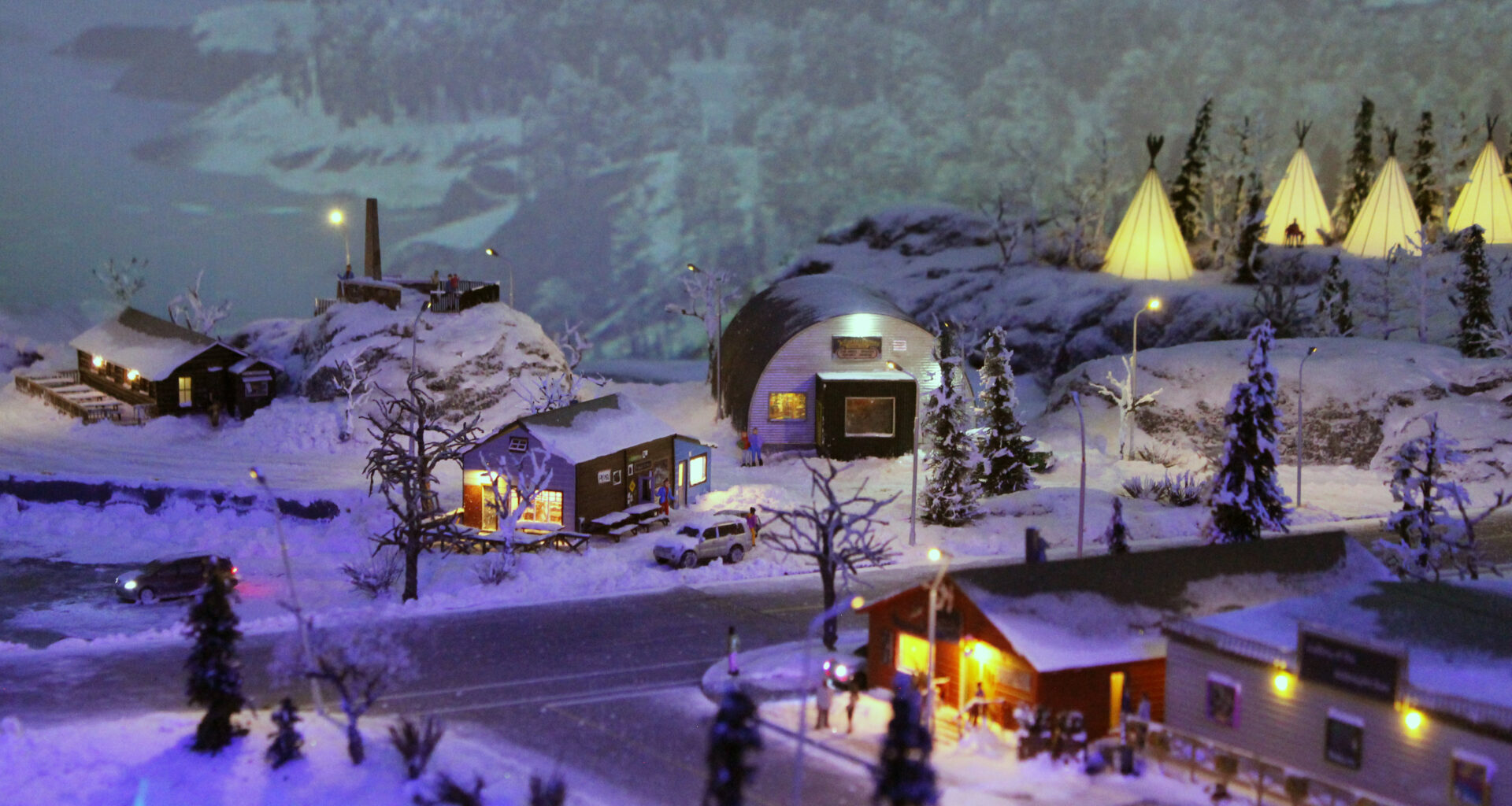
Where Yonge Street meets Dundas in downtown Toronto, hundreds of students, shoppers, tourists and office workers speed through the intersection, many unaware of tiny worlds beneath their feet.
Under one of Canada’s busiest intersections sit miniature replicas of cities, towns and hamlets from across the country, each one celebrating the history – and the whimsy – the nation has to offer.
In October, the attraction known as Little Canada opened its newest exhibit, Little North, which showcases scenes from Yellowknife, Tuktoyaktuk and various communities in Nunavut and Yukon.
The exhibit is temperature-controlled at 17C – slightly cooler than the rest of Little Canada – so visitors can not only see and hear the North, they can feel it too. It includes a tiny Snowcastle complete with sculptors chipping away at their ice, a version of Yellowknife’s Gold Range Hotel, the Gallery of the Midnight Sun, Bullocks Bistro and more.
As the only Canadian team in Major League Baseball reached the World Series for the first time in more than 30 years, people across Canada flocked to the home of the Toronto Blue Jays – many northerners among them.
Shane Bennett and Adam Scarf took the red-eye flight from Yellowknife to Toronto first thing on October 31 to watch game six of the series. Bennett called it a “once-in-a-lifetime experience.”
“After all the stuff that everyone’s gone through in the country since Covid, it’s kind-of nice to have something that actually unites people, and it’s a positive thing that we all can actually be happy about,” said Bennett.
Claire McFarlane caught up with fans who had made trips from the NWT to see some of the Jays’ World Series run.
“When we were in middle school, they flew drummers from the high school in Fort Simpson to the set.”
Lynx River never existed, but Melaw Nakehk’o and Brie O’Keefe know exactly how it would have looked and sounded.
The community at the heart of North of 60 was modelled on a Dehcho village like Fort Simpson, where Nakehk’o and O’Keefe grew up watching the show on CBC.
Thirty years later, they’re rewatching every episode in a new podcast: Lynx River Revisited.
Alexander Brown never felt that a natural hair colour was a true reflection of who he is. He started dying his hair as a teenager and now rocks a full rainbow.
“It’s something you can change easily and something that’s not permanent,” Brown said, adding it’s a safe way to figure yourself out.
“You make a sudden and visible change to yourself,” he said, “and suddenly you can look in the mirror and say, ‘Oh, there I am.’ … It feels like a part of myself that I get to have on the outside.”
Miriam Bosiljevac, no stranger to hair dye herself, met some Yellowknifers who go the extra mile for their hair.
Related Articles