
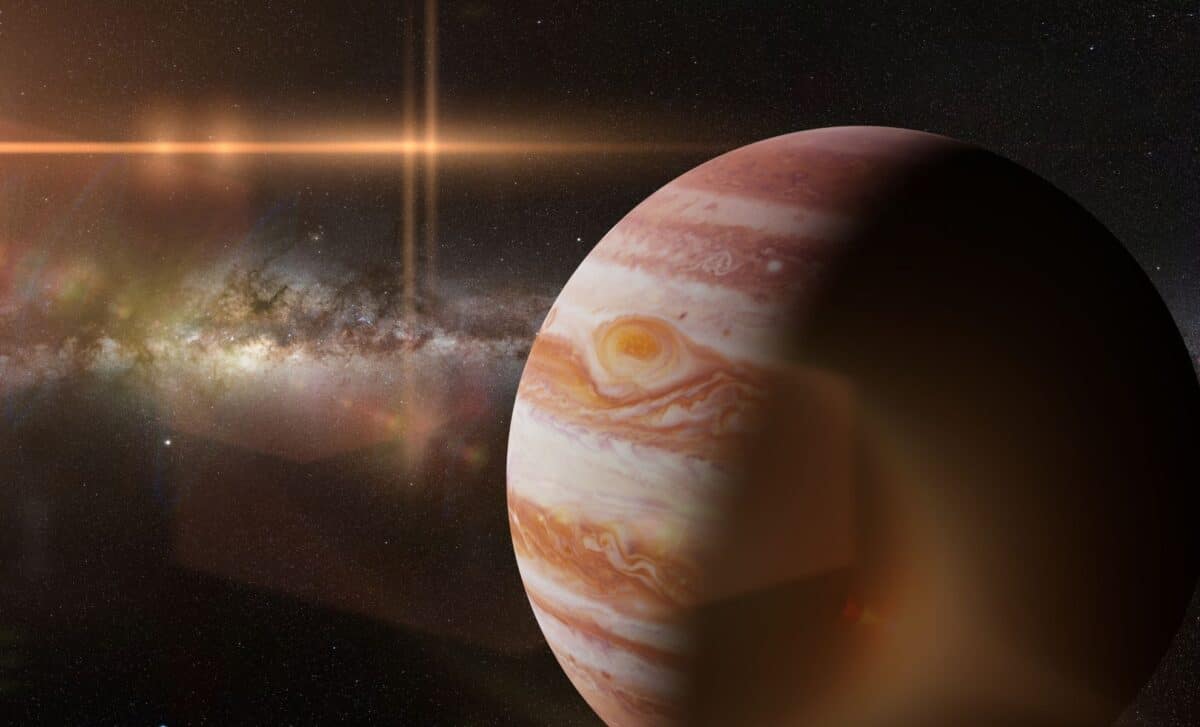
The year begins with a powerful celestial display as Jupiter takes center stage in the night sky. This January, the gas giant appears brighter and more prominent than usual. The planet reaches a key orbital position known as opposition, when it sits directly opposite the Sun from Earth’s perspective. This event allows observers to see the planet in peak condition: large, steady, and luminous from dusk to dawn. Combined with the arrival of a meteor shower and a seasonal constellation lineup, it marks one of the most watchable months for amateur astronomers.
Rare Clarity Makes Jupiter Shine Like Never Before
The visibility of Jupiter this month is unusually favorable, particularly for urban observers. According to Earthsky.com, the planet’s position and brightness make it one of the easiest objects to spot in the sky. Its light does not flicker like stars but glows steadily, helping even novice skywatchers distinguish it from surrounding celestial bodies. And while the planet is visible without any equipment, a pair of binoculars will bring its four largest moons, Io, Europa, Ganymede, and Callisto, into sharp view.
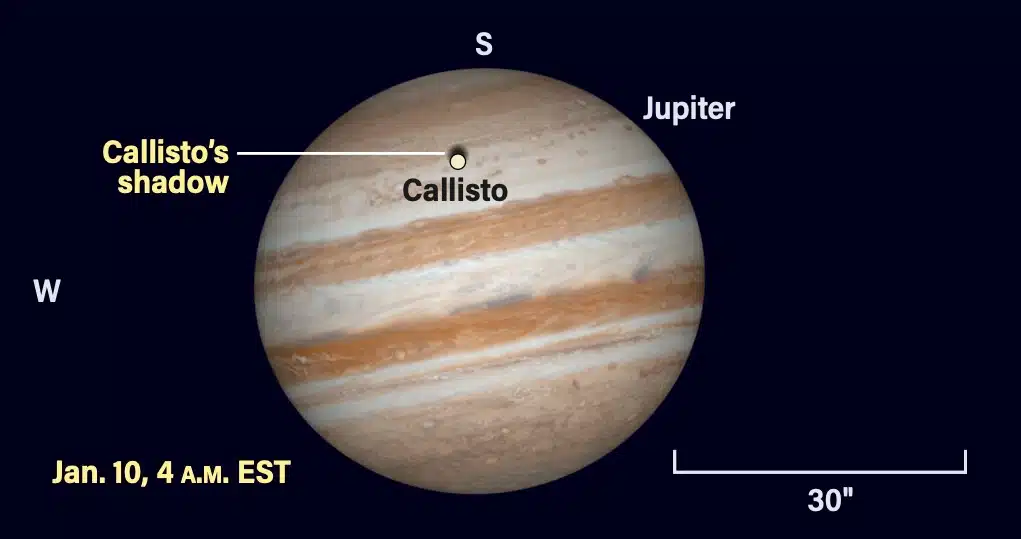 Callisto casts its shadow on Jupiter’s cloud tops. Credit: Roen Kelly
As explained by Jackie Faherty, an astrophysicist at the American Museum of Natural History:
“It is a really good month to look for Jupiter.” he added, “Jupiter is high in the sky, and is up all night throughout the month and looks really awesome.”
On the night of January 10, Jupiter reaches full opposition, a term used when Earth is directly between the Sun and another planet. This alignment happens once a year, but conditions this January make it especially favorable. And on January 4, it will appear right next to the full moon, making for a particularly photogenic pairing.
A Meteor Shower Adds Fire To The Winter Sky
Alongside Jupiter’s brilliance, the Quadrantids meteor shower will peak on January 3. Though it began in late December and will continue through January 16, the best viewing conditions align with early January nights.
The meteors travel at roughly 90,000 miles per hour and can deliver up to 10 visible streaks per hour under typical conditions. In ideal darkness, NASA estimates that as many as 200 meteors per hour could be seen. As noted by Gothamist, the show may be partially muted this year due to the full moon, but the potential for bright fireballs, large, colorful bursts of light.
Orion, Taurus and the Winter Constellations
Beyond planets and meteors, the January sky is rich with stellar arrangements that are easy to find, even from within city limits. One of the most recognizable is Orion, marked by three aligned stars forming the hunter’s belt. From there, stargazers can spot Rigel, a blue-white star in Orion’s knee, and Betelgeuse, the reddish star in his shoulder.
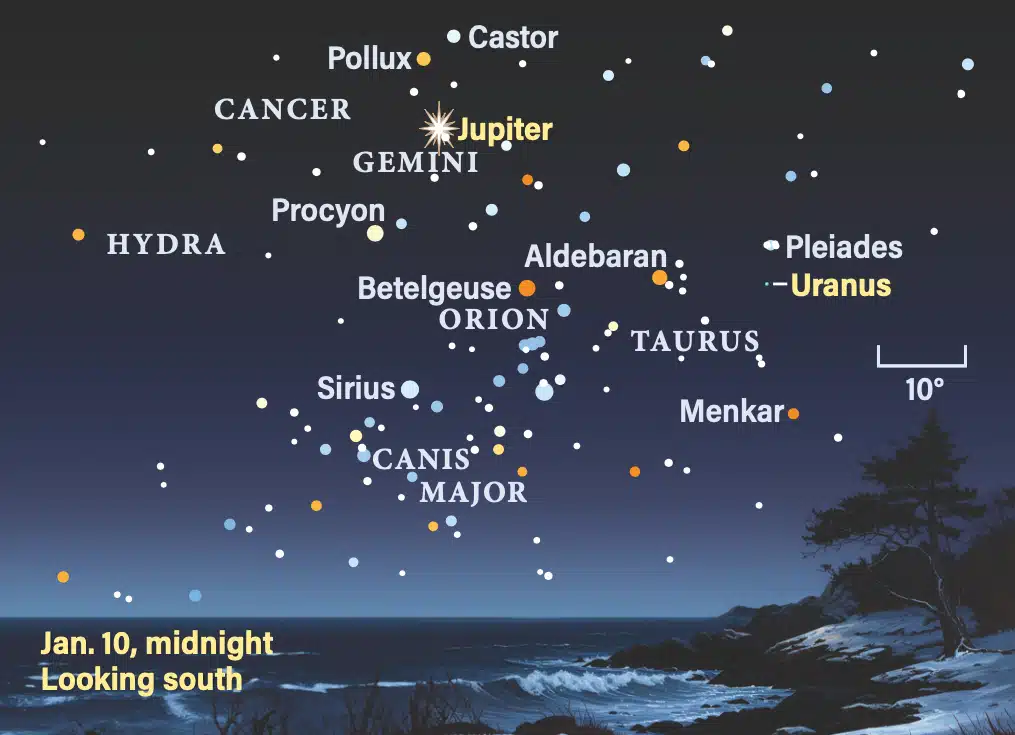 Jupiter stands out near Gemini amid January’s brightest constellations. Credit: Roen Kelly
To Orion’s right lies Taurus, another seasonal highlight. Its most notable star, Aldebaran, represents the bull’s red eye. Just past that, observers will find the Pleiades, a compact, bluish cluster of stars often mistaken for a fuzzy patch in the sky.
“Right now our winter sky, our sky is dominated by the rise of Orion and Taurus,” explained Faherty. “When you go out at night or get out after work, these are the constellations that are going to strike you because they’re going to be rising, and they’ve got all the bright stars that your eyes are going to be drawn to, and they just do a little lap around around your zenith and set by the end of the night.”