
At US President Donald Trump’s Mar-a-Lago home in Palm Beach last week, Prime Minister Benjamin Netanyahu likely assumed that he was at the front of his host’s mind, or at least the issues he had come to discuss were: Gaza, Iran, Lebanon and a pardon.
By all accounts, the two leaders enjoyed a friendly and productive meeting, and also spent New Year’s Eve together at the resort’s black tie ball.
The attention of the White House, though, was far from the Middle East. Instead, it was busy planning for an impending daring special forces raid to snatch Venezuela’s President Nicolas Maduro from one of his homes and take him into custody to face narcotics and terrorism charges in the US.
The stunning operation early Saturday marks the latest use of military force by the US president that shattered ostensible red lines and forced observers to scramble to find a new description of his foreign policy doctrine.
As evidenced by his January 2020 assassination of Qassem Soleimani, who led Iran’s Islamic Revolutionary Guard Corps Quds Force, and the US strikes on nuclear sites at the tail end of Israel’s 12-war against Iran in June, Trump is no isolationist. He is ready to use American military might in an aggressive but targeted fashion against adversaries, especially after repeated warnings.
Get The Times of Israel’s Daily Edition
by email and never miss our top stories
By signing up, you agree to the terms
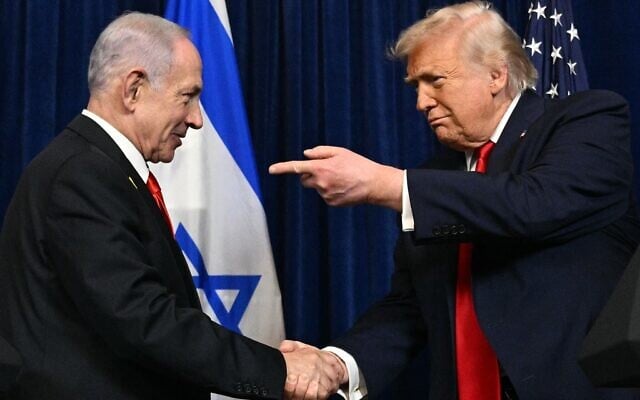
US President Donald Trump (right) and Prime Minister Benjamin Netanyahu shake hands during a joint press conference at the Mar-a-Lago residence in Palm Beach, Florida, December 29, 2025. (Jim WATSON / AFP)
While it took place far from the part of the world Netanyahu was most concerned with, Trump’s strike on Caracas has reverberated far beyond Latin America.
The Israeli premier had gone to Florida with matters largely unsettled in Gaza and Lebanon, where the Hamas and Hezbollah terror groups have refused to disarm and have shown signs of attempting to rebuild, and worried that Iran could be gearing up for a fresh conflict as well.
On all three fronts, the outcome largely hinges on Trump and what guarantees he can provide Israel, as well as what threats he can issue against his and Netanyahu’s adversaries. Thus Jerusalem has a clear interest in the effectiveness of the Venezuela raid and what effect it has on the potency of both.
As a rule, a US president that is willing to back up threats with the judicious use of military force is a good thing for US allies in the region, including Israel. When Washington is seen as disinterested in the Middle East, or is run by a president who chooses endless diplomacy to avoid using force, America’s enemies are emboldened.
Netanyahu made his sentiments clear, congratulating Trump for his “bold and historic leadership on behalf of freedom and justice.”
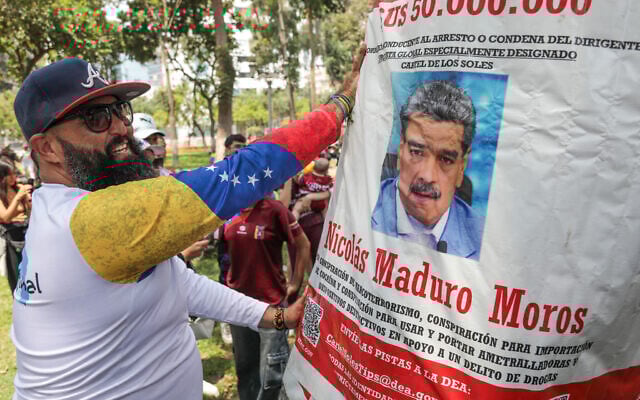
A man pastes a sign reading “Reward US$50,000,000” depicting Venezuelan President Nicolas Maduro, at the Miguel de Cervantes park, near the Venezuelan Embassy in Lima on January 3, 2026, after US forces captured him. (Connie FRANCE / AFP)
Iran, which expanded its influence over the Middle East as the US tried to disengage from the region in the wake of the long Iraq and Afghanistan occupations, has reason to be nervous after the raid.
Standing next to Netanyahu last week in Florida, Trump said unequivocally that he would back an Israeli strike on Iran if it resumes its missile and nuclear programs.
“If [Iran] will continue with the missiles — yes. [And if they continue with] the [production of] nuclear [capabilities] — fast. One will be yes, absolutely. The other, we’ll do it immediately,” Trump said, indicating that the US could again join Israel in an attack on Iran.
Days later, as widening economic protests swept across parts of the Islamic Republic, Trump issued a new threat. He warned Iran that if it “violently kills peaceful protesters,” the United States “will come to their rescue.”
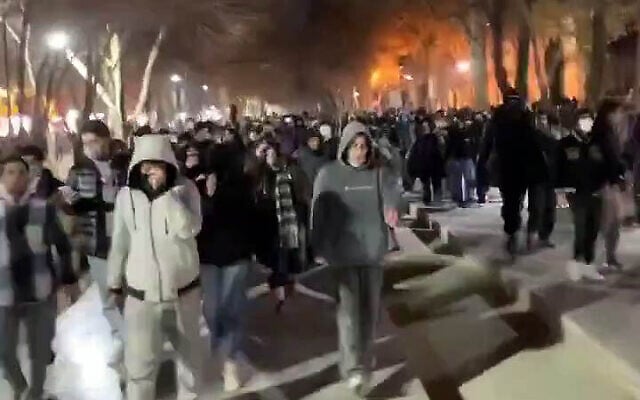
A video appears to show anti-regime protesters marching in Isfahan, Iran, January 1, 2026. (X screenshot: used in accordance with Clause 27a of the Copyright Law)
“We are locked and loaded and ready to go,” Trump wrote.
With the Venezuela raid, the Islamic Republic should reasonably conclude that Trump is willing to back up his threats with action, and has the ability to make it happen.
While it isn’t entirely clear what the path is to another US bombing operation, and or even an assassination or extraction, in Iran, it certainly seems shorter after Saturday’s raid in Caracas.
Iran has long allied with Venezuela, using Caracas to bypass sanctions, and selling oil for gold in order to fund its armed proxies. Hezbollah, an Iranian proxy, also enjoys deep support networks in Venezuela, raising money through its ties to narcotics traffickers.
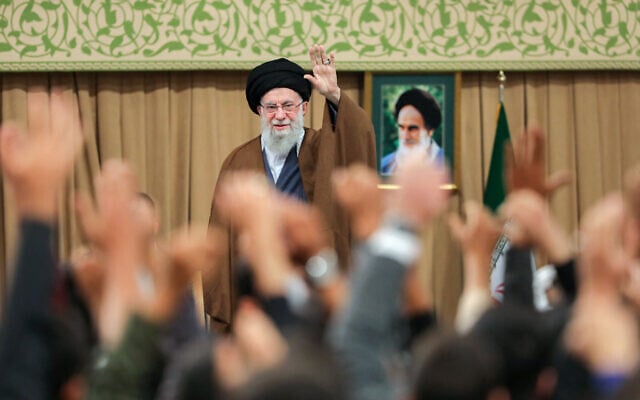
A handout picture provided by the office of Iran’s Supreme Leader Ayatollah Ali Khamenei shows him addressing a meeting with students in Tehran, Iran, on November 3, 2025. (KHAMENEI.IR / AFP)
The fall of the Maduro regime, if Trump pursues such a goal, would rob the Iranian axis of its base in the Americas.
None of that means that Iran is about to sue for peace with the US, however.
Leaders in Tehran are likely to see the Maduro arrest as further proof that Trump is really interested in regime change, not just stopping the nuclear and ballistic missile program, noted Raz Zimmt, who heads the Iran and the Shiite Axis research program at the Institute for National Security Studies in Tel Aviv.
“Consequently, there is little incentive to negotiate with the Trump administration,” he said.
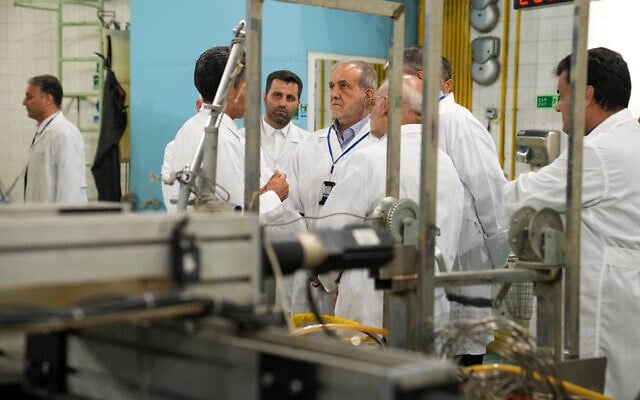
Iranian President Masoud Pezeshkian listens to explanations as he visits the country’s nuclear achievements during his tour to the Atomic Energy Organization in Tehran, Iran, in a photo released on November 2, 2025. (Atomic Energy Organization of Iran via AP)
“I see no growing willingness to engage in negotiations — certainly not on [Supreme Leader Ali] Khamenei’s part,” Zimmt said. “In any case, the current conditions — complete lack of trust and US demands perceived by Iran as total capitulation — do not allow for an agreement.”
At most, it seems, the Venezuela operation could cool Iran’s resolve to resume nuclear enrichment or break out toward a nuclear weapon, at least as long as Trump is in office.
Over the longer term, however, Iran might use the operation as further evidence that in order to survive it has to drastically enhance its deterrence against the US, even in the form of a quiet push toward a nuclear weapon.
Iran will be watching to see what happens next before it draws its final conclusions from Saturday’s operation.
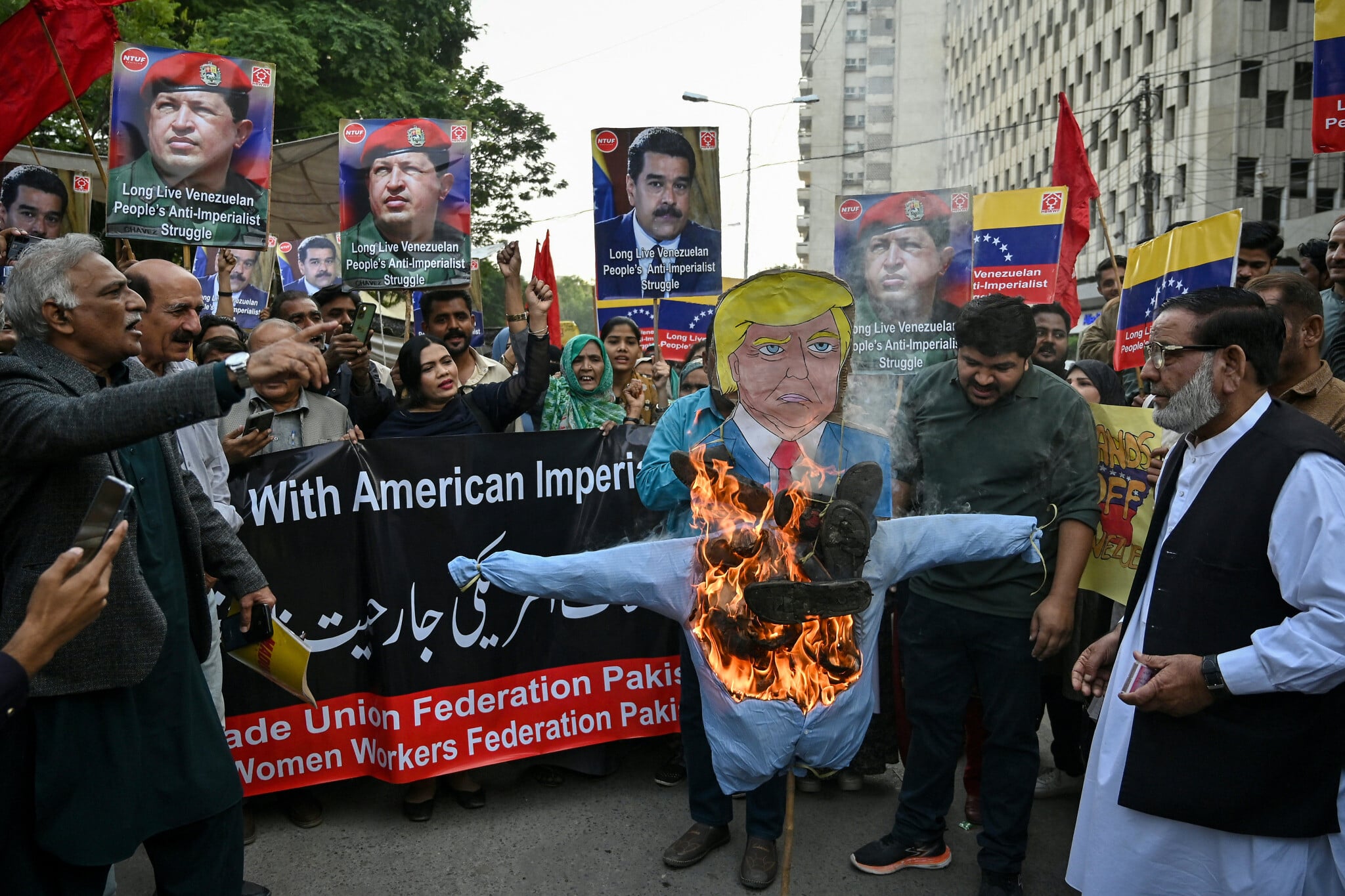
Labor union activists burn an effigy of US President Donald Trump during a demonstration against the US’s attack on Venezuela, in Karachi, Pakistan, on January 4, 2026. (Asif HASSAN / AFP)
“The issue with Iran is less the question of what the president did, and the question is what the president does [next],” noted Danielle Pletka, senior fellow at the American Enterprise Institute, a conservative think tank in Washington. “If he allows the vice president [of Venezuela] to remain in power, the Iranians will breathe a sigh of relief.”
Even if Trump decided to decapitate Iran’s leadership, without follow-up action, the ayatollah regime, backed by the IRGC, would remain in power and perhaps even tighten its grip on the country.
Trump’s previous military engagements with Iran were brief and pointed, reflecting his aversion to becoming entangled in a protracted conflict abroad.
That was also seen in Yemen, where the administration ended a sustained but largely ineffectual bombing campaign against the country’s Iran-backed Houthi rebels after a few weeks, reaching a deal that protected America’s interests in the Red Sea but left Israel to fend for itself against the group.
Rubio’s no Witkoff
In Gaza, though, the Maduro raid “may cause Hamas to take Trump more seriously,” noted Pletka.
At Mar-a-Lago last week, Trump issued a threat to Hamas over its refusal to give up its weapons under the administration’s 20-point plan that halted fighting there in October.
The terror group, he said, “will be given a very short period of time to disarm,” or “there will be hell to pay for them.”
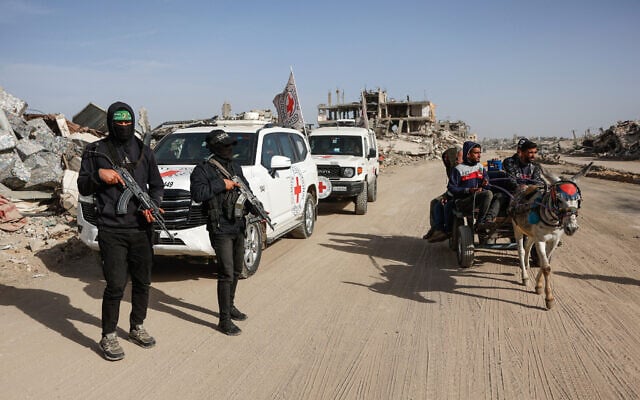
Hamas gunmen are present as Egyptian workers, accompanied by members of the International Committee of the Red Cross, search for the remains of the last Israeli hostage, Sgt. Ran Gvili, in the Zeitoun neighborhood of Gaza City on December 8, 2025. (Omar AL-QATTAA / AFP)
At the same time, Trump’s approach to Gaza differs from his stance on Venezuela. US Secretary of State Marco Rubio has run point on American policy toward Caracas, advocating an aggressive posture with a steadily escalating use of US military force.
Regarding Gaza, on the other hand, Trump has put special envoy Steve Witkoff in charge.
Witkoff, a diplomatic novice, has shown a belief that problems can be solved by talking face-to-face, even to hardened terrorist leaders.
In October, Witkoff described sharing a moment of connection with Hamas leader Khalil al-Hayya over their shared experience of losing a son.
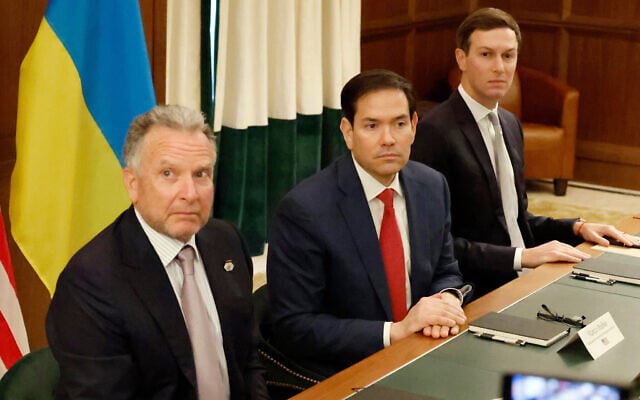
(L-R) US Special Envoy Steve Witkoff, Secretary of State Marco Rubio, and White House adviser Jared Kushner, US President Donald Trump’s son-in-law, attend a meeting with Ukrainian officials in Hallandale Beach, Florida, November 30, 2025. (AP Photo/Terry Renna)
“We expressed our condolences to him for the loss of his son,” said Witkoff. “He mentioned it. And I told him that I had lost a son, and that we were both members of a really bad club, parents who have buried children.”
“When Steve and him spoke about their sons,” recalled top Trump Middle East adviser Jared Kushner to CBS News, “it turned from a negotiation with a terrorist group to seeing two human beings kind of showing a vulnerability with each other.”
Witkoff’s late son Andrew died at the age of 22 of an opioid overdose. Al-Hayya’s son Himam al-Hayya was killed in an Israeli airstrike on Hamas headquarters in Doha that drew Trump’s ire.
It’s impossible to imagine Rubio having a heart-to-heart with enemy leaders.
“They are very different people with very different ideas,” said Pletka of Rubio and Witkoff.
Interventionists on the rise
The Maduro raid may also signal the growing ascendancy of the Rubio-led interventionist wing of the administration, as opposed to the isolationist flank led by Vice President JD Vance.
Rubio is a staunch friend of Israel, while Vance, a close friend of conservative Israel-critic Tucker Carlson, seems to have far less invested in the US-Israel relationship.
There is another benefit for Israel of having Rubio leading the way on Venezuela. He is and is seen as a leading candidate to replace Trump in 2028.
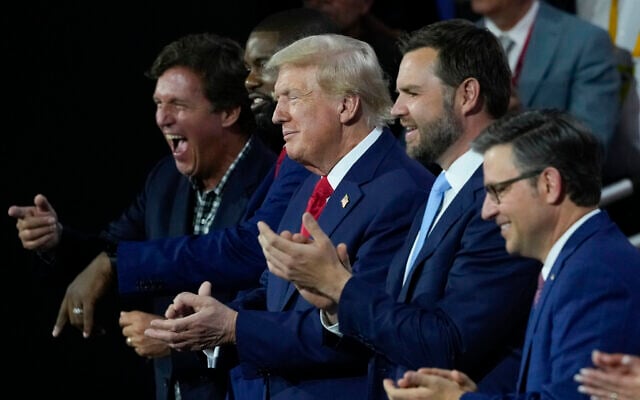
Republican presidential candidate former President Donald Trump, center, and Republican vice presidential candidate Sen. JD Vance, R-Ohio, second from the right, attend the first day of the Republican National Convention, Monday, July 15, 2024, in Milwaukee. Joining them are from l-r., Tucker Carlson, Rep. Byron Donalds, R-Fla., and House Speaker Mike Johnson of La. (AP Photo/J. Scott Applewhite)
While Vance has been out of the spotlight in recent weeks — he wasn’t at Mar-a-Lago at all during the Netanyahu visit — Rubio has taken center stage. With Saturday’s stunning action, he has shown Trump that his way, and not Vance’s instinctive isolationism, enhances the president’s credibility and leads to wins for US policy.
The isolationists may not only be losing in the White House, but on the street level as well.
According to a Ronald Reagan Institute poll conducted in late October and early November, 87 percent of self-identified MAGA Republicans said they backed Trump’s strikes on Iran, and 73% said they would back the use of US military force to prevent Iran from developing nuclear weapons.
And 90% said they supported US strikes against drug traffickers in the Caribbean, including from Venezuela.
With Trump convinced that bold, targeted strikes are a moral and necessary tool in order to force adversaries to accede to US demands, he is more likely to sympathize with Israel doing the same in Gaza, Lebanon, and Iran.