
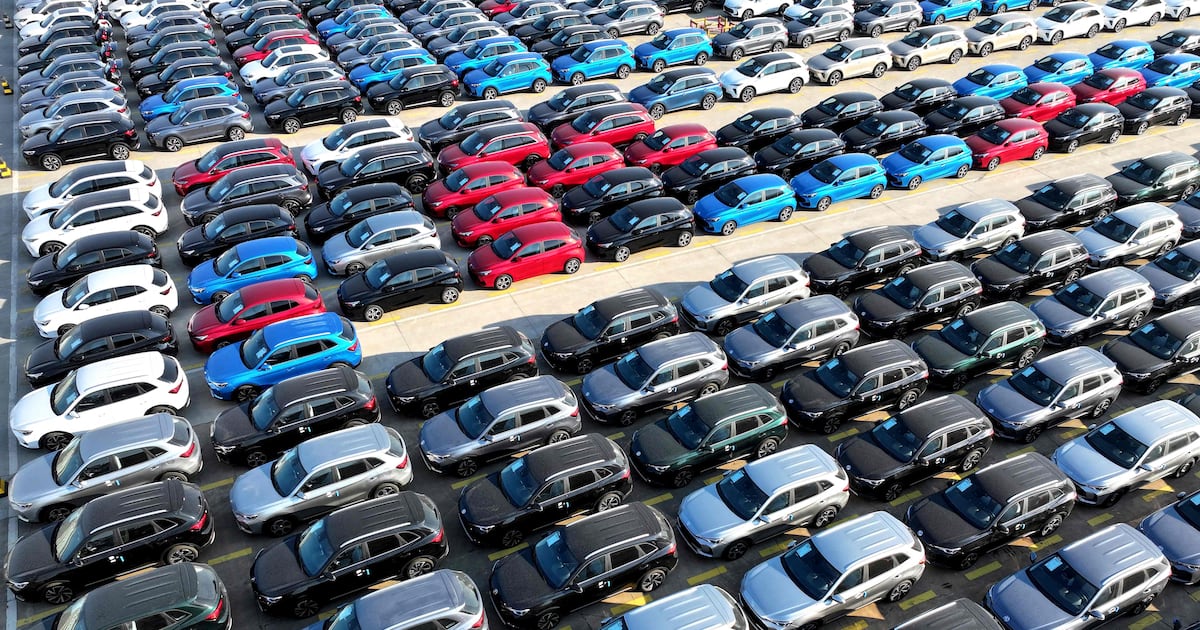
China’s export-driven economic model is sharpening a trade-off western policymakers know all too well: shielding domestic industry usually comes at the cost of higher prices. Politicians face an uncomfortable choice: disappoint voters worried about living costs, or industries squeezed by low-priced Chinese goods.
But the constraints are not the same across the West. Europe’s exposure to China is deeper, and firms and households are still dealing with the legacy of higher energy prices after Russia’s invasion of Ukraine.
The US has responded bluntly − relying on high tariffs, alongside restrictions in selected sectors. Europe, by contrast, is more divided over how far to go in response to Chinese competition.
France, for one, has called for a “Made in Europe” approach, with President Emmanuel Macron arguing for a tougher line on Chinese exports – which he recently said were becoming “unbearable” for European industry.

‘Steady but fragile world’ as tariffs bite, says IMF
Tariff redirection
US tariffs were expected to redirect Chinese exports towards Europe, and in some industries that pressure on local producers is now evident, particularly in textiles and steel. With domestic consumption subdued, Chinese firms have increasingly turned to foreign markets − notably Africa and South-East Asia. Even so, calls in Europe for a more protective response are growing.
The Made in Europe targets, which would require up to 70 per cent local content for some products like cars, risk adding more than €10 billion ($11.8 billion) a year in higher costs but for limited industrial gain.
The wider danger for western policymakers is that blocking Chinese exports through tariffs or quotas risks reinforcing inflationary pressure, just as price pressures have eased but not disappeared.
If the West raised further barriers to trade with China, prices would almost certainly rise at first, as production would shift to higher-cost producers in Europe and the US.
Analysts have, for example, warned that forcing much of the iPhone supply chain to the US would push its price towards $3,500 in extreme cases, even if practically unrealistic.
A harder line also raises the risk of retaliation, including restrictions on rare earths exports (China dominates that global supply chain) and pressure on western firms operating in China. All of this lands at a difficult moment for Europe in particular.
For EU policymakers, the past year has been bruising. US trade barriers have weighed on European manufacturers, alongside tougher competition from lower-priced Chinese rivals and still-elevated energy costs. Under this strain, firms have turned to Brussels for support, and Chinese imports have become an obvious focus of the debate.
Little wonder: China is now running a trade surplus of almost $1 trillion with the rest of the world. Over the past decade, China’s surplus with Europe has nearly doubled to about €300 billion. These figures help explain the political anxiety. But they risk being read as evidence of a system-wide shock when, in reality, they are not.
Europe has misunderstood the threat from China. What policymakers are now confronting is not cheap labour or the imitation of existing products, but Chinese firms that can compete directly on price, scale and execution.
The threat from Chinese exports is uneven and often overstated. Exports have risen this year, but they have grown faster before without provoking the same alarm. The political and economic context, not the scale, has changed.
Moreover, since the launch of Made in China 2025, the share of European exports that compete directly with Chinese rivals on world markets has barely changed. Such exposure varies sharply between countries and sectors. France, for example, is significantly less exposed than Germany.
Other high-income economies, such as Japan and South Korea, are more exposed to Chinese exports than Europe, but have not seen the broad industrial decline now being debated on the continent.
The data show Europe is generally less exposed to Chinese competition than in East and South-East Asia, and in parts of the Americas such as Mexico. In most western economies, well under half of exports compete directly with Chinese rivals in global markets.
If there is a case for intervention, it is stronger in a narrow set of sectors, such as steel, where Chinese dumping has long been seen as a problem. They also make sense where western firms face tighter restrictions in China than the reverse, particularly in services.
The mistake is to treat these cases as evidence of a general threat to the West’s entire industrial base; it is not. Long-running productivity weakness in parts of the EU has made the competition from China more painful.
How to be competitive
In practice, Europe is likely to respond more selectively than the US, with higher tariffs in areas such as steel and electric vehicles, and tighter scrutiny of products that collect or transmit data.
Writing in the Financial Times recently, Mr Macron signalled that Europe is prepared to defend its market, if rebalancing economic relations with China fails.
France has long favoured tougher barriers on Chinese imports, while Germany has often acted as a brake. As Berlin’s resistance has softened, European action has become harder to block.
The US response, by contrast, has already been blunt: high tariffs on Chinese imports, combined with extra restrictions in sensitive sectors, even after a recent detente with China. The implications are now clear.
This past year has crystallised a hard truth for western manufacturers, particularly in Europe. Competing with China on cost alone is no longer viable for most of them. So, competitiveness will have to come instead from product quality, branding and innovation.
One senior European executive put it bluntly: Europe should move up the value chain and leave lower-end segments to China.
The challenge for policymakers in Brussels − and for the wider western response – is whether firms can move up the value chain fast enough before the competitive pressure erodes the margins and scale needed to do so.
What are the influencer academy modules?
Mastery of audio-visual content creation.
Cinematography, shots and movement.
All aspects of post-production.
Emerging technologies and VFX with AI and CGI.
Understanding of marketing objectives and audience engagement.
Tourism industry knowledge.
Professional ethics.
%20Ramez%20Gab%20Min%20El%20Akher
%3Cp%3E%3Cstrong%3ECreator%3A%3C%2Fstrong%3E%20Ramez%20Galal%3C%2Fp%3E%0A%3Cp%3E%3Cstrong%3EStarring%3A%3C%2Fstrong%3E%20Ramez%20Galal%3C%2Fp%3E%0A%3Cp%3E%3Cstrong%3EStreaming%20on%3A%20%3C%2Fstrong%3EMBC%20Shahid%3C%2Fp%3E%0A%3Cp%3E%3Cstrong%3ERating%3A%20%3C%2Fstrong%3E2.5%2F5%3C%2Fp%3E%0A
Avatar: Fire and Ash
Director: James Cameron
Starring: Sam Worthington, Sigourney Weaver, Zoe Saldana
Rating: 4.5/5
Specs
Engine: Dual-motor all-wheel-drive electric
Range: Up to 610km
Power: 905hp
Torque: 985Nm
Price: From Dh439,000
Available: Now
Western Region Asia Cup Qualifier
Results
UAE beat Saudi Arabia by 12 runs
Kuwait beat Iran by eight wickets
Oman beat Maldives by 10 wickets
Bahrain beat Qatar by six wickets
Semi-finals
UAE v Qatar
Bahrain v Kuwait