
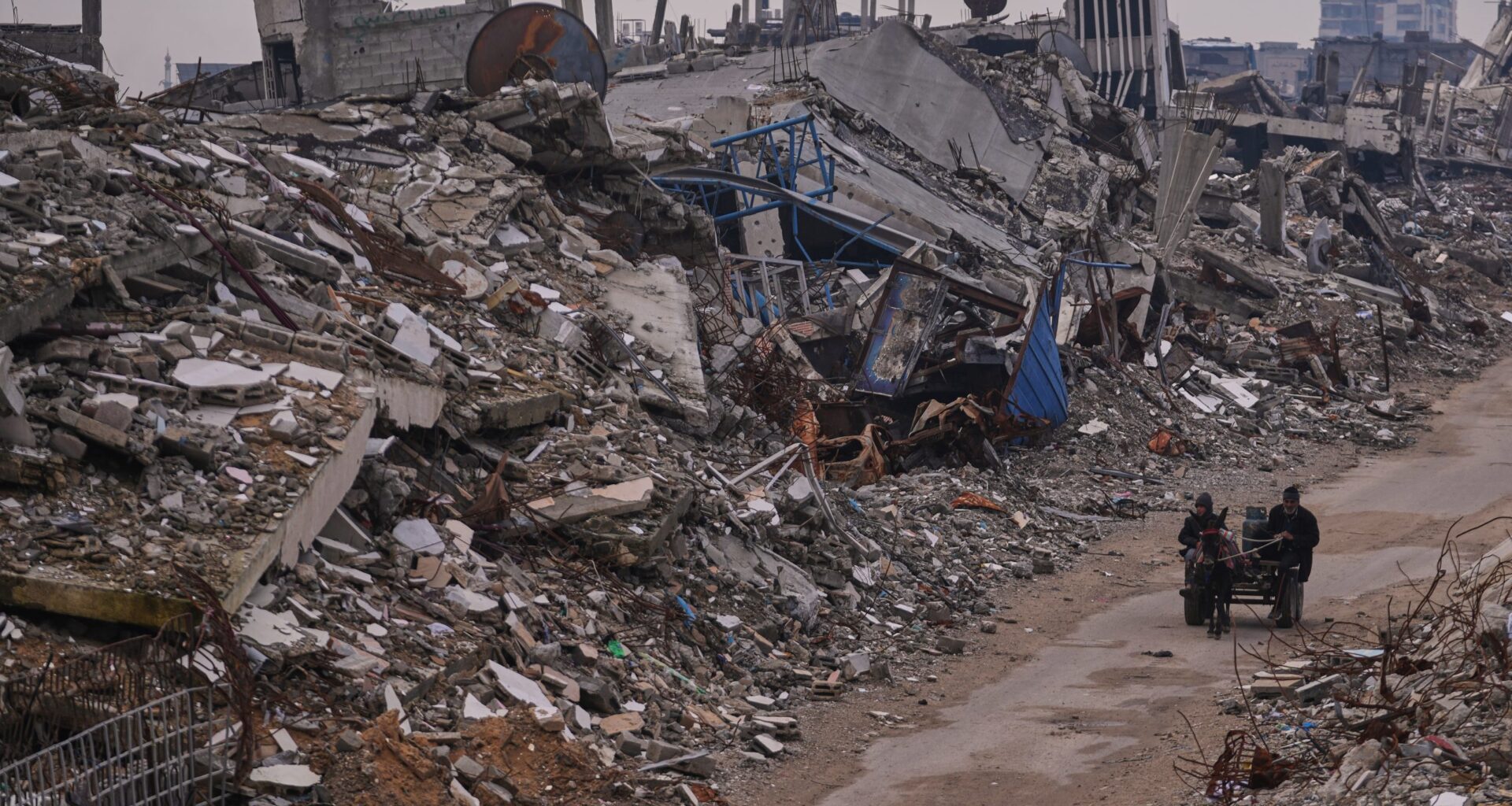
Over the last couple of months, I have heard many Americans, including well-intentioned friends, say about Gaza, “I’m glad it’s over” or “Good thing the violence has stopped.” These would be welcome sentiments if they reflected reality.
The horrific attack on Jews celebrating Hanukkah in Sydney, Australia, was rightly condemned, widely and immediately, but the everyday grinding violence that Palestinians face has become almost invisible.
In fact, while the cease-fire between Israel and Hamas has stopped the worst of the bombardment, the suffering has continued. Since Oct. 10, more than 360 Palestinians have been killed in Gaza by Israeli military attacks, including at least 70 children according to Gazan health authorities. Humanitarian aid is still not flowing at the scale necessary to address the urgent needs for food, water and shelter. As a result, more than 9,000 children in Gaza were hospitalized for acute malnutrition in October, according to the U.N. child protection agency Unicef. In a further discouraging development, Israel has barred many international aid organizations (including Caritas International) from operating in the coastal enclave.
Still, some of our leaders, including former Secretary of State Hillary Clinton, have suggested that concern for Gaza is the result of social media and TikTok “propaganda,” rather than the result of hearts of young people being moved by injustices unfolding before their eyes and made possible with U.S. weapons.
Photos of the devastation in Gaza are not a mirage; aerial shots reveal the vast destruction of civilian infrastructure: The United Nations estimates that 92 percent of homes and more than 90 percent of school buildings have been damaged or destroyed by the Israeli military. Those legitimately worried about online misinformation should push Israel to allow in international journalists, still blocked after more than two years.
The Israeli military remains in the coastal enclave and has set up a “yellow line,” which Israel’s military chief is calling a “new border” with Israel, demonstrating how President Trump’s peace plan and the U.N. Security Council’s resolution endorsing it are failing to bring about full withdrawal and reconstruction. The land east of the line amounts to 53 percent of the already narrow strip and, as Israeli human rights lawyer Sari Bashi has explained, includes most of Gaza’s “arable land and industrial zones.”
Since fall 2023, 95 percent of Palestinians in Gaza have been displaced and more than 70,000 killed in what has been termed a genocide by the Holocaust historians Amos Goldberg and Omer Bartov and by numerous other scholars, human rights groups and a U.N. commission. Thousands live in flimsy tents as the winter season of cold rain has flooded their bedding and belongings—as shown in numerous photos and videos that are easily obtainable and heartbreaking. Babies are dying of hypothermia.
This is not the stuff of mere TikTok memes. As Nataly Sayegh, a Palestinian Christian in Gaza, wrote in August, “We are real people, living through all of this—with our bodies, our pain, our stories. Hunger, illness, fear, deep sadness and loss.”
We must heed Ms. Sayegh’s words in taking to heart the insights of the Christmas season now coming to a close. When we began Advent, we heard in the Gospel to “stay awake” (Mt 24:42) and to be mindful of the coming of the kingdom of God. The story of the Epiphany is of those who hear the call to be alert. “We saw his star at its rising and have come to do him homage,” say the three magi about Jesus.
Epiphany is the Greek word for “manifestation”—God appears to humanity through the incarnation. By the divine entering our reality as a vulnerable infant, we know that God is with us. As Pope Francis preached last year, “God seeks everyone, always.” The kingdom of God is among us; it is not just a spiritual place far off in the future but something we are called to make real here and now through awareness, prayer and solidarity.
How, then, should we respond when we see the faces of two Palestinian brothers, Fadi Abu Assi, 10, and his brother Jumaa, 12, who were killed in Gaza in November by a drone dispatched by the Israeli military? How should we react when we learn that the Israeli military called them “suspects” simply because they crossed the so-called yellow line, which is largely an invisible line marked with a few concrete blocks? What should we do when we hear of their crime—of looking for firewood?
Intensifying threats in the West Bank
Pope Francis worried about a “globalization of indifference,” by which we “become used to the suffering of others.” And while Gaza has, or had until recently, garnered some meaningful attention from Americans, there has also been a continuing and intensifying threat to Palestinian existence in the Israeli-occupied West Bank that has largely gone unnoticed, including in the wake of the fragile Gaza cease-fire.
The fall olive harvest in the West Bank, the main source of income for many Palestinian families there, was the most violent in at least a decade, according to the United Nations. In October, there were 264 attacks by Israeli settlers against Palestinians in the West Bank, or about eight a day. Videos show settlers attacking and intimidating Palestinians as well as Jewish, Christian and Muslim activists who joined “protective presence” efforts organized by groups like Rabbis for Human Rights.
In December, the Israeli government approved a proposal for another 19 settlements in the West Bank, illegal under international law, bringing the total number of new settlements to 69 since the beginning of 2023. And last year saw the largest Palestinian displacement in the West Bank since 1967. An astounding 40,000 were pushed from their homes by Israeli military operations.
In November, settlers damaged two mosques in the West Bank, threatening to turn what has primarily been a geopolitical matter into a religious conflict. The Israeli government also moved forward on a plan to seize ancient Roman ruins and olive trees belonging to the village of Sebastia, in what David Neuhaus, S.J., describes as a “direct assault on Palestinian religious heritage.”
Pope Leo: ‘Identify with the pain of others’
On the very day that the so-called cease-fire went into effect in Gaza, I received numerous messages about a Palestinian Christian administrative detainee. Despite the lack of formal charges, 25-year old Layan Nasir is in Israeli prison for the third time, arrested as attention was focused on the last living Israelis freed from Hamas captivity and on the 2,000 Palestinians released from Israeli prisons—including 1,700 Gazans also detained without charges or trials. Ms. Nasir remains in detention.
In considering systemic injustices in Palestine and elsewhere, it is easy, as Pope Leo has explained, to fall into a “globalization of powerlessness,” in which we “risk becoming immobile, silent, perhaps sad, thinking that nothing can be done.” He urges instead a “culture of reconciliation,” which requires us to “identify with the pain of others” and recognize that “we have the same dreams and the same hopes.”
That empathy should then drive action. You can ask your member of Congress to support the Block the Bombs Act to limit weapons sent to Israel. You can boycott Chevron, whose gas electrifies Israeli settlements, military bases and prisons. And you can maintain the spirit of the global Advent campaign to light a red candle for Palestine, affirming the sanctity of every human life, Palestinian and Israeli alike.
The violent oppression of Palestinians in Gaza and the West Bank continues, and looking away will not change that. On Epiphany, we are reminded once again that Jesus was born in Bethlehem, and Palestinian Christians lit the Christmas tree there again in 2025 after two dark years, a model of steadfastness. Right before the holiday, Latin Patriarch Pierbattista Pizzaballa visited the Holy Family Church in Gaza, named for the biblical flight of Mary, Joseph and Jesus; he helped release doves into a bright sky so often marred by smoke and explosions and vowed to rebuild. In this new year, let us keep our eyes on Palestine and redouble our work for justice, peace and equality throughout the Holy Land.
Related