
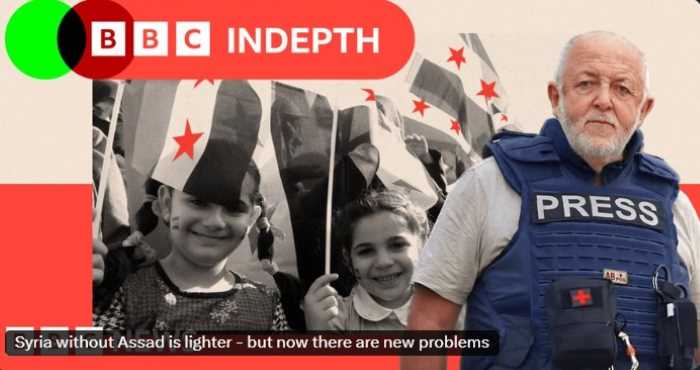
On December 8th 2025 the BBC News website published a long report by the corporation’s international editor titled “Jeremy Bowen: Syria feels lighter without the Assads’ crushing weight – but now there are new problems”.
That report – which carries the BBC’s ‘In Depth’ logo – remained on the website’s ‘Middle East’ page until January 3rd 2026.
The December 8th edition of BBC Radio 4’s ‘Today’ programme included a similar audio report by Bowen – from 1:36:23 here.
Both those reports were produced as part of BBC coverage marking the one-year anniversary fall of the Assad regime in Syria, following a ten-day trip by Bowen to the country.
Bowen’s written report includes portrayal of Syria’s new president Ahmad al Sharaa – formerly known as Jolani – as a “man who outgrew his jihadist roots”, without providing any evidence to support that obviously significant claim. Notably, on the day that both of Bowen’s reports appeared, celebrations in Damascus and elsewhere included ISIS flags, anti-Israel and anti-Jewish chants as well as vows to conquer Jerusalem.
Bowen reminisces about his meeting with al Sharaa during a visit to Syria a year earlier, immediately after the fall of Bashar al Assad, but predictably has nothing to say about either his own record of reporting – or that of the BBC in general – throughout the thirteen years of the Syrian civil war.
Bowen’s written account of events in Syria since Assad’s fall include a sanitised portrayal of the July 2025 massacre of Druze (and Christians, who are not mentioned at all) in the Suweida province.
“In July in the southern province of Suweida, serious violence between Druze and Bedouin communities shook the Sharaa administration to its roots. The Druze religion developed out of Islam around a thousand years ago, and its followers, who some Muslims believe are heretics, amount to around 3% of Syria’s population.
When government forces entered Suweida, supposedly to restore order, they ended up fighting Druze militias. Israel, which has its own Druze community that is fiercely loyal to the Jewish state, intervened. Its airstrikes included the near destruction of the ministry of defence in Damascus.
It took a rapid American intervention to force a ceasefire that stopped a spiral down into much worse violence. Tens of thousands of people were driven from their homes and remain displaced.”
Under the sub-heading “the Israel question”, Bowen then goes on to tell readers that: [emphasis added]
“It is still not clear whether Sharaa and his interim government are strong enough to survive another crisis as serious as that. Israel remains a looming and dangerous presence to Syrians.”
Both his written and audio reports include accounts of a trip made to Beit Jinn, with Bowen telling ‘Today’ listeners that:
“We moved on to Beit Jinn – a village in the foothills of the Israeli-occupied Golan Heights where the problem is Israel.”
Bowen states that his visit took place three days after an incident which was badly reported by the BBC News website at the time:
BBC FAILS TO PROVIDE INFORMATION ON ISLAMIST GROUPS IN SYRIA
In his written report, Bowen tells readers that:
“We visited the border village of Beit Jinn, which was raided by IDF troops on 28 November. The IDF said they were arresting Sunni militants who were planning attacks.
Local men fought back, wounding six Israelis as the raiding party was forced into a hurried retreat, abandoning a military vehicle that they later destroyed with an airstrike. The Israelis killed at least 13 local people and wounded dozens, state media reported.
It was a sign of how hard it will be to broker a security deal between Syria and Israel. The Damascus government called it a war crime. Calls for retaliation intensified.”
Bowen fails to clarify that those “Sunni militants” were members of Jamaa Islamiya – a Lebanon-based branch of the Muslim Brotherhood with ties to Hamas and Hizballah that participated in the war between Israel and Hizballah – or that the two operatives that IDF forces arrested on November 28th 2025 had previously launched rockets at Israel.
In the audio account of the same trip to Beit Jinn, he tells Radio 4 audiences that:
“It seems to me these are people – these villagers – who have just been buffeted and trapped by circumstances in the uprising against Assad, the war, unable to control their own lives. And a year on from the fall of Assad, that hasn’t changed. It’s simply that the forces gripping their lives have changed. The reality of how they live hasn’t.”
Notably, Bowen had nothing to tell BBC audiences about the fact that the small town of Beit Jinn has long been a hub of Hamas activity, with operatives having been arrested there in June 2025 and Hamas terrorists having been targeted in the area several days before that and in January 2024. In September 2023, the IDF targeted Palestinian Islamic Jihad operatives in the region.
Neither did Bowen bother to provide his listeners and readers with any information about the reestablishment of various terror groups in areas adjoining Israel’s border with southern Syria and how that might be perceived by Israelis as a “looming and dangerous presence” in light of the events of October 7th 2023.
Instead, Bowen prefered to promote the decidedly not “in depth” (but definitely predictable) narrative that it is Israel that is “the problem” in the Golan Heights border area.
Related Articles:
REVIEWING A DECADE OF BBC REPORTING ON SYRIA