
Back to Article List
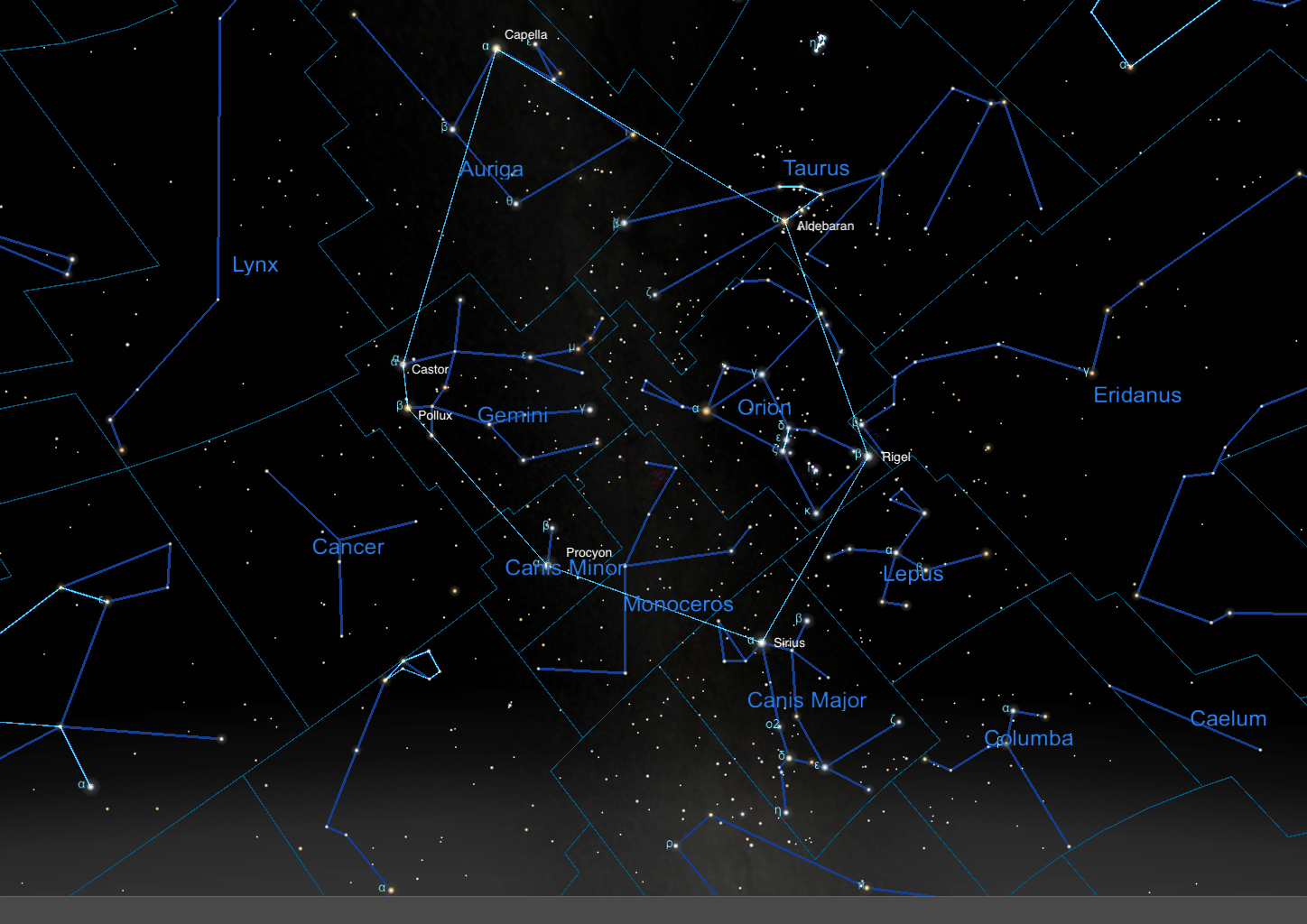
A huge asterism is visible in the east, rising after sunset this evening. Trace out the Winter Hexagon, spanning six constellations.
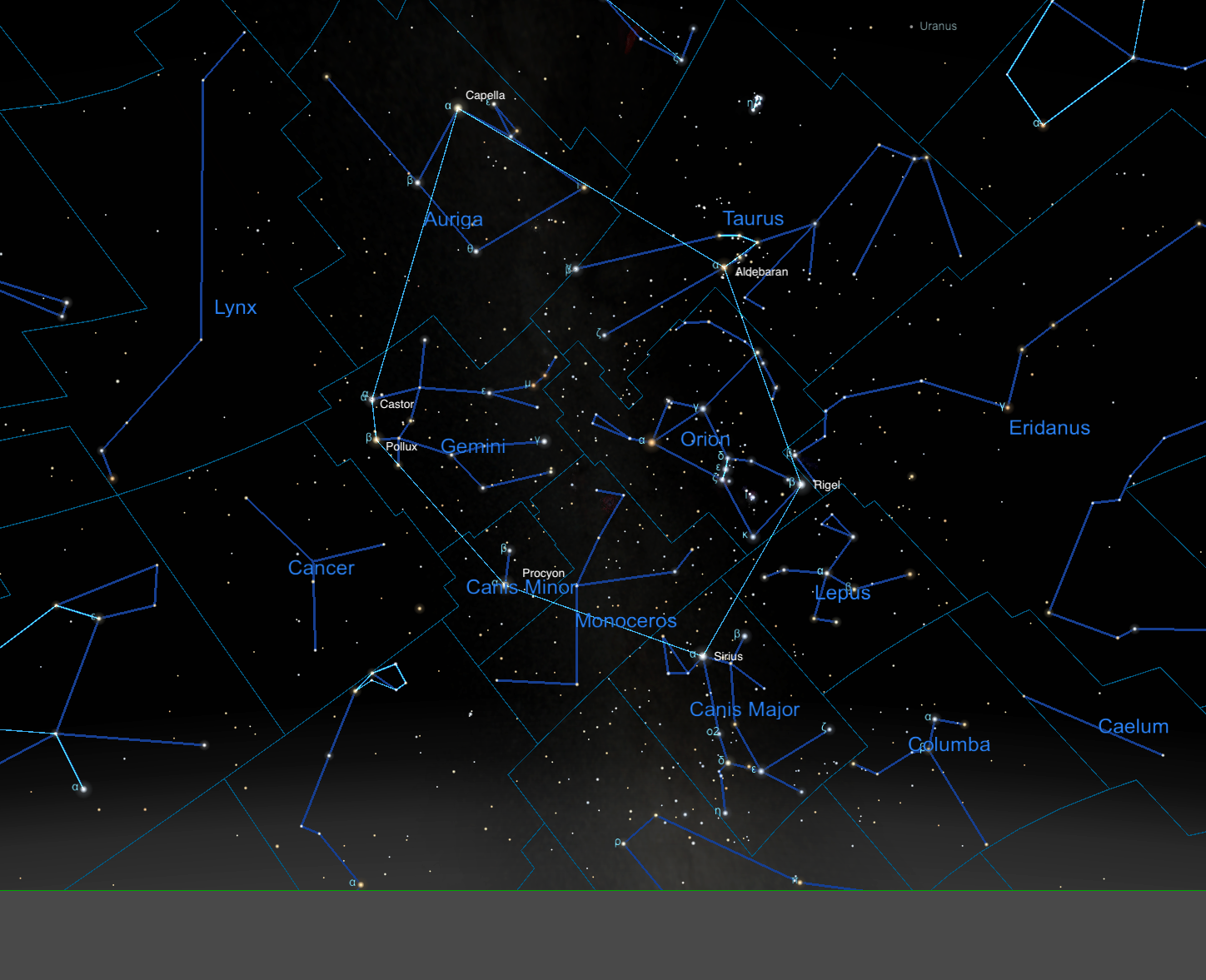
The Winter Hexagon is a large asterism created by linking seven stars in the wintertime sky. Credit: Alison Klesman (via TheSkyX)
The Winter Hexagon, a large asterism consisting of seven bright stars (Sirius, Rigel, Aldebaran, Capella, Castor, Pollux, and Procyon) across six constellations, becomes fully visible above the eastern horizon by 9 P.M. local time.
Astronomical data for January 3 indicates a Waning Gibbous Moon at 96% illumination, with specific local times provided for sunrise (7:22 A.M.), sunset (4:48 P.M.), moonrise (6:23 P.M.), and moonset (8:41 A.M.) from 40° N 90° W.
Comet 24P/Schaumasse, recently observed at approximately magnitude 10, will be located in northern Virgo, rising shortly before midnight on January 4 and best viewed in the hours preceding dawn.
On the morning of January 5, the comet will be situated near the globular clusters M53 (magnitude 7.6) and NGC 5053 (magnitude 9.8), which are positioned just over 1° east of the star Diadem.
Looking for a sky event this week? Check out our full Sky This Week column.
January 3: The Super Moon and the Quadrantids
You may have heard of the Summer Triangle, but do you know the Winter Hexagon?
This large asterism spans six constellations and, just as the Summer Triangle is easily visible on warm summer nights, the Winter Hexagon stands above the horizon on cold winter evenings. By 9 P.M. local time, the entire star pattern is well above the eastern horizon. The lowest star at this time is Sirius in Canis Major, who sits at the feet of Orion the Hunter and lies below Orion’s Belt as the pair rises. Sirius, shining at magnitude –1.4, is the brightest star in the sky.
From here, move your gaze counterclockwise into Orion. The next star in the Hexagon is Rigel, which shines at magnitude 0.2 and depicts the Hunter’s right knee (as the figure is often drawn facing away from us). From Rigel, next look upward and slightly to the left to magnitude 0.9 Aldebaran, the eye of Taurus the Bull.
The magnitude 0.1 star Capella in Auriga caps the Hexagon as the highest star as it rises in the sky, standing to the upper left of Aldebaran. Now we start moving down toward the horizon again — the heads of Gemini the Twins, magnitude 1.6 and 1.2 Castor and Pollux (respectively), together form the next point in the Hexagon and lie below and slightly to the left of Capella. Note that bright magnitude –2.7 Jupiter is nearby, to the right of Pollux.
The last star in the Winter Hexagon is magnitude 0.4 Procyon in Canis Minor, to the lower right of Castor and Pollux and roughly halfway between Castor and Sirius.
Sunrise: 7:22 A.M.
Sunset: 4:48 P.M.
Moonrise: 6:23 P.M.
Moonset: 8:41 A.M.
Moon Phase: Waning gibbous (96%)
*Times for sunrise, sunset, moonrise, and moonset are given in local time from 40° N 90° W. The Moon’s illumination is given at 10 P.M. local time from the same location.
Rising shortly before midnight on January 4 and best viewed in the hours before dawn, Comet 24P/Schaumasse is located in northern Virgo, traveling through a rich region of the sky. Although the bright Moon will likely interfere, observers with larger scopes or astrophotography rigs may want to brave the moonlight to spot Schaumasse near the globular clusters M53 and NGC 5053 on the morning of January 5.
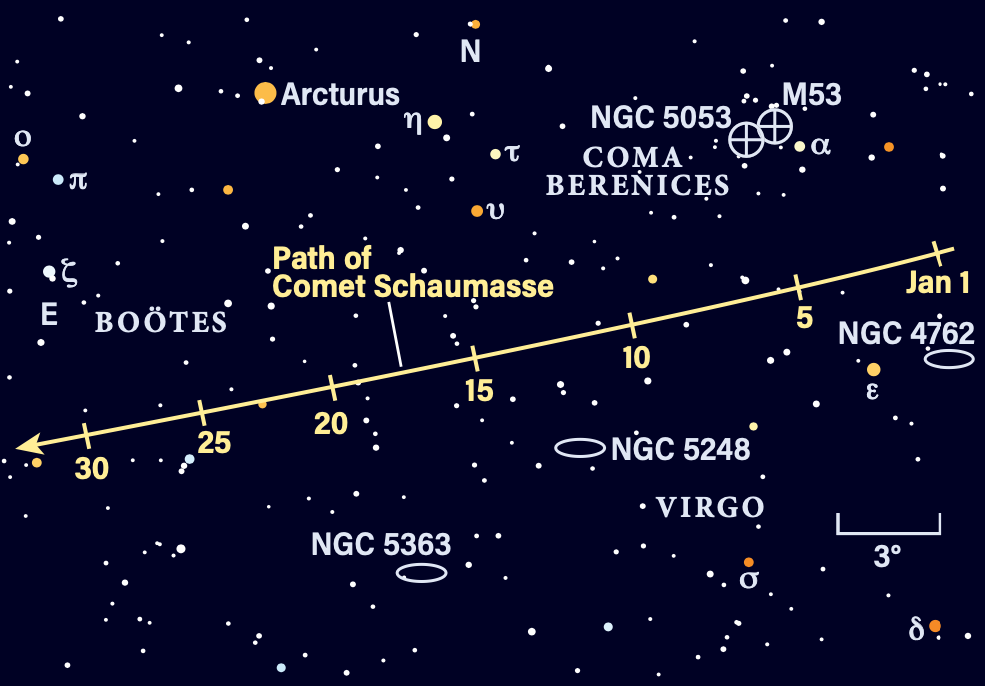
Comet Schaumasse leaves the galaxy-rich regions of Virgo and spends its time south of Arcturus later this month. Credit: Astronomy: Roen Kelly
By 4 A.M. local time, this region of the sky is some 50° high in the southeast. Schaumasse, recently observed around magnitude 10, lies roughly between the stars Diadem (Alpha Comae Berenices) and Vindemiatrix (Epsilon [ε] Virginis). For a more precise position, look 4° due south of Diadem to find it.
M53 and NGC 5053 lie just over 1° east of Diadem, so you can use this star as a jumping-off point to find them as well. Both are roughly the same angular size (10’) but M53 is brighter at magnitude 7.6, compared to NGC 5053’s magnitude of 9.8. The latter is much closer to the current magnitude of the comet.