
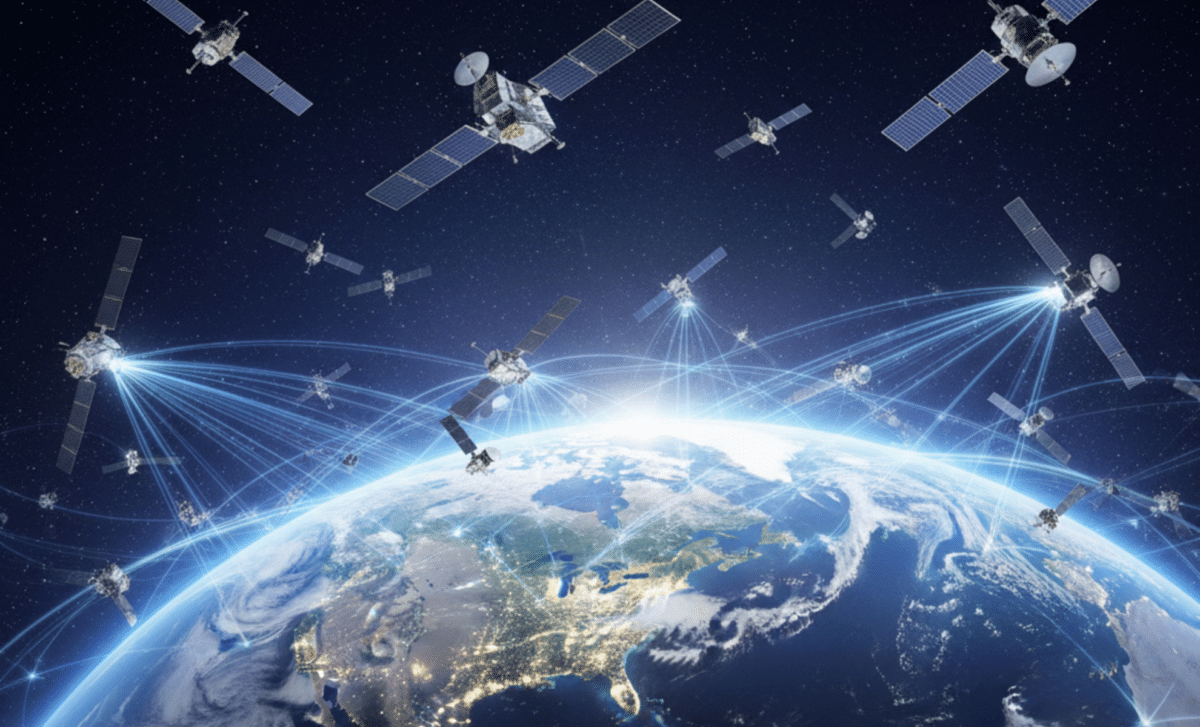
As the number of satellites in orbit continues to climb, so does the risk of their remnants falling back to Earth, and into the path of commercial airliners. A 2025 study conducted by the University of British Columbia estimates a 26% probability that, within a year, uncontrolled space debris will re-enter Earth’s atmosphere over heavily trafficked airspace. And by 2030, the probability of an individual commercial aircraft encountering a piece of debris could reach 1 in 1,000, based on earlier modeling.
Why Small Debris Poses Big Danger At Flight Altitude
The primary threat doesn’t come from large rocket bodies or defunct satellites, but from small fragments that survive atmospheric re-entry. These can range from dust-sized particles to fuel tanks, many of which descend rapidly through the same altitude at which commercial aircraft operate, around 30,000 to 40,000 feet.
“Aircraft can be affected by much smaller pieces of debris. For example, airplanes flying through the ash of a volcano is risky because of the small particles,” explained Benjamin Virgili Bastida, a space debris system engineer at the European Space Agency (ESA). “Kind of a similar thing could happen with re-entering debris.”
These particles pose a unique risk to jet engines, navigation systems, and fuselage integrity. While atmospheric entry typically burns up most of a spacecraft, some elements, particularly metallic and composite structures, can endure, retaining enough mass and velocity to inflict damage.
Virgili Bastida and his team recently published their findings in the Journal of Space Safety Engineering. Their work focuses on the challenges of determining when and where airspace should be closed due to potential re-entry threats, an issue that becomes increasingly complex as launch frequency rises.
Lessons From The Long March And The Need For Coordination
In November 2022, Spain was forced to close a significant portion of its airspace when the core stage of China’s Long March 5B rocket made an uncontrolled re-entry. Over 300 flights were delayed, rerouted, or canceled, as air traffic controllers attempted to mitigate the unknown trajectory of a 20-ton object, one of the largest uncontrolled re-entries in recent years.
This incident highlighted the current lack of global coordination and limited predictive accuracy regarding space debris paths. As reported by Space.com, experts say these kinds of shutdowns may become more frequent, unless more precise forecasting systems and international standards are put in place.
“What we are trying to investigate in the studies we are running is to see what is really the threshold for risk for an aircraft,” said Virgili Bastida. “At what risk should we react?”
The dilemma lies in finding the balance between overreaction and inaction. React too frequently, and commercial aviation could suffer unnecessary disruption; wait too long, and the consequences could be catastrophic.
“If we react at every risk, half of the world will be impacted every now and then, so it’s not feasible,” Virgili Bastida warned. “Do we react for everything which has a chance to reach the ground? Or do we react only for the very large objects, as we did for the Long March?”
Uncertainty And Delays: The Cost Of Wide Margins Of Error
One of the most significant technical barriers is the current inability to precisely predict when and where space debris will re-enter. Even during the final orbit, the margin of error can span several hours, which translates into thousands of miles of uncertainty on the ground.
This gap in precision forces air traffic controllers to make binary decisions, either close massive corridors of airspace, at significant economic cost, or risk lives on the chance that debris might miss.
“There’s a desire to be more specific and make those windows and closures as narrow and constrained as safety allows,” said Ian Christensen, senior director at the Secure World Foundation. He notes that efforts are underway, by both national agencies like the FAA and international organizations like the ICAO, to develop narrower, more targeted closures, especially as the commercial launch industry expands.
Better Forecasting Starts With Better Data
Improving space debris re-entry predictions will require better understanding of atmospheric dynamics at the edge of space, a region between 62 and 124 miles (100–200 km) above Earth, where the transition from vacuum to air is gradual and heavily influenced by solar activity.
According to Space.com, the European Space Agency is planning the DRACO mission (Destructive Re-entry Assessment Container Objective) in 2027 to gather high-resolution data on how small satellites disintegrate during re-entry. The capsule will carry over 200 sensors, including temperature and structural sensors, and will eject a black box upon breakup to relay data back to Earth.
This mission, alongside the Inter-Agency Space Debris Coordination Committee’s (IADC) ongoing Re-Entry Campaigns, is expected to refine existing models and establish standards for safer satellite design, ones that fully disintegrate before reaching aircraft altitudes.
Setting Standards Before The Next Incident
Experts emphasize that building an effective defense against falling debris will require not only technical solutions, but also international coordination.
Air traffic regulators, satellite operators, and space agencies will need to agree on when and how to respond to future re-entry threats. That means setting standards for risk thresholds, defining acceptable levels of particulate matter, and automating decision-making wherever possible.
“The aviation world is very driven by standards, and we’re seeing a lot of activity in the space world around standards as well,” said Christensen. “Those give us ways to develop technical mitigation approaches, technical solutions, and then implement them at the national level with some coordination internationally.”
Until such frameworks are widely adopted, aviation may face occasional, weather-like delays from space debris, a growing side effect of our increasingly saturated near-Earth environment.