
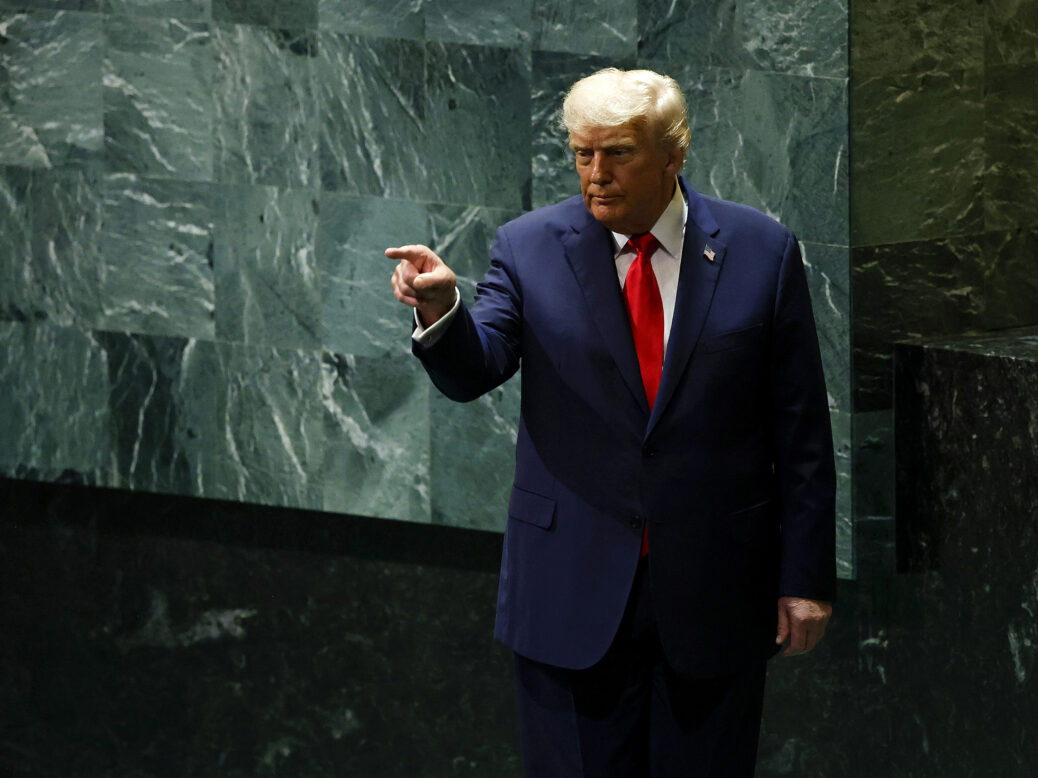
Photo by Chip Somodevilla/Getty Images
Almost every period of reshaping conflict produces an aftermath of illusion. The Treaty of Westphalia was supposed to create a Europe of calm, balance and religious tolerance. At Vienna, with Napoleon down, there was to be a new conservative-Christian order. After the First World War, we had Versailles, the pruning and pacification of Germany, new countries such as Czechoslovakia, and the League of Nations.
The illusion was that national imbalances, unresolved yearnings and hatreds, and the ambitions of would-be leaders can be perpetually anaesthetised by a new international order. This would stand above and cancel the previous dangerous feuding. Siege-cannon, hussars, machine guns and air forces were over; harmony had dawned. In our world, the illusion was the postwar order of international law symbolised by the United Nations. It, too, offered a new world of peace. After Ukraine, and now after Venezuela, that illusion is shattered. It’s gone the way of the League and the Hapsburgs.
We can no longer allow ourselves to close our eyes. All the vast, wordy brocade of sleek, urbane international jurisprudence, which means so much to our Prime Minister; all the desperate goldfish-gabbing at the UN in New York; all the pretence that small, weak, new nations are sovereign in just the same way that the US or Russia is a sovereign; the almost-religious assumption that there’s a shadowy, immanent, universal order… gone, all gone.
We are back in a world where hypersonic missiles and attack helicopters matter far more, and where national borders from Sudan to Eastern Europe, and perhaps now the Americas, too, can be altered by force. Nothing new there, you might say. As the New Statesman has been arguing for some time this is a world dominated by three rival emperors. Over the New Year one of them, Donald Trump, re-emphasised that his backyard, his subservient fringe, belonged to nobody but his imperial America. It must feel scary in Cuba, Colombia and even, perhaps, in Greenland. Less so in Russia and China. For all the legalistic cant and pious protests we may hear from them, both Putin and Xi (the latter moving fast into South America) will be secretly delighted. For they have backyards, too. But with the treaty of Westphalia gone, what does this mean for everybody else?

New year, new read. Save 40% off an annual subscription this January.
Hiding below the cover of a global order, the elites in many places took their quiet chances to behave badly. In much of the world, across Africa, swathes of Asia, and throughout parts of the former Soviet Union, this took the form of grotesque corruption. Millions were impoverished and had their hopes destroyed. And as Anne Applebaum’s Autocracy, Inc eloquently demonstrated, rampant corruption was also an essential component of dictatorships whose autocrats took comfort from their UN seats. In Iran, which may yet prove a bigger story than Venezuela, and in Afghanistan, Pakistan and Israel – and, up to a point, India – the elites used toxic religious fundamentalism to protect themselves. Below the shared fiction of a universal order, irreconcilable confrontations were building up – rather as European nationalisms eventually upended the pieties of the Congress of Vienna.
Speaking of which, in Europe, the elites pretended war had been abolished and consumerism was an appropriate universal philosophy. They created a very bourgeois network of welfare and bureaucracy, which had the drawback only of checking growth. That was more comfortable, less damaging, than choosing corruption or fanaticism, but it also grew under what proved to be illusory beliefs. It wasn’t the case that after the fall of the USSR, Russia would become Europe-friendly. It wasn’t the case that the Nato pledge from the US was unconditional. But even if Trump had chosen to spend his life in New York real estate, Europe’s ruling class would have had to confront dilemmas of nationalism, demography and migration which would eventually become existential for them.
So, here we are. On the fringes of the empires, not all the news is bad. Ukraine is holding on, European countries are rearming and Russian nuclear sabre-rattling has won the Kremlin precisely nothing. If the Iranian regime really does fall, a sophisticated network of Islamist propaganda and subversion inside Britain will fall with it; the consequences for migration, cohesion, and security should, for us, be benign. And a world economy which the creative, hard-working Iranian middle class could re-enter would be a richer one.
Venezuela is going to be hard for the White House to control without getting much more deeply involved, and there may be horrors ahead – as there were in Iraq. Trump’s gamble may be good for US oil, but it is not popular in America.
In Britain the most important lesson is the old one: we cannot rely on anyone else and must look after ourselves. That means protecting our democracy aggressively against outsiders, from US tech moguls to Russian troll farms, who want to subvert it. It means rearming, even if that implies cuts in other budgets. But although it is prudent to prepare ourselves with missile and sub-sea defences against a Russia which only wishes us harm, this does not mean we should necessarily be sending our only functioning aircraft carrier into the South China Sea to swim alongside the Americans. That’s their imperial fight, not necessarily ours – a message that perhaps Keir Starmer could take on his forthcoming visit to Beijing.
[Further reading: America kidnapped a president. Keir Starmer said nothing]
Content from our partners