
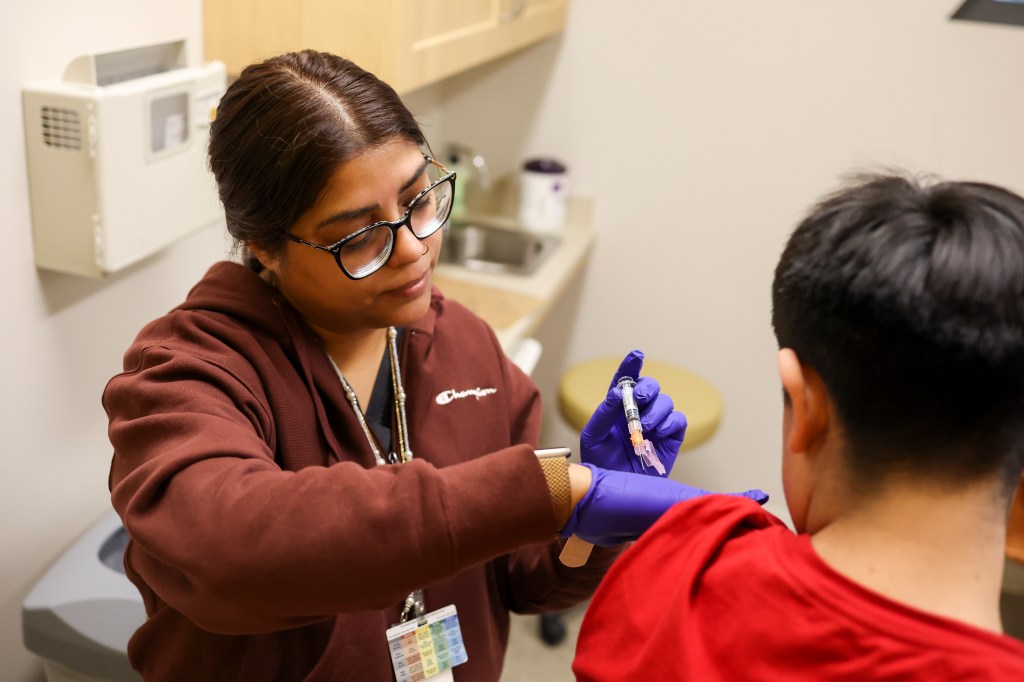
The federal government’s decision to dramatically reduce the number of vaccines it recommends for children, including the flu shot, will have “no bearing” on Illinois’ vaccine recommendations, said the director of the Illinois Department of Public Health on Monday — the same day that Illinois announced that the state had moved to “very high” levels of flu activity.
The head of the federal Centers for Disease Control and Prevention on Monday formally moved to remake the childhood vaccination schedule, to recommend children be vaccinated against 10 illnesses, whereas it previously recommended 17 immunizations for all children.
Federal health care leaders said the new vaccine schedule came after a review of other countries’ vaccine practices and the scientific evidence behind them, conducted at the instruction of President Donald Trump.
“After an exhaustive review of the evidence, we are aligning the U.S. childhood vaccine schedule with international consensus while strengthening transparency and informed consent,” said Robert F. Kennedy Jr., secretary of the U.S. Department of Health and Human Services, in a news release Monday. “This decision protects children, respects families, and rebuilds trust in public health.”
The CDC will continue to recommend all children be vaccinated against diphtheria, tetanus, whooping cough, polio, measles, mumps, rubella, human papillomavirus and chicken pox, among other illnesses.
Other vaccines will be recommended for children in certain high-risk groups. For still other vaccines, such as those that protect against the flu, rotavirus, COVID-19, meningococcal disease, hepatitis A and hepatitis B, it will be left up to parents and doctors whether to give them to individual children.
Previously, the CDC had recommended an annual flu shot for everyone over 6 months old.
Illinois Department of Public Health Director Dr. Sameer Vohra said in a statement Monday that the federal changes won’t affect Illinois’ childhood vaccine recommendations, which are based on “up-to-date scientific evidence.”
Last year the state health department adopted the CDC’s immunization schedules from early August — before federal health leaders began making controversial changes. Gov. JB Pritzker also signed a bill into law last year formally establishing a process for the state to issue its own vaccine guidelines.
“As the federal government unilaterally makes changes without transparent review or evidence to support changes, Illinois will continue to promote the well-being of Illinoisans by issuing recommendations based on the full weight of scientific evidence,” Vohra said.
Illinois has already broken with the federal government’s recommendations on COVID-19 and hepatitis B vaccines.
Major medical associations — including the Itasca-based American Academy of Pediatrics and the Chicago-based American Medical Association — were also swift to criticize the changes to the federal childhood immunization schedule on Monday.
American Academy of Pediatrics President Dr. Andrew D. Racine called the changes “dangerous and unnecessary” in a statement Monday.
Responding to reports that the new recommendations are based off of the childhood vaccine schedule in Denmark, Racine said, “Denmark’s population, public health infrastructure, and disease-risk differ greatly from our own.” Denmark has universal health care and has a much smaller, more homogenous population than the U.S.
“At a time when parents, pediatricians and the public are looking for clear guidance and accurate information, this ill-considered decision will sow further chaos and confusion and erode confidence in immunizations,” Racine said. “This is no way to make our country healthier.”
Racine said the American Academy of Pediatrics would continue to publish its own childhood vaccine recommendations, and he urged parents to work with their children’s pediatricians to make decisions about what’s best for their children.
The academy and the American Medical Association also criticized the process through which the changes are being made. In past years, a committee of doctors and experts would meet to discuss and vote on potential changes, which would then be recommended to the head of the CDC for adoption. The decision Monday, however, mostly bypassed that committee — which was reconstituted last year by Kennedy, a longtime vaccine skeptic.
“When longstanding recommendations are altered without a robust, evidence-based process, it undermines public trust and puts children at unnecessary risk of preventable disease,” Dr. Sandra Adamson Fryhofer, a trustee with the American Medical Association, said in a news release.
She said the American Medical Association supports continued access to childhood vaccines recommended by national medical specialty societies.
The new federal vaccine recommendations come as Illinois and other states struggle with surges of the flu.
Illinois had “very high” levels of flu activity for the week that ended Dec. 27, up from “moderate” levels for the previous week, according to the state health department. Illinois also reported on Monday its first child death from the flu during this respiratory illness season.
Chicago and suburban Cook County also had “very high” levels of flu activity for the week that ended Dec. 27. In Chicago, hospitalizations and emergency department visits for the flu are at their highest levels since 2022, according to the Chicago Department of Public Health.
Nationally, more than half of states had “very high” levels of flu activity for the week that ended Dec. 27, according to the Centers for Disease Control and Prevention.
COVID-19 activity in Illinois has also risen to moderate levels, according to the state health department.
This year’s flu vaccine isn’t a perfect match for a new variant of the flu called subclade K, but doctors say it may still help reduce the severity of the illness and reduce the risk of hospitalization. A study out of the United Kingdom, published in November, found the vaccine offered some protection against hospitalization and emergency department visits.
“Vaccinations remain the most effective tool to prevent severe illness from flu, COVID-19, and RSV,” Vohra said in a news release Monday.