
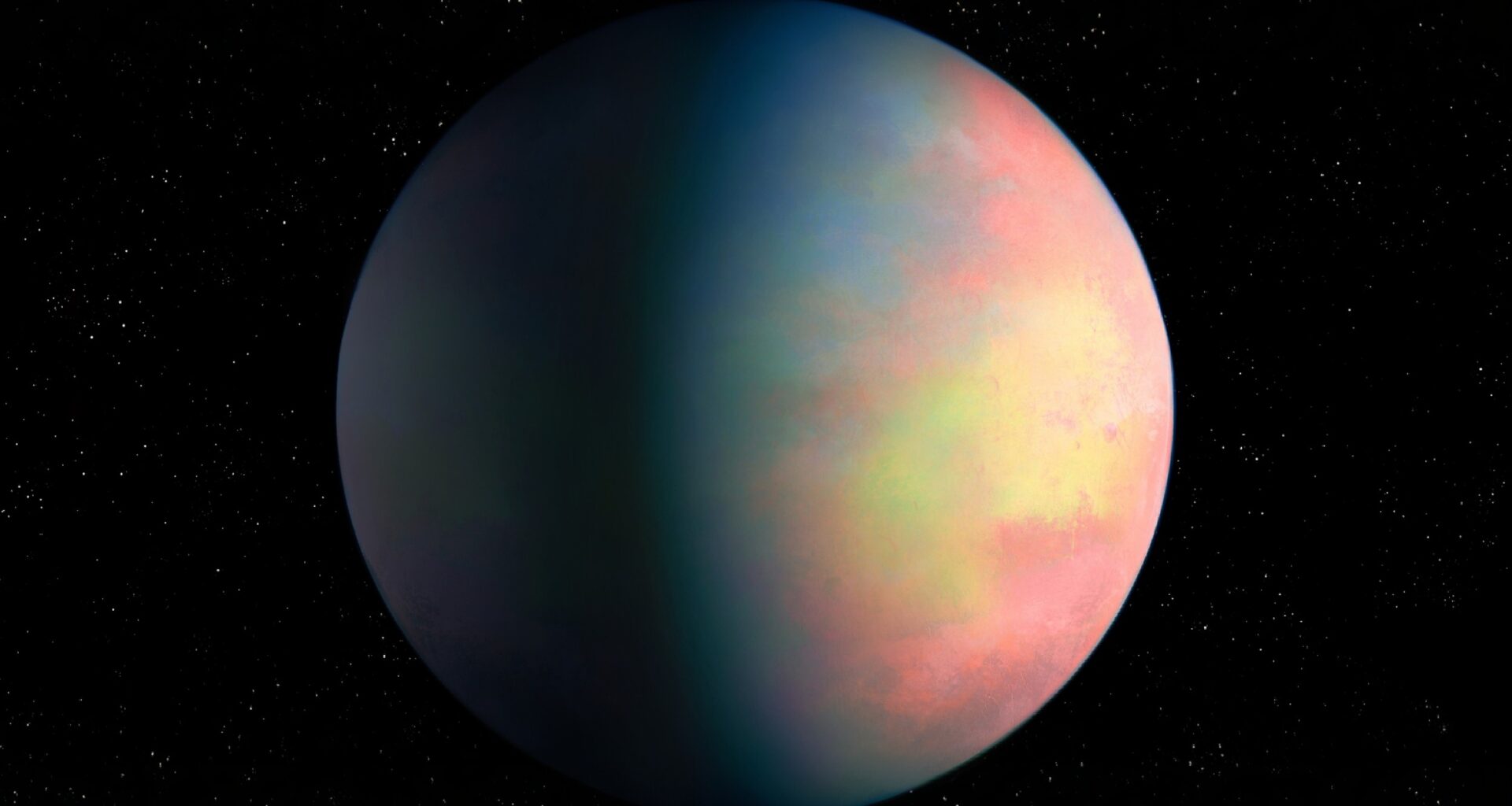
Planets usually stay close to stars, moving in neat paths for billions of years. Yet some worlds break free and travel alone through the Milky Way. Astronomers call such worlds free-floating planets.
A new study has now captured one such planet in rare detail. By watching the same event from Earth and from space, scientists measured both the mass and the distance of a planet that drifts without a star.

This result opens a clearer window into how violent planetary histories can be and how often planets get thrown into deep space.
Free-floating planets without stars
Most planets shine only because a nearby star lights them up. A free-floating planet lacks that light source, so direct views remain almost impossible.
Astronomers instead rely on gravity. When a dark planet passes in front of a distant star, gravity bends the starlight for a short time. This bending causes a brief brightening. Scientists call this effect microlensing.
Microlensing events last only days or weeks. Such events often reveal that a planet exists, but vital details stay hidden.
Distance remains unclear, and mass estimates stay rough. For this reason, many free-floating planets remain mysterious points on a chart rather than full worlds with known traits.
A rare double view
The research was led by Subo Dong, an expert in the Kavli Institute of Astronomy and Astrophysics (KIAA) at Peking University.
The new discovery stands out because researchers used two very different vantage points. The data came from several ground-based surveys along with the Gaia space telescope.
Gaia orbits far from Earth, so the same microlensing event appeared slightly different from each location.
That small timing shift carried outsized importance. Known as microlensing parallax, it revealed details that are usually hidden. Finite-source point-lens modeling then refined the result.
This careful method allowed direct measurement of both mass and location, a rare success for a free floating planet.
Origins of the rogue planet
The planet weighs about 22 percent of Jupiter’s mass. This value places the object close to Saturn in size.
The planet sits about 3,000 parsecs from the center of the Milky Way. That distance puts the world deep inside the galaxy rather than near Earth.
Such a mass offers clues about origin. Objects born alone, like small stars or brown dwarfs, usually grow heavier.
A Saturn-sized body fits better with planet formation around a star. The evidence suggests that this world once circled a sun before a violent event pushed it away.
How planets are ejected
Planetary systems often begin in crowded and unstable states. Young planets tug on one another through gravity.
A close pass between two large planets can fling one outward. A nearby star can also disrupt orbits. Over time, these disturbances can eject a planet entirely.
Scientists believe this process explains many low-mass rogue planets. The new measurement supports this idea.
A Saturn-mass object drifting alone likely started life within a planetary family before chaos took over.
Why this discovery matters
Only a small number of free-floating planets have clear measurements. Each new case helps astronomers test ideas about planet formation and survival.
The new study also shows the power of teamwork between Earth based telescopes and space missions.
“Simultaneous space- and ground-based observations of microlensing events could be applied in the planning of future exploratory missions and could lead to a better understanding of how planets form across the Galaxy,” noted Gavin Coleman, a researcher at Queen Mary University of London.
Finding more free-floating planets
The search for rogue planets is set to grow fast. NASA plans to launch the Nancy Grace Roman Space Telescope in 2027.
This mission will scan wide areas of the sky with high precision. Many more microlensing events should appear as a result.
With lessons learned from Gaia and ground surveys, future studies may measure masses and distances more often. Each new detection will refine knowledge of how common these lonely travelers are.
A clearer picture of the galaxy
Free-floating planets once hid in darkness, known only through brief hints. This new observation shows that careful timing and multiple viewpoints can turn faint signals into solid facts.
The Milky Way may hold billions of such wanderers. With new tools and methods, astronomy is finally starting to count and understand this hidden population.
Each discovery adds one more piece to the story of how planetary systems change, break apart, and shape the dynamic history of our galaxy.
The study is published in the journal Science.
—–
Like what you read? Subscribe to our newsletter for engaging articles, exclusive content, and the latest updates.
Check us out on EarthSnap, a free app brought to you by Eric Ralls and Earth.com.
—–