
An old Bus Reassembled for Play in beijing
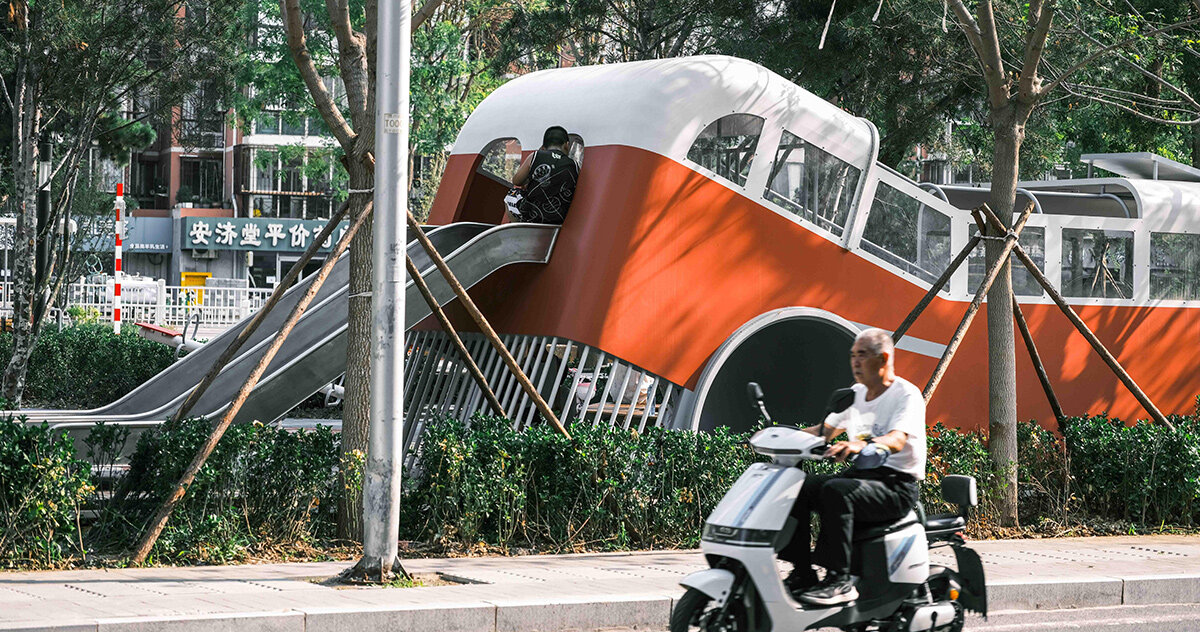
XISUI Design breathes new life into discarded infrastructure with this Old Beijing Bus, a public children’s space on the streets of Changping District in Beijing. Set within Sanjiaodi Park, the project recycles the shell of a BK640, China’s first domestically manufactured bus, into an occupiable structure embedded into the neighborhood fabric.
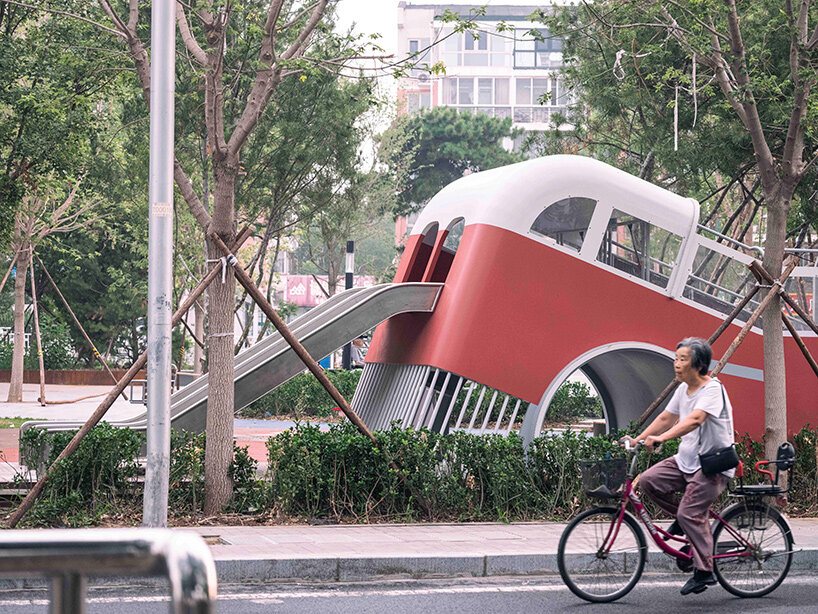
The installation occupies the former site of a playground established in the 1980s. Its presence is immediate from the street, where the familiar outline of a bus body appears at a scale for children rather than traffic, positioned between mature trees and the pedestrian edge.
The BK640 entered service in 1957 and, across several decades, became a common presence on Beijing’s streets. The project draws directly from that memory through proportion and profile rather than replication. Panels, openings, and surfaces are abstracted from the original vehicle to read as fragments assembled into a playscape.
images © Hu Yihao
XISUI Design activates Sanjiaodi Park
The team at XISUI Design sites its Old Beijing Bus in Sanjiaodi Park, a threshold in the city where historic routes intersect with the modern urban fabric. The broader renovation of the park organizes circulation, water features, and open ground into a sequence of public zones tied to local geography and history.
Within this framework, XISUI was commissioned to design the children’s area. The bus-themed installation occupies a footprint that’s both visible and compact, aligning with existing sidewalks and maintaining continuity between the park and the surrounding street life.
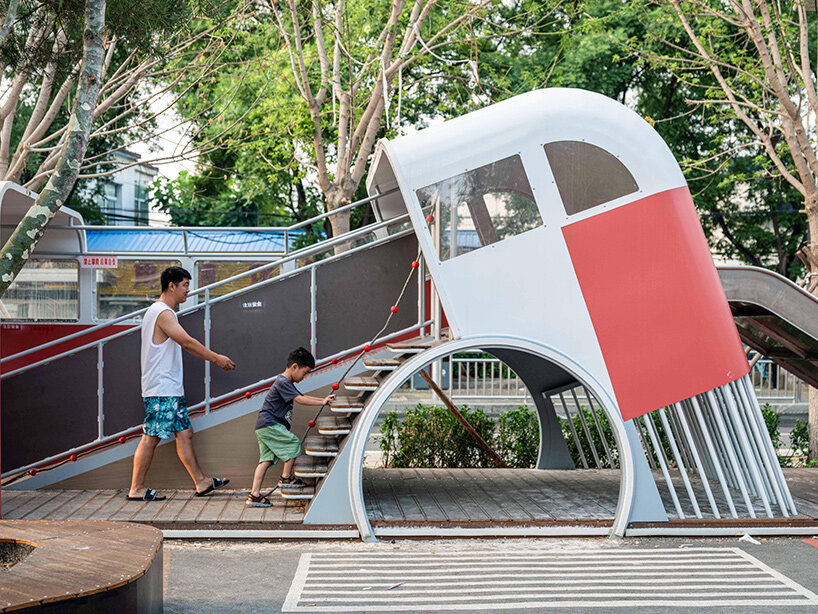
the Old Beijing Bus transforms a historic vehicle form into a public children’s space
the interactive playscape
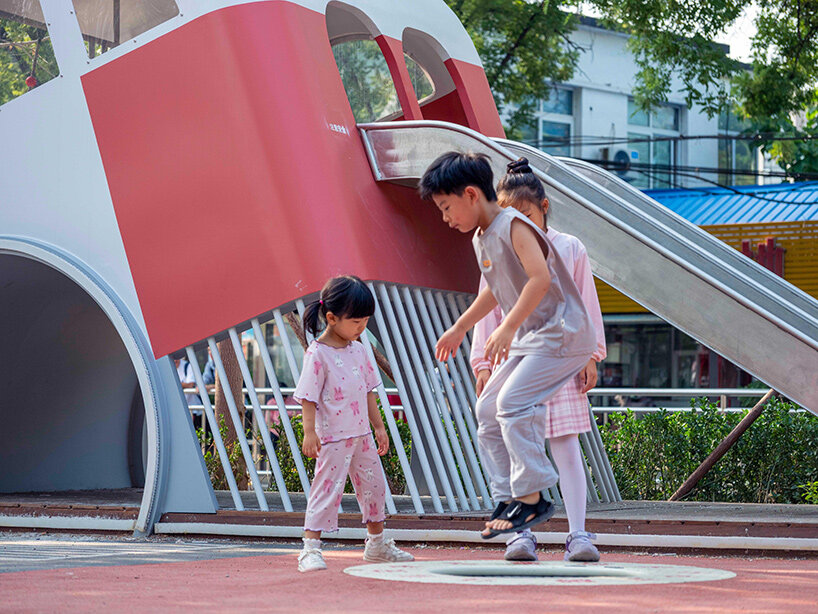
The Old Beijing Bus is divided by XISUI Design into two activity zones divided by a pathway marking its front and rear sections. The front section addresses younger children through lower heights and closer spacing. Climbing frames, small slides, balance elements, and tactile walls are integrated into the envelope, while fixed seating modeled on bus benches lines the perimeter for supervision and pause.
The rear section supports broader age ranges through taller ladders, ropes, paired slides, swings, and ground-based games. Equipment is distributed to encourage movement across the full length of the structure rather than concentration at a single point.
Interactive elements like voice tubes, steering wheels, and flip panels are embedded flush with steel surfaces or timber inserts. These elements sit within reach without interrupting circulation to keep the interior legible even during peak use.
the project occupies Sanjiaodi Park at the edge of an active neighborhood street
Material Assembly and Construction
Galvanized steel forms the main structural system, selected for durability in a heavily used public setting. Surfaces are finished with fluorocarbon paint, providing weather resistance while maintaining a consistent color field.
Areas of contact and seating incorporate carbonized bamboo wood. The timber introduces a warmer tactile surface against the steel frame and withstands outdoor exposure without applied coatings that would require frequent renewal.
The color palette draws from the red and white tones of the historic BK640. Applied across panels and railings, the red registers against surrounding greenery and the everyday backdrop of shops, bicycles, and passing buses.
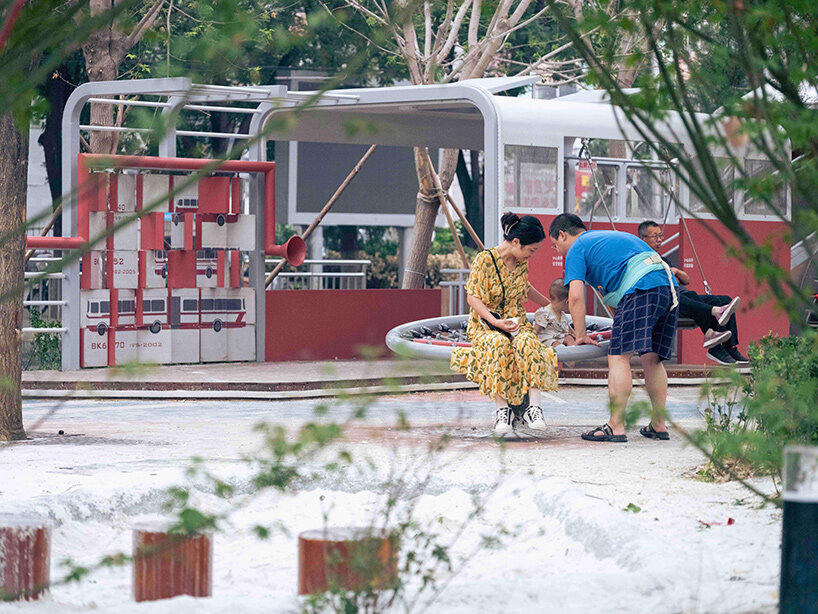
its design draws from the BK640 bus through proportion and abstracted detailing
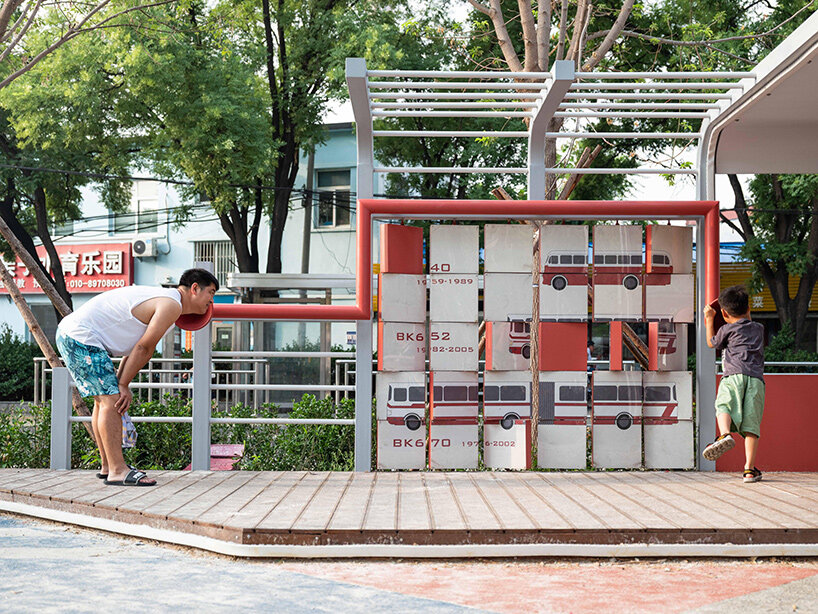
the structure is divided into front and rear play zones linked by a transverse path